Stirred Cucumber Drinks

This week’s Robb Report article was about a cocktail called the Archangel. You can read it here if you like, but briefly summarized: the Archangel is a neo-classic from 2006, essentially the build of a Gin Martini, but with the bold bittersweet liqueur Aperol subbed in for dry vermouth’s herbal whisperings: 3 parts gin, 1 part Aperol.

It also has one additional twist, the curious addition of a lightly muddled (or “bruised”) cucumber, stirred all together and strained up.
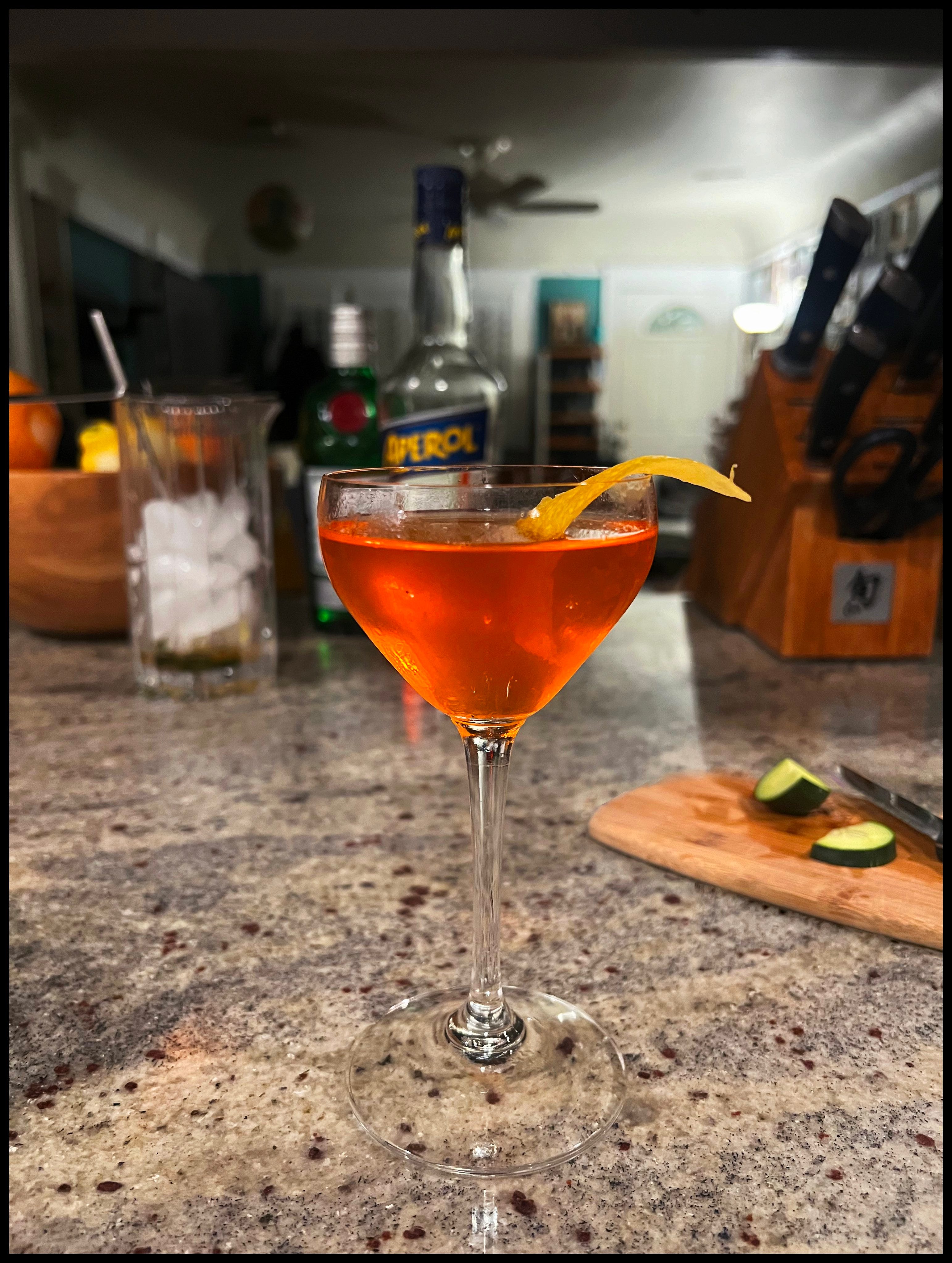
If you don’t live and work in the cocktail world, maybe you don’t know how strange this “bruised” cucumber business is. Cucumbers are for shaken refreshing drinks, not boozy stirred ones. Cucumber Margaritas. Cucumber ‘Tinis. This sort of thing. They bring a cooling herbaceousness to the palate that is broad and almost urgently refreshing, and are what make drinks like the Eastside Rickey (gin, lime, cucumber, mint, soda) so irrepressibly, grab-the-table-with-your-eyes-closed delicious. As far as I knew, the Archangel, invented in 2006, is the first time anyone specifically designed an all-booze, no-juice drink with a muddled cucumber (I wasn’t exactly correct about it being the first, more on that below). 

I’ll do you one more: the Archangel is fucking amazing. The drink is a total banger — the cucumber takes on a floral resonance, a green ribbon of flavor that weaves throughout the entire tasting experience, like a smell in a cartoon that lifts you off your feet and tractor-beams you toward a pie. It’s great both on the rocks or up, and, in another big surprise to me, it’s great across styles of gin, from Tanqueray to Plymouth to Hendrick’s to even something wild like Aviation.
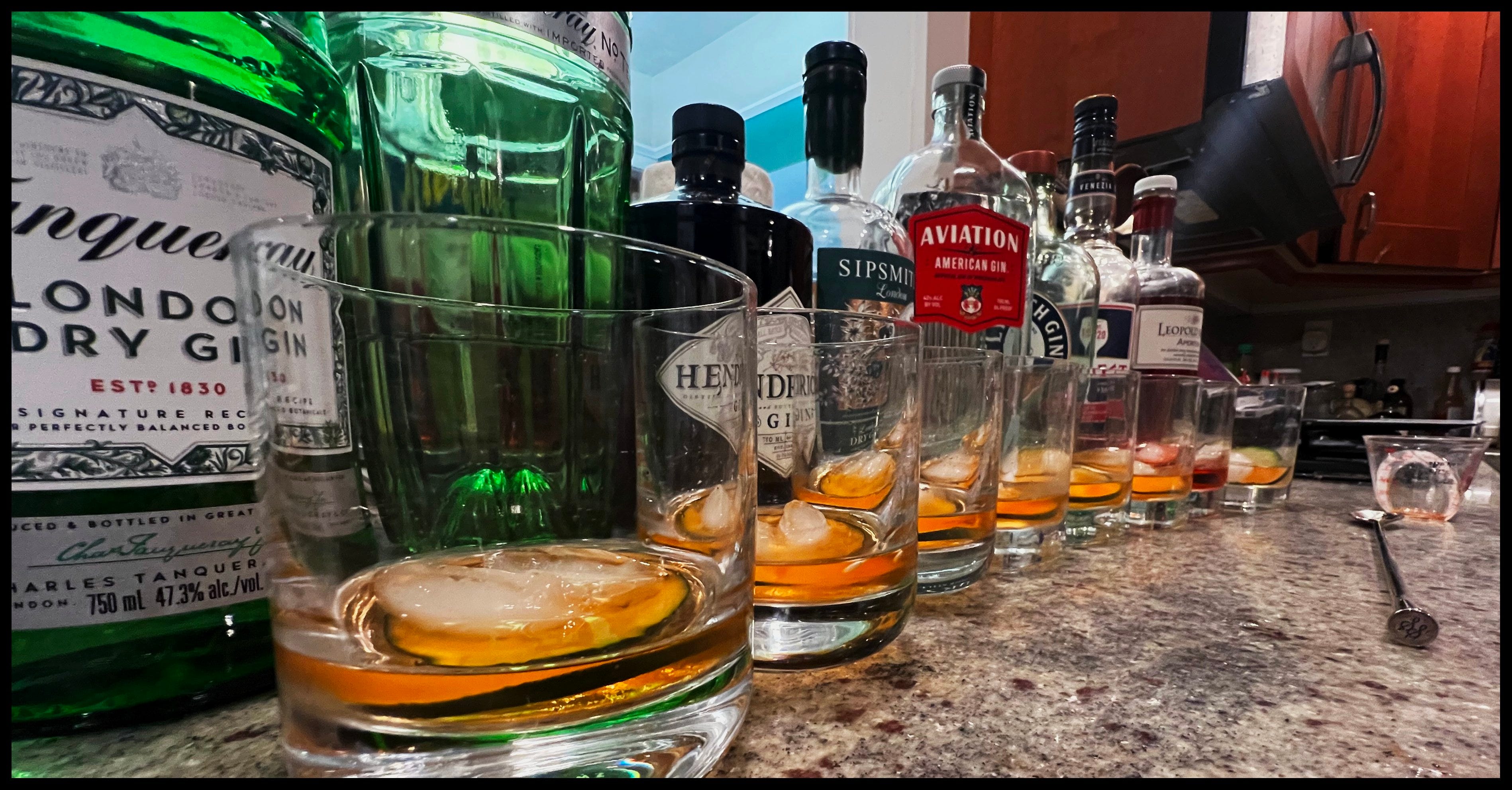
It’s just great. It’s a great drink. Full stop.

So what, we’re stirring our cucumbers now?

Every idea has to start somewhere, so I understand that maybe no one had done that exact thing before Michael McIlroy and Richard Boccatto came up with it at Milk & Honey, but that was 18 years ago. What about since? Where are the cucumbers in stirred drinks now? Surely the Archangel isn’t the only possible way to use this technique?

This is not rhetorical, it was an honest question. When Jeffrey Morgenthaler came up with barrel aging cocktails in 2010, they were doing it at Ruth’s Chris Steakhouses by like 2012. A technique breakthrough, especially one with such a delicious proof of concept, should be everywhere, but before I started writing this I only knew of one other bruised cucumber stirred drink, and that one sucked.

Incredulous, I scoured a bunch of cocktail books and blogs and gathered as many as I could find, which ended up as the following 10. Of those 10, I made 8 of them, because I would have needed to buy six new bottles to make the final drinks, and that’s too many.
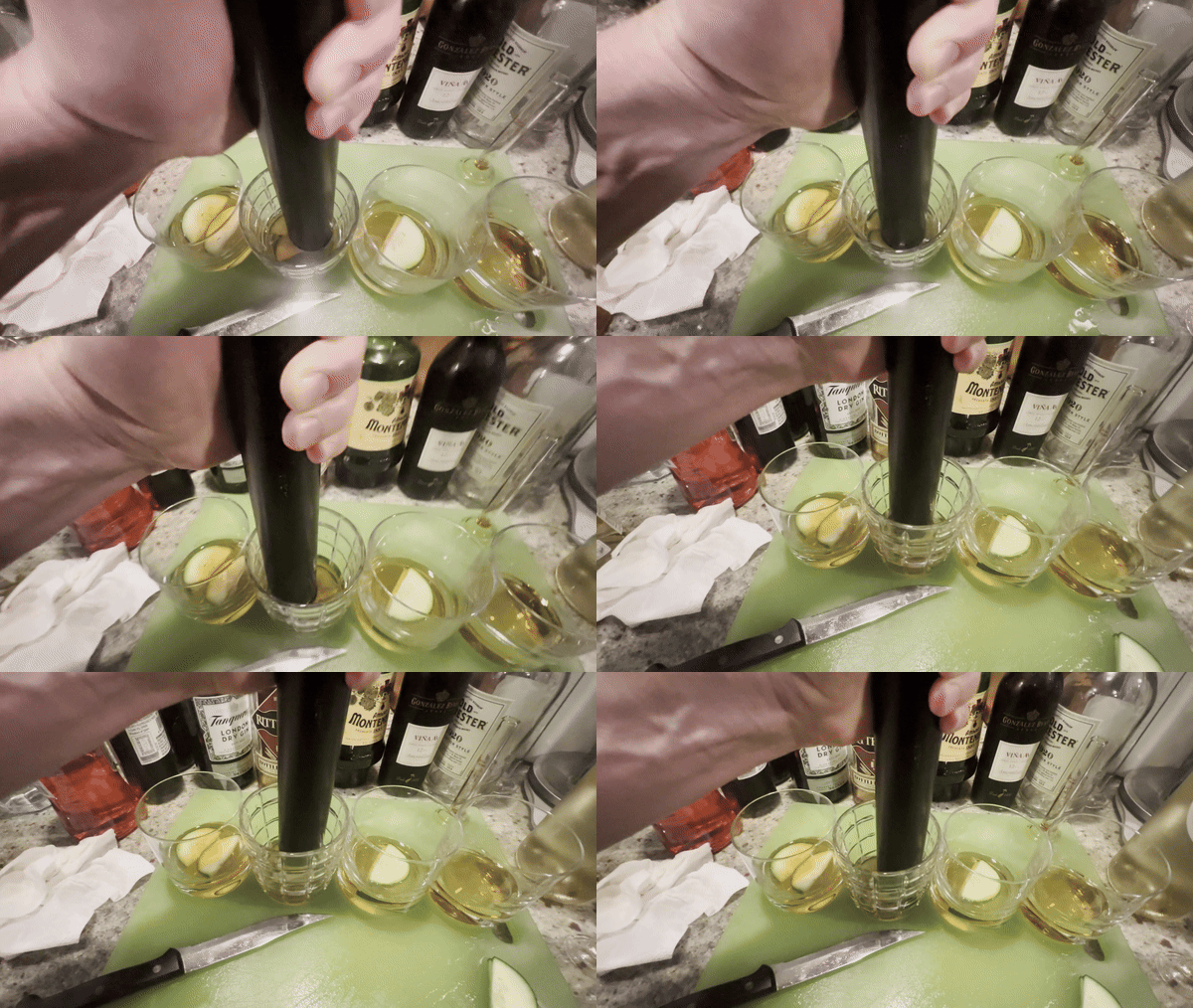
And now, may I present:

WONDERFUL COCKTAILS with STIRRED CUCUMBER

Archangel

  • 2.25oz Gin
  • 0.75oz Aperol
  • 3 cucumber wheels

Muddle cucumbers in a mixing glass. Add liquids and ice and stir for 10-20 seconds. Strain up into a coupe, and garnish with a lemon peel or a cucumber slice.


Green and Red — Thomas Waugh, 2012, as detailed in the Death & Co. Cocktail Book.

  • 1oz Siete Leguas Blanco Tequila
  • 1oz Jalapeno-infused Siembra Azul Blanco Tequila
  • 0.75oz Cocchi Americano
  • 0.75oz Dolin Dry Vermouth
  • 0.25oz Alvear Festival Pale Cream Sherry
  • 3 cucumber wheels

Muddle cucumbers in a mixing glass. Add liquids and ice and stir for 10-20 seconds. Strain up into a coupe, and garnish with a cucumber ribbon, on a pick

My notes:

Oh, that’s wonderful. Tequila and the cucumber goes super well together — the green notes from the tequila melds with cucumber like a dream, and the jalapeno infusion obviously helps. The way the cocchi + sherry interact, especially on the finish, is phenomenal. Goddamnit Cocchi is such a good product. Arcs over the palate, while the cucumber plays it’s floral game. Heat helps with sweetness. Really good.


Mexicano — Jim Meehan, 2010, as detailed in the PDT Cocktail Book

  • 1.5oz Partida Reposado Tequila
  • 0.75z Gran Classico Bitter
  • 3 Cucumber slices
  • 2oz Champagne

Muddle cucumbers in a mixing glass. Add tequila and liqueur and ice and stir for 10-20 seconds. Strain up into a coupe, top Champagne, and a lemon peel.

My notes:

Oh shit this is actually pretty good. Very bitter. Cucumber plays toward the vegetal-ness of the tequila. Cucumber more apparent on the nose than on the palate. Lemon peel helps. Robust vegetal bitterness on the back palate that the cucumber seamlessly transitions to. I hate the name but this is pretty good. Bubbles manage to lift it up. They clash with the gran classico, at least cava does, but that’s all on the finish. From the front to the midpalate it’s like “hi I’m lemon cucumber brightness” and then abruptly the Gran Classico is like “i’ll take it from here, son” and cucumber bitterness takes over.


Wheeler and Wilson — Leo Robitschek, as detailed in the NoMad Cocktail Book

  • 0.5oz Amaro Montenegro
  • 0.5oz Dolin Blanc
  • 0.5oz Lustau Los Arcos Amontillado Sherry
  • 0.75oz Diplomatico Reserva Aged Rum
  • 1oz Old Forrester 100 Bourbon
  • 3 cucumber slices

Stir with cucumber slices, then strain into a coupe, and garnish with 2nd cucumber slice

My Notes:

Woah. So much going on. Great though. Deep complexity. Harnesses the weirdness of the Montenegro well. There’s some noise here, and I strongly suspect it’s because I didn’t use the same brands (I had Dooley’s XO rum and Old Forrester 1920 Bourbon), but that’s not the drink’s fault. Even still, with the proof off and the rum very off, it’s solid — the cucumber gives a broad green base to a ton of complexity. If you’ve got the brands on hand, or even if you don’t, I recommend.

A STIRRED CUCUMBER DRINK that ALMOST BROKE MY BRAIN

Spring Sting — Pietro Collina, as detailed in the NoMad Cocktail Book

  • 1oz Pierre Ferrand 1840 Cognac
  • 0.75oz Cocchi Americano
  • 0.5oz Laphroig 10
  • 0.5oz Chareau
  • 1 tsp Amaro Nardini

Stir all together (no cucumber), then strain into a Nick & Nora, and garnish with a cucumber ball, placed into the drink.

My Notes:

WHAT THE FUCK. This is so fucking cool. Chareau and Laphroig? I’m sorry, what??

The description calls this “a stirred savory grasshopper,” and I see it vividly, but I’m not sure how it’s working. Starts with minty melon from Chareau, and smoke almost immediately makes a presence. Everything fits together amazingly well, and I’m not even using the right amaro [I used Averna]. This starts almost chocolaty, from what, the amaro+cognac? Then Chareau, then Laphroig. Cucumber supports Chareau aromatically and otherwise. Fabulous.

I’m not supposed to muddle cucumber but I did anyway. It’s great. Made it again without muddled cucumber, just placing a freshly cut cucumber into it after it’s made. Also great. Too insane for me to pick a favorite, I’ll have to try it side by side. I will be making this again.
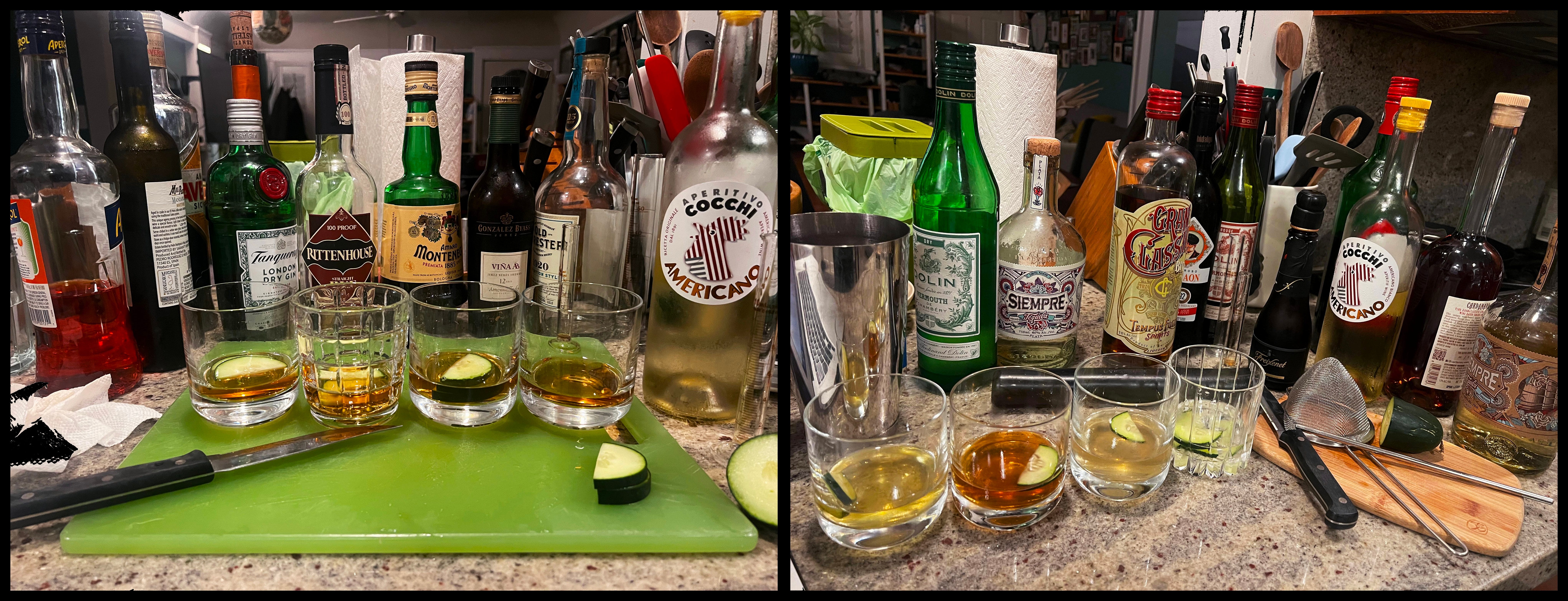
STIRRED CUCUMBER DRINKS that ARE JUST FINE

For the sake of completeness, here’s the others. The next four I made and didn’t think were excellent, and won’t be making again. Listing them for completion, because there is otherwise no catalogue of all these in one place:

Polaris — Brandon Bramhall, Attaboy Nashbille, 2018, as detailed in the Bartender’s Choice App

  • 1.5oz Gin
  • 1oz Manzanilla
  • 0.5oz Aperol
  • Bruised cucumber

Stir. Up. Lemon twist 

My notes:

Good. Just an Archangel plus sherry. Sherry changes it. Completely takes over the finish. Aperol to gin to sherry. Adds complexity. Not sure it’s better, but it is good. Lemon really adds this time, in a way I don’t think it adds in the Archangel itself. Sherry fans might even consider this an improvement, but I mostly just want an Archangel. Shery fits in super well, but totally dominates the finish. It shortens the tasting process of the other, and then sherry’s like HI IT’S ME SHERRY.


Cobble Hill — Sam Ross, Milk & Honey, 2005, as detailed in the Bartender’s Choice App

  • 2oz Rye
  • 0.5oz Dry Vermouth
  • 0.5oz Montenegro
  • Cucumber

Stir. Up. Garnish with a freshly sliced cucumber.

My notes:

I tried this twice, and it is unique for me in that it’s the first Sam Ross cocktail that I haven’t liked even a little. Rye is weird. First impression is that this isn’t special. At least not with Bulleit rye. Doesn’t come together. Cucumber is a presence on the front palate, but the finish is just rye and weird. I see what he’s going for I think, and maybe gets there with a different rye, but not this one.

Trying again with Rittenhouse this time. Rich on the body. Still bad. What the shit. Bad. In that it’s not at all good. Tastes like pickles. Too dry.


Chin Up — Sam Ross, Milk & Honey, 2005, as detailed in the Bartender’s Choice App

  • 2oz gin
  • 0.5oz Cynar
  • 0.5oz Dry Vermouth
  • Salt
  • Cucumber 

Stir. Up. Lemon Twist

My notes, such as they are:

MUCH better than the Cobble Hill. Gin is just a better call. Still, nowhere as good as the Archangel. This sticks out in all the wrong places.


 False Start — Anne Robinson, Westlight, as detailed at Punch

  • 1.25oz Siete Leguas Reposado Tequila
  • 1oz Cardamaro
  • 0.75oz Dolin Rouge Vermouth
  • 0.25oz Cynar

Muddle 2 cucumbers slices, then add all ingredients and ice and stir, then fine strain into a coupe and garnish with a cucumber wheel.

My notes:

Pretty good. I see what it’s going for I think. I certainly don’t hate it, just a little anodyne. I didn’t use Siete Leguas Reposado which might make the difference [I used Siesta Repo], but I don’t think so. If the cocktail is that brand-dependent it’s a little meh. Just meh. Nothing bold, nothing sticks out, just sweetish, kinda boring. No edge. Like bobbing in an above-ground pool.

STIRRED CUCUMBER DRINKS that I HAVEN’T TRIED YET

Stone Crush — Chaim Dauermann, Up & Up Bar, as detailed in Spirited

  • 3-4 cucumber slices
  • 1.5oz Brennivin
  • 0.5oz Blanc Vermouth
  • 0.25oz Rabarbaro Zucca Amaro
  • 1oz Pilsner Beer

Muddle, then shake everything but beer, strain into rocks glass, top with pilsner, and stir to combine. Garnish with a lemon twist and a couple cucumber slices.

Beau Four — Leo Robitschek, as detailed in the NoMad Cocktail Book

“A springtime Manhattan with mentholated complexity and depth”

  • 1.5oz Jim Beam Black bourbon
  • 0.75oz Dolin Dry
  • 0.5oz Amaro Nardini
  • Short 0.5oz Amaro Foro
  • Cucumber slices

Stir on ice with cucumber slices. Strain into the coupe, garnish with a cucumber slice

Thanks for reading! Let me know how these strike you. Especially the Spring Sting. Good god.

FYI: I have an affiliate thing set up through Amazon, so buying the books through the links will give me a very small amount of money. It seems honorable to mention it.


My Favorite Manhattan Recipe

Or: How I think about the differences between a good drink and a great one.

My Definition of a Great Drink:

This seems like an easy question, admittedly — “the one that tastes awesome” — but there’s more to it than that. A great drink:

  1. Has a distinct beginning, middle, and end. Each ingredient plays a role, and you taste everything — not as a shotgun blast of complementary flavors, but as an elegant unfolding on the palate.
  2. Spans the palate across high tones, mid tones, and low tones. If it were all high notes — lemon zest, St. Germain, and fresh raspberries, say — it would be good but not great, because it would just hang out up there, on the tip of your tongue. Similarly vanilla, Cynar, and coffee: delicious but redundant, because they’re all low tones. Great drinks, for me, travel across the tonal flavor spectrum.
  3. The Flavors work. Obviously. No amount of clarity or tonal fascination can save it if the flavors don’t work together.

There are exceptions to this — some great drinks aren’t #2, and some aren’t even #1, though they all are #3 — but for the most part, this is what I’m looking for when I’m making or drinking cocktails. Below, I will explain a little more.

Mercy Rule: If you’re just here for the advertised “favorite Manhattan recipe” and don’t have five minutes for the why of it all, just click here.

Good Drinks vs. Great Drinks

Good drinks are easy. Anyone can make a good drink. Grab the Flavor Bible, pick any two ingredients that go together — blackberries and sage, say, or peaches and thyme — and put them together with a spirit and then sweet/sour balance, and voilà. You did it. Amazing.

Great drinks are a different thing entirely. Great drinks aren’t just about the flavors working, they’re about the unique flavor signature of each particular ingredient. To explain:

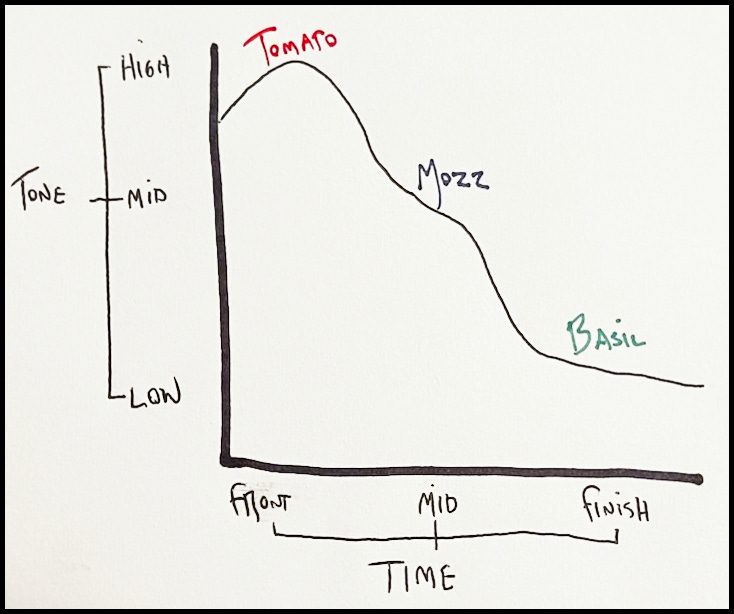
The problem with cocktails is that unlike chefs, we don’t have texture to play with. Take a caprese salad: Basil, tomato, and mozzarella, combined to form one of the best things on earth. The textures mean that even though you get all three on the same bite, they hit your palate at different times — the tomato is up front, sweet and acidic, and you taste its juiciness before you even start chewing. Then comes the creamy mozzarella, rich and resonant, occupying the middle and tempering the sweetness of the tomato. Then finally, after a few chews, basil begins to really express itself, from what was just a fragrance to a musky and robust herbaceousness that lingers on the finish.

High, middle, low. Beginning, middle, end. The Caprese is a great dish.

Now imagine that someone put those three in a blender and invited you to drink it with a straw. Still good? It’s the same flavors, right? Ignoring the fact that you’d be dealing with a psychopath, perhaps you take my point: remove texture from the equation and suddenly everything hits all at once, and while the flavors are still fine, you lose something essential of the dish.

Now consider a cocktail. Cocktails are homogeneous — every sip is exactly the same, and you taste every ingredient all at once. So if you want a drink with a distinct beginning, middle, and end — and what’s more, if you want it to have high notes, mid notes and low notes — you need to do it with the inherent character of the ingredients themselves. This is why great drinks are hard. Liquids react to each other in interesting and sometimes unpredictable ways, so to make something great, you need to either (1) know your ingredients preternaturally well, or (2) do a ton of trial and error.

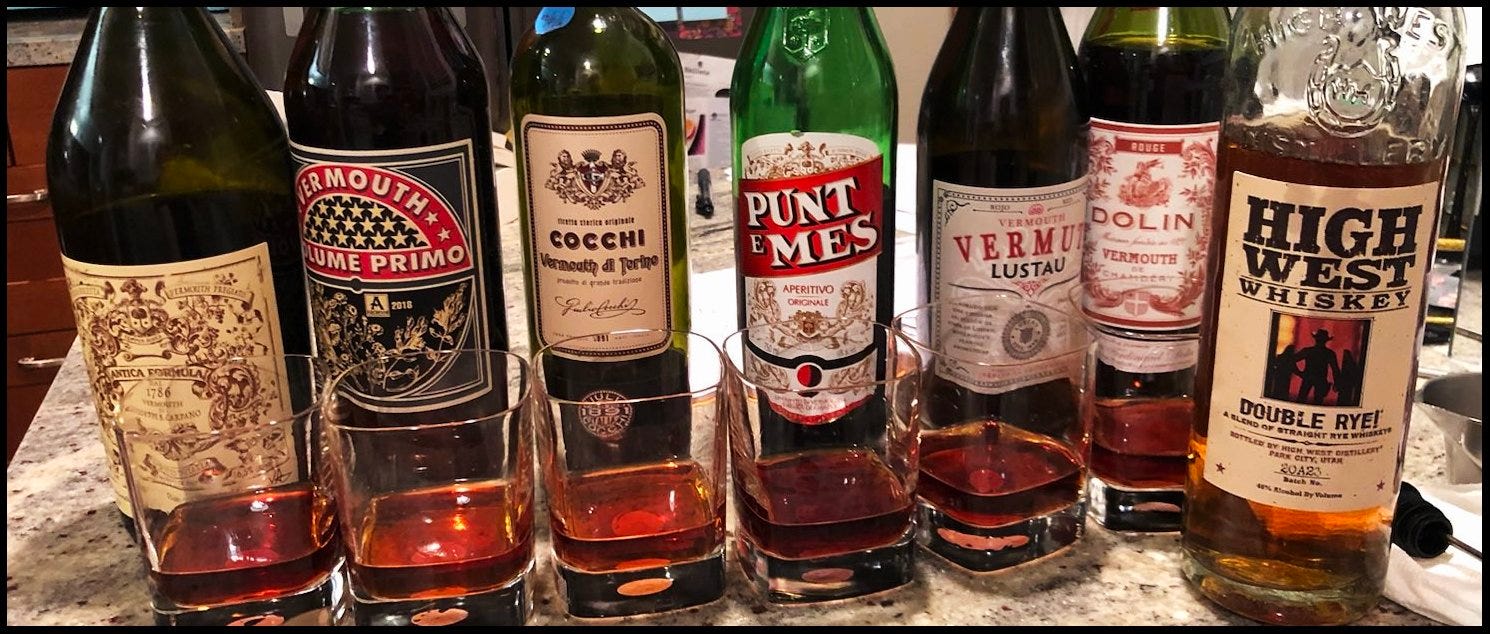
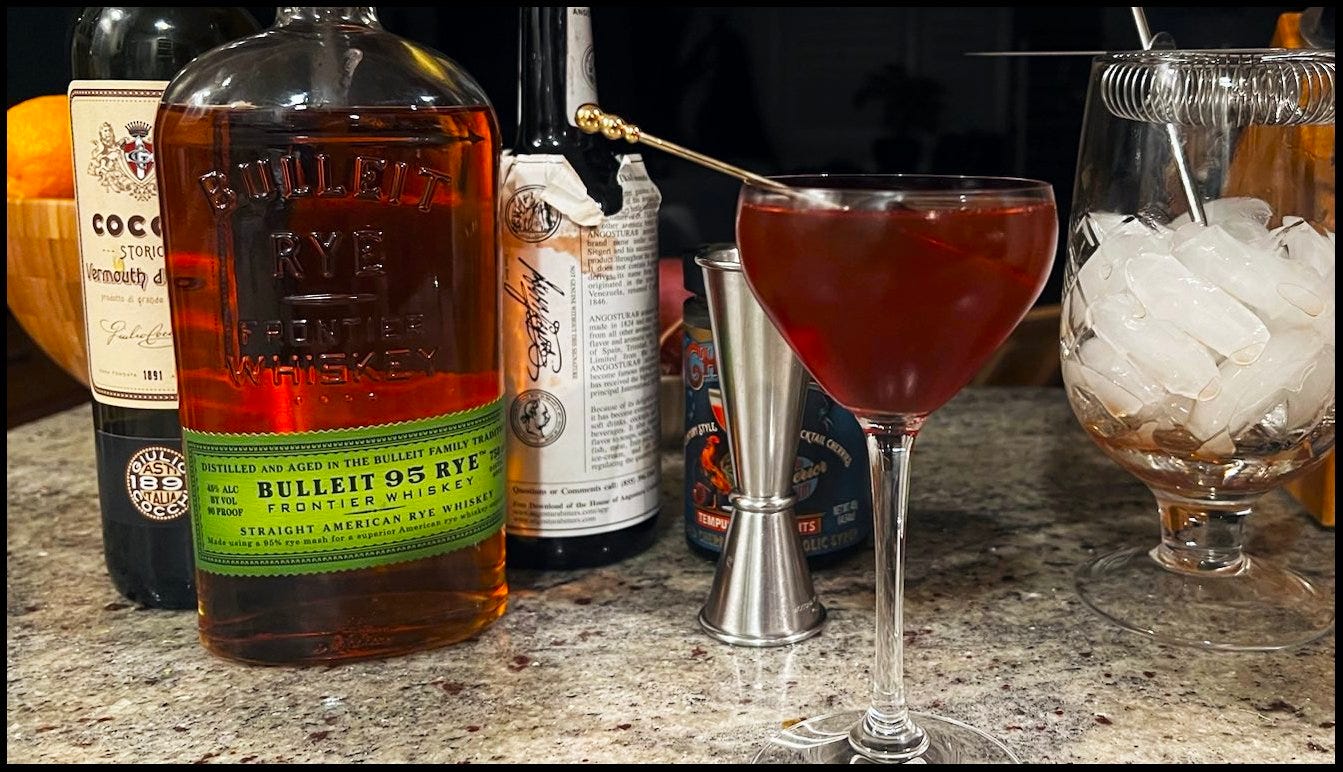
Pictured: a few scant ounces of the metric shit-ton of trial and error I’ve done on Manhattans, and how I spent pretty much all of April 2020.

The Problem with Most Recipes

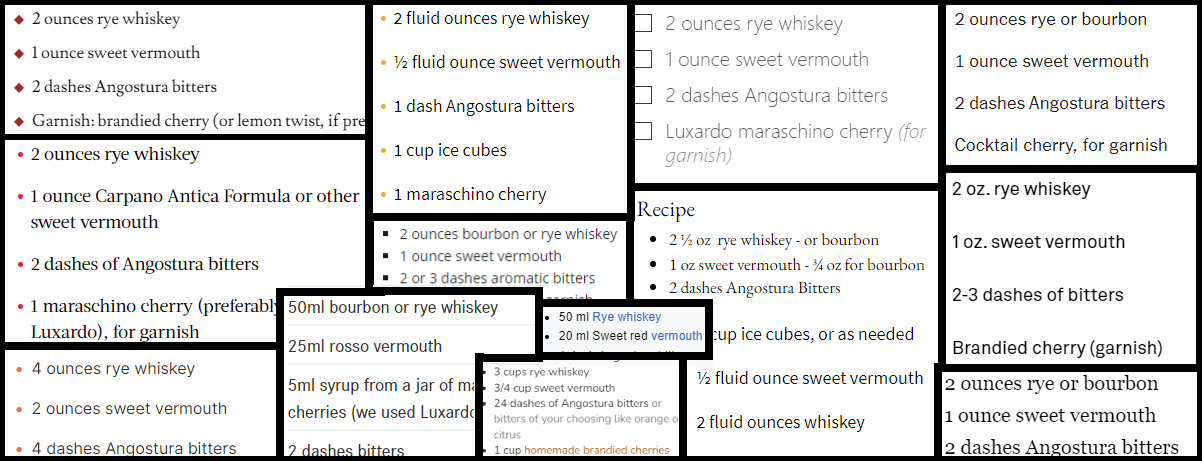
This is why it drives me nuts to see cocktail recipes that don’t mention a style or a producer, and will be like: “use 2oz rye.”

I’m sorry, “RYE?

It’s all at least 51% rye and it’s all aged in oak, but beyond that, there are wild differences between the bottles. By “rye” do you mean punchy and full of corn like Rittenhouse? Or soft and green like Templeton? Or also soft and green but also heavily filtered like Dickel? Or fruity and a bit hollow like Old Overholt? Or chocolaty and deep with 100% malted rye like Old Potrero? Or aggressive and intense like Pikesville? Is the sweet rum barrel finish of Angel’s Envy OK? Any help on any of this? Nope. Just “rye.”

I’m not nitpicking here. This is the first 2 pages of Google.

Some cocktails, like the Whiskey Sour or Old Fashioned, are so basic and protean as to taste good with everything, but they’re the minority. When vermouth and juices and liqueurs start getting involved, just calling for a certain measure of “rye” is like giving up on the idea of greatness before you even start.

This is why I tend to get prescriptive about brands. Not because I take any money from them (I don’t), but because a cocktail recipe is like a biometric safe, and to make a great drink — what I’m always looking for, in accordance to those three goals at top — you need the specific fingerprint of a specific bottle or category to unlock it.

The Manhattan

My go-to Manhattan is for me the most dynamic, the one which takes me on the biggest and most satisfying flavor rollercoaster.

That being said, it’s important to note: I’m not here to say there’s one “best” version of each drink. There are, in fact, a bunch of truly great Manhattans, more than a few tall peaks on that particular flavor landscape. I’ve found three so far, and I know there are many, many more I’ve not yet discovered.

I’m going to show you the one I tend to reach for most often because of my particular tastes, but I’m not saying it’s better than other great Manhattans. What I’m saying is that all the great Manhattans are better than the ones that are merely good.

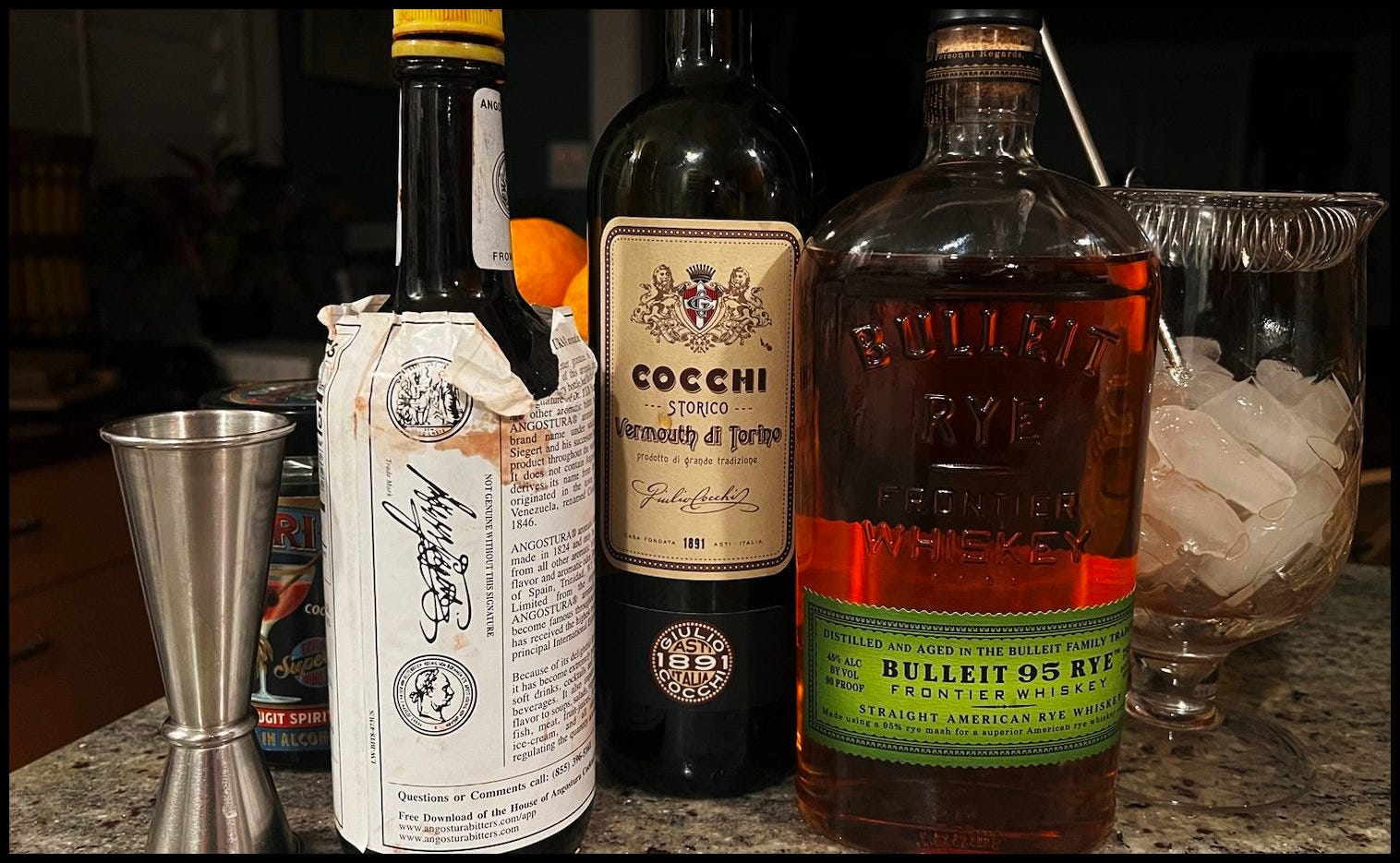
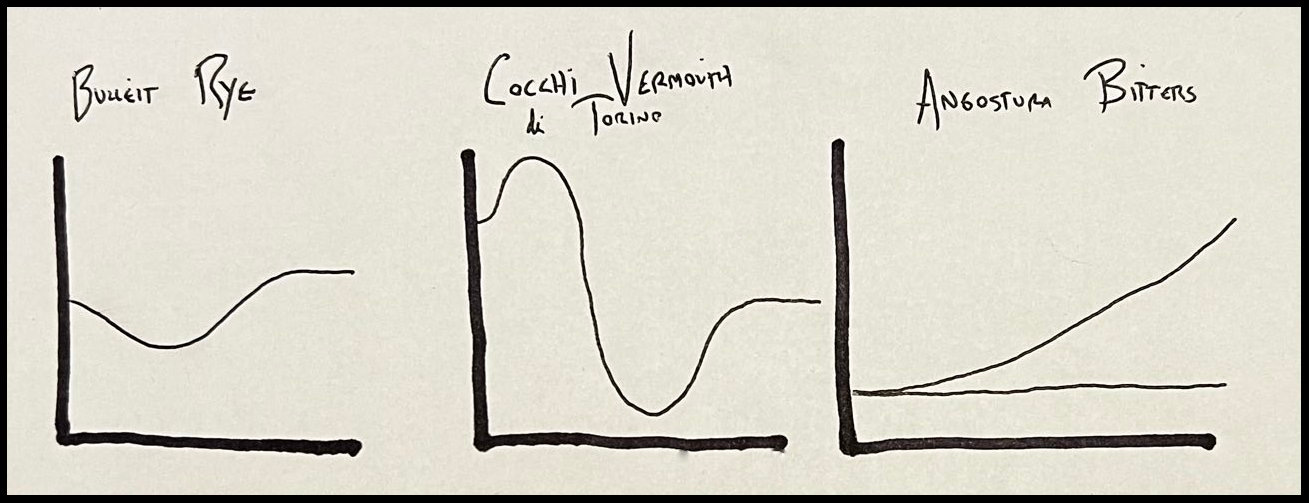
The one I tend to make the most is Bulleit Rye, Cocchi Vermouth di Torino, and Angostura Bitters. Every liquid ingredient has its own flavor curve, where and when on the palate it expresses itself. I think of their flavors like this:

Bulleit Rye: Starts very quiet, with a gentle light grain sweetness, goes a touch low in the midpalate, and then finishes higher with textured oak and the rye’s spice.

Cocchi Vermouth di Torino: Sweet and high fruity up front, then the midpalate swings dramatically down with a low vanilla hum, then it comes up to the rest of the herbs and a lightly sweet, light bitter finish.

Angostura Bitters: There’s a low bitter floor that persists the whole way, but it also has non-bitter flavor notes, which rise in baking spices and citrus through the palate. This complexity is one of the reasons Angostura is perpetually better than its competitors.

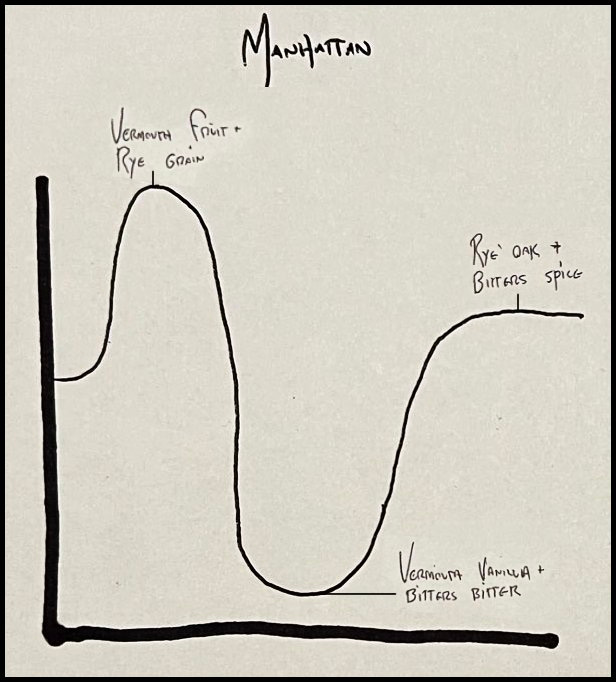
The Manhattan, put together:

There’s just so much movement in this version. It goes high to low and then mid-high again, and each peeling off one-by-one. Remember that the liquid is completely mixed, and each sip is exactly the same, so when you can find ingredients that give you this kind of ride just through the interactions of their innate personalities, you, my friend, have found a great drink.

My favorite Manhattan (so far):

  • 2.25oz Bulleit Rye
  • 1oz Cocchi Vermouth di Torino
  • 3 dashes of Angostura Bitters

Chill a coupe or cocktail glass. Then add all the ingredients to a chilled mixing glass with ice, and stir for 15-20 seconds (on decent ice) or 10-15 seconds (on shitty ice). Taste before you strain — you’re looking for the flavors to be clear and articulate. If the ingredients are all trying to speak at the same time, stir for 5 more seconds, but try not to overdilute. The Manhattan is frustratingly easy to under- or over-dilute. It’s not that hard, just a little annoying in the beginning. Once you know what you’re looking for, you can hit it every time.

Two Parting Questions:

  1. What did you think about this? Do the visuals make sense to you? Do you think about tasting some other way?
  2. Do you have a favorite Manhattan? If so, DM me, or leave it as a comment. I’d love to try it out. The work is never over.

Where Have I Been?

Hello friends,

I’m grateful and flattered that people continue to look at this blog, considering I’ve updated it once in the last four years. Thank you for coming.

So where the hell have I been?

For the last two years, I’ve been writing at Robb Report. Content there is more abbreviated than the type of Saturn V-level nerdery that I usually host on this site, but it’s the same concept — for each cocktail, I tease it apart, and weigh in on both common variations and individual ingredient notes. Not just the what, but the why.

Anyway, thank you, again, for your continued visits and comments. Below is a linked & alphabetized list of every cocktail I’ve written about on Robb Report to date. Hopefully this will be sufficient until I can figure out how to have time/energy to write both there and here.

—Jason

Cocktail Videos: I’ve only shot about a dozen of these so far, but they’re all available on YouTube.

Cocktail Articles (updated 9.22.24):

Absinthe ColadaEl DiabloOld Cuban
Absinthe SuissesseEl GuapoOld Fashioned
Admiral Schley HighballEl LupoloOld Pal
AdonisEspresso MartiniPainkiller
AirmailFancy FreePaloma
AlaskaFog CutterPaper Plane
Amaretto SourFort PointPeanut Butter Old Fashioned
American TrilogyFort Tilden CoolerPeanut Malt Flip
AmericanoFrench 75Penicillin
AppletiniFrench MartiniPenicillin (N/A)
ArchangelFrozen NegroniPimm’s Cup
Army & NavyGaribaldiPina Colada
Arsenic and Old LaceGeorgia JulepPink Lady
AviationGibsonPisco Punch
BandolierGimletPisco Sour
Bee’s KneesGin Basil SmashPoet’s Dream
BelliniGold RushPonton Smash
Benton’s Old FashionedGreenpointPornstar Martini
Betty is BackGrowing Old… etcQueen’s Park Swizzle
BiciclettaGunshop FizzQuick Fix
BijouHanky PankyRamos Gin Fizz
Bitter GiuseppeHarvard CocktailRed Hook
Bitter Start (N/A)Harvey WallbangerRemember the Maine
Bitter TearsHemingway DaiquiriRevolver
Black ManhattanHot ToddyRob Roy
BlinkerHurricaneRome With a View
Blood and SandImproved Whiskey CocktailRose Collins
Blood Moon (Punch)InfanteRosita
Bloody MaryIrish CoffeeRum & Coke
Boozy Hot ChocolateJack RoseRusty Nail
BoulevardierJapanese CocktailSaturn
Bourbon RenewalJasmineSazerac
BrambleJet PilotScorpion Bowl
Brandy AlexanderJungle BirdSeven Days in Berlin
Breakfast MartiniKamikazeSidecar
BronxKentucky BuckSiesta
BrooklynKingston NegroniSingapore Sling
BrooklyniteKir RoyaleSingle Village Fix
Brown DerbyLast WordSouthside
Cable CarLemon DropSpanish Coffee
CaipirinhaLion’s TailSpiced Cranberry Sour
Cameron’s KickLittle ItalyStinger
Captain’s BloodLong Island Iced TeaStrawberry Daiquiri (Frozen)
CarajilloMai TaiSummer Crush (Shrubs)
Cardboard PlaneManhattanThree Dots and a Dash
CasinoManhattan (“Perfect”)Ti’ Punch
Chamomile Old FashionedMargaritaTipperary
Champagne CocktailMartiniTom Collins
Chartreuse SwizzleMartini (Freezer)Toronto
Chet BakerMexican Firing SquadTrifecta
Chocolate MartiniMicheladaTrinidad Sour
ChrysanthemumMichiganderTuxedo No. 2
Clover ClubMidnight StingerVesper
Colleen BawnMimosa (Sparkling Wine)Vieux Carre
Corn n OilMint JulepWard 8
Corpse Reviver No. 1MojitoWatermelon Margarita
Corpse Reviver No. 2Monte CarloWatermelon Pina Colada
CosmopolitanMorning Glory FizzWhiskey Smash
DaiquiriMoscow MuleWhiskey Sour
Daisy de SantiagoMulled Apple CiderWhisky Highball
Dark ‘n StormyN/A Pina ColadaWhite Lady
Death in the AfternoonNaked and FamousWhite Negroni
Don’t Give Up the ShipNapoleonWhite Russian
Earl Grey MarTEAniNegroniWhite Toreador
East India CocktailNew York SourWidow’s Kiss
Eastside RickeyNorth Beach CoolerWild Eyed Rose
EggnogOaxaca Old FashionedZombie

What’s the best recipe for a Mint Julep?

Note: an earlier and much more concise version of this article appears at Robb Report.

alt text

The Mint Julep doesn’t give a damn about the rules. That much is clear to just about everybody. As a cocktail, it violates almost almost every drinking norm we have, so easily spanning apparent contradictions so as to make the impossible possible.

Take a moment to consider its achievements:

It evokes a sense of 200 years of Southern history that is almost impossibly sanitized, and no one seems to mind. It is essentially a large cup of whiskey, and yet has been embraced by every strata of society as perfectly acceptable to have several on a Saturday afternoon. It is simultaneously exuberant and genteel, a sign of a great party and yet deeply serious, and has found favor in everyone from Teddy Roosevelt to Margaret Mitchell. The same jaded bartender who rolls his eyes at your request for a copper Moscow Mule mug will not only accept but insist on a traditional pewter cup for your Mint Julep.

The Kentucky Derby without the Juleps would be shorter than a commercial break, and just as skippable (I can’t be alone here). But add in Mint Juleps? Suddenly it’s a multi-day event, and the thought of dressing up like a carnival barker from the 1930s seems necessary. Important even. It’s about tradition.

History:

“Somebody somewhere was kidding,” writes David Wondrich, in his magesterial Imbibe!. “A ‘julep,’ you see, was medicine, pure and simple, and always had been.” From the Persian “gulab” — literally “rose water” — the word exclusively referred to sweetened medicinal liquid for some 300 years. It travels from medicine cabinet to liquor cabinet by way of an English novel called Tom Jones in 1749, wherein a character describes a bottle of wine, jokingly, as a “medicinal julap.” It is similar, Wondrich points out drolly, as referring to a bong hit as “glaucoma medicine.”

The burgeoning ice trade, started in New England in 1806, was by the 1810s shipping ice down south year round, and that’s all the drink needed to really take off. Juleps — the cocktail kind, with mint — quickly took root in Virginia, and soon were nationally embraced, the “first true American drink.”  Like so many cocktails in the 1800s, early ones would’ve been with Cognac, or the less expensive rum. It wasn’t until the last few decades of the century, those of whiskey’s ascendant quality and Cognac’s struggling production, that whiskey slid into the starring role, where it quite rightly remains.

Mint Julep’s specific attachment to the South is less clear. It was popular all across the country in its day, and it’s “day” was almost 100 years. It drifted out of style in the early 1900s, and anyway, Prohibition came along in 1919 and so thoroughly obliterated drinking culture that it would take us 80 years to even start to get it back.

In any case, it’s easy to imagine that the Mint Julep never really lost a foothold in the South. As medicine, it is a particularly effective palliative against the kinds of paper-wrinkling humidity and weapons-grade mosquitoes that attend Southern summers. It was named the official drink of the Kentucky Derby in 1938 (just 5 years after Prohibition was repealed), and has since become so enmeshed with the event that one intrinsically suggests the other, like turkey and Thanksgiving, or Taco Bell and gastric distress.

What’s the Best Recipe for a Mint Julep?

Old Forester is the official bourbon for the Kentucky Derby much in the way Dannon is the official yogurt of the NFL, which is to say, corporate bullshit that should be summarily ignored. Old Forester isn’t bad — very few bourbons are bad, here — but for this drink I personally prefer one on the sweeter, as opposed to spicier, end of the spectrum. Too much rye spice in the bourbon seems to fight with the mint, particularly on the finish.

Full conclusions below, but first, the best Mint Julep:

Mint Julep
2.5oz Four Roses Small Batch Bourbon
0.5oz – 0.75oz simple syrup (to taste)
10-12 mint leaves
In a metal cup, gently muddle the mint into the simple syrup. Add bourbon, and fill ⅔ with crushed ice. Stir to chill, until a frost forms on the outside. Then pack the rest of the cup with ice. Take 2 or 3 mint crowns, lightly bruise them with your fingers, and stick them against the inside close to the straw. Enjoy.

INGREDIENT NOTES:

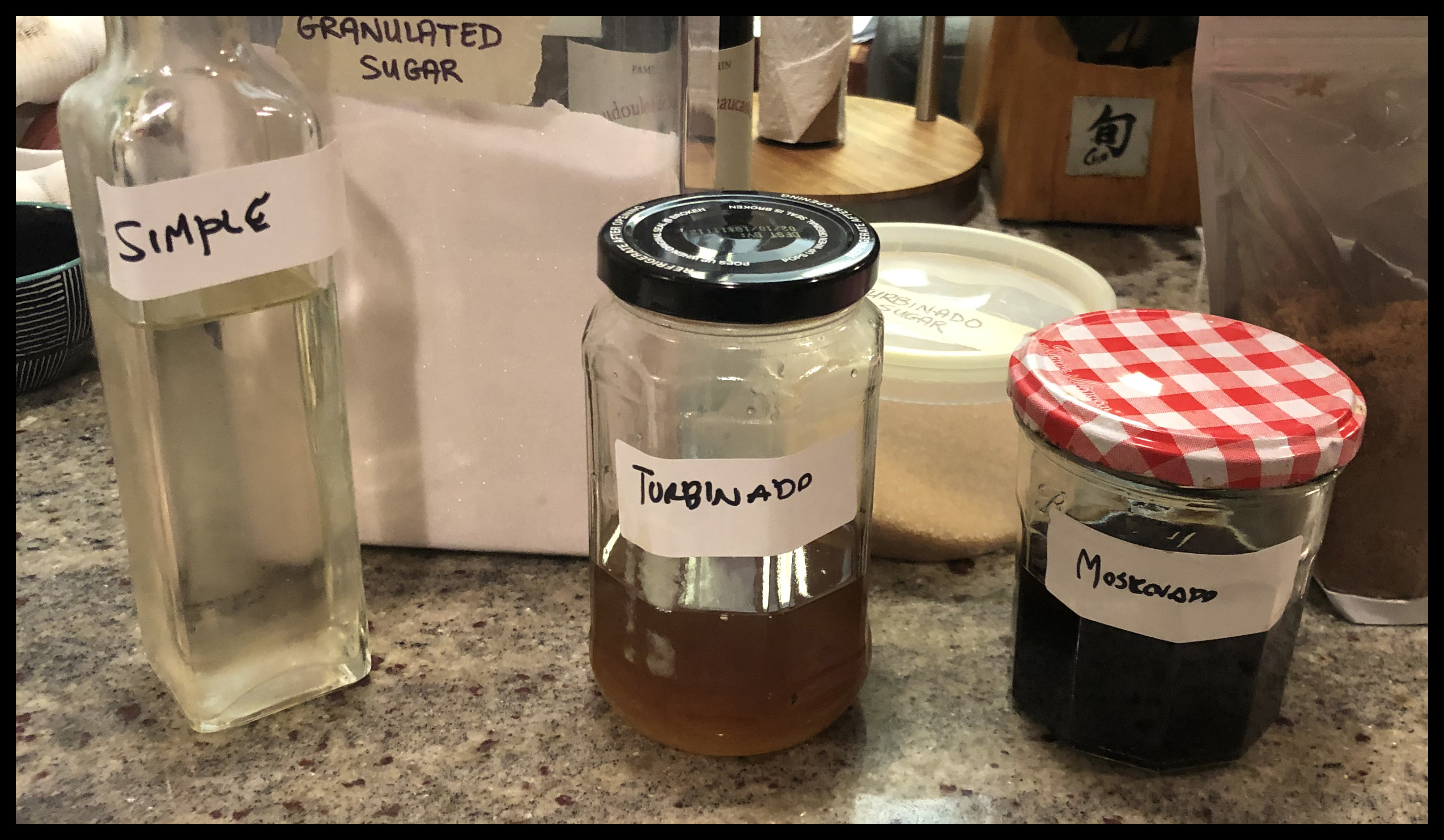
Sugar:  SIMPLE SYRUP with WHITE SUGAR

For ease and precision, make a simple syrup. Equal parts sugar and water, and stir. Hot water will dissolve the sugar faster, but it’s not necessary. It’ll keep for a month in the fridge and couldn’t be easier. It’s literally the simplest syrup.

Use plain white sugar. Demerara syrup and muscovado sugars are less refined, with darker, richer, more molasses-like flavors, but you get as much as you could ever want of that kind of thing from the bourbon itself. Mint is a piccolo — it’s bright and light and delicate, and the darker sugars blunt its effect.

Mint: SPEARMINT

About 10-12 leaves of mint, reserving 1 (or ideally 2+ crowns) for garnish. Pretty much every reputable recipe on the internet will admonish you to gently muddle the mint, warning that over muddling will release bitter chlorophyll into the drink. This is sound advice, but honestly, the warnings get a little hysterical.

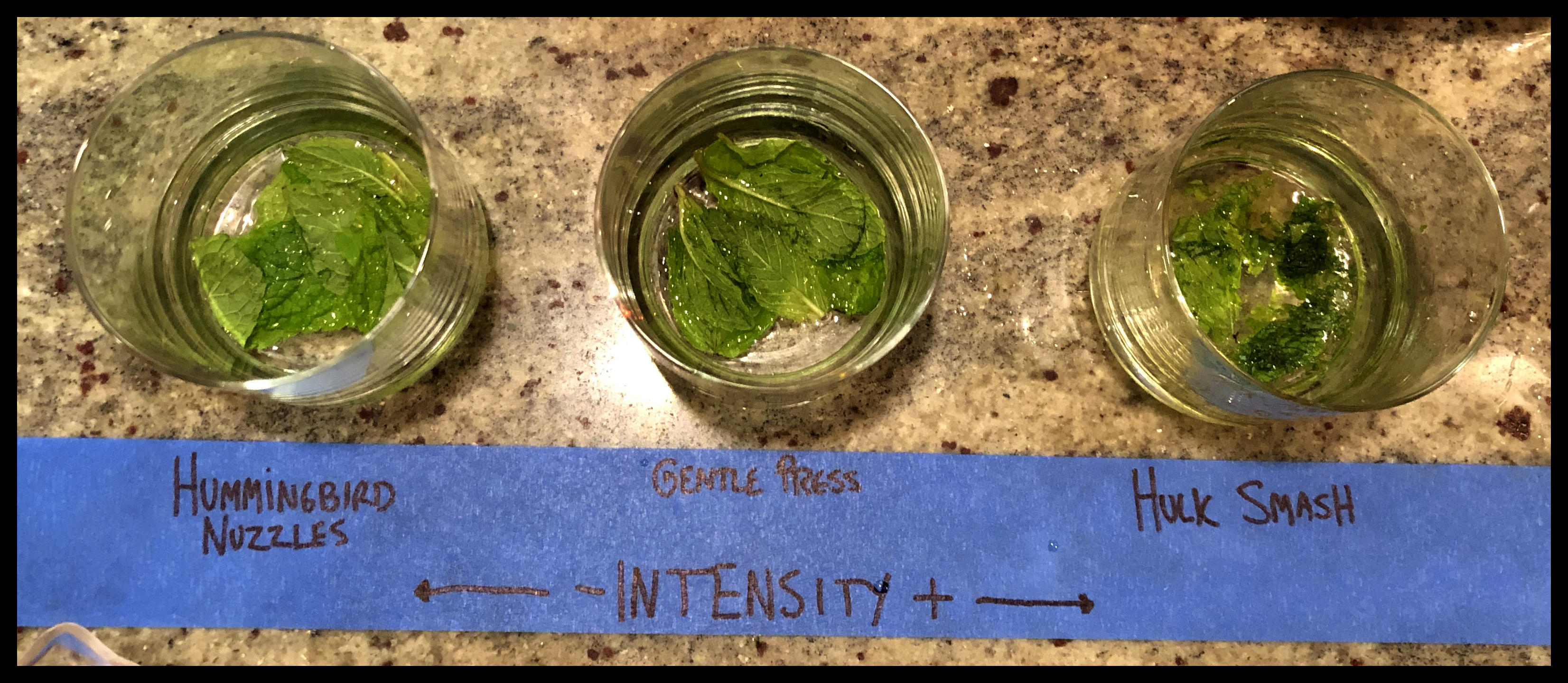
I tried 3, side by side. The first, I barely tapped. The second, gently pressed, and the third, I pounded that shit like I was forging a sword. I crushed it into a wet pile of dark green shreds. And yeah, a light press on the mint will release brighter flavors, but the over-muddled one was still good — too loud and unsubtle, maybe, “a little toothpasty” my notes say — but not bad, and certainly not bitter.

Aim for about as much pressure than it would take to crush a ripe raspberry. The goal is clarity, not volume. If you want the mint louder, add more of it. Though be advised — as I mentioned in the mojito trials, double mint does not double your delightment. You can easily overdo it with the mint. 10-12 leaves is solid.

Ice: CRUSHED ICE

Crushed ice is pretty important here. Mint Juleps taste best when they’re ice cold and well-diluted.

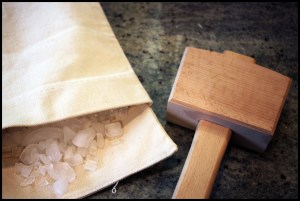
There are a few ways to do this: professionals use a dedicated Ice Mallet and a canvas sack called a Lewis Bag to hammer ice to order, which is surprisingly effective and you can find for around $30 online. A clean dish towel and a rolling pin provide similar, if less elegant, services. Pulsing in a blender or food processor works as well.

If you’d prefer to avoid violence entirely, you can (1) likely buy it at a local ice company, or (2) every Sonic Drive-In restaurant in the country sells 10lb bags of pebble ice for something like $2. I’m assuming most towns in America have access either to an ice company or to a Sonic or, unlikely, both.

Vessel: METAL CUP

A traditional julep cup is Pewter or Silver, and about 12-16oz. They’re fun and inspirational in their own right (catching a glimpse of one in a cupboard is often sufficient prodding to turn any day into a Julep day), but all that really matters is that it’s made of metal, which conducts the way you need it to.

The smaller base of a cocktail shaker works just fine, as long as it’s not too big. If you must use glass, put it in the freezer for 10min before making the drink. As far as Juleps are concerned, cold is an ingredient.

Bourbon: FOUR ROSES SMALL BATCH BOURBON

Four Roses Small Batch cozies up perfectly to the mint, perfectly mentholating the sweet richness of the bourbon. Too much agreeability can actually make Mint Juleps flat and a little dull, and Four Roses Small Batch had just enough depth and complexity to keep interest but with no tension, no spikes, no fights. 45% alcohol seems to be the sweet spot. Smooth without being boring. Works as well as I can imagine.

Individual Bourbon Details (with ABV%)
*note on method: every bourbon was blind tasted at least twice, usually 4 or 5 times, across 9 rounds. The sole exception to this is Templeton Rye, which was only tasted once because I knew it didn’t belong and I threw it in just to make sure.

MY FAVORITE:

Four Roses Small Batch (45%). Like it was made for it. There might be something better out there but it’s honestly hard to picture, as this feels like the ideal balance between having its own character and agreeing with the overall cocktail.

TOP TIER, WOULD HAPPILY ACCEPT ANY TIME EVER

Buffalo Trace (45%): An excellent all-rounder, really complements the cocktail, but there’s a small bitterness on the finish. Still — this almost won, until I tried it next to Four Roses Small Batch, which took the day each of the 3 times they competed.

Four Roses Single Barrel (50%): not just 5 points hotter than the Small Batch but also a different mashbill, a whole different product. Proof offers a surprising richness here — brown sugar, butterscotch, midpalate like a minted Werthers. Gets a little prickly on the finish but it’s delicious, if perhaps a touch intense for an already intense daytime drink.

Woodford Reserve (45.2%): Very mild. Perhaps too mild. This also perfectly conforms to the figure of the cocktail, but almost too well; so mild it borders on flat. I wanted more flavor. I could see someone thinking this was best, though. “Smooth and soft like baby butt.”

GOOD, BUT WOULD PREFER ONE OF THE ABOVE

Maker’s Mark (45%): Well rounded. Soft. Arcs like a scared cat — front too soft, midpalate oak rises fast and dries it all out, and finishes soft. Less compelling than I want it to be. “Something very dry up front, a flavor that travels concurrently with the cocktail.” Perhaps the wheat, because that happened with Larceny, too. Not unpleasant but not ideal.

Bulleit Bourbon (45%): This would be I think most similar to Old Forester — nice tertiary flavors, and some cool fruit, but spice rises up assertive in the midpalate. Huge fans of Bulleit might appreciate that here — to me, the peppery spice isn’t bad but it doesn’t do the drink any favors. Works against purposes with the mint.

Basil Hayden (40%): Similar problem to Bulleit (above), too much rye fighting with the drink. Flavor is cool but the effect is not.

GOOD BUT TOO HOT

Maker’s Mark Cask Strength (56.7%): Good. Boozy. A little too boozy. After a few minutes the dilution fixes this, bringing out some really cool stone-fruit notes, but it takes a bit. “Finish, while long, is not 100% pleasant.”Overall tasty, but this isn’t what I’d reach for. The Mint Julep, as a drink, doesn’t want for booziness. Keep it 50% or under.

DON’T RECOMMEND FOR THIS APPLICATION

Larceny (46%): Weird front palate and weird finish. This is wheated, like Maker’s Mark, so I expected it to soft and mild, but it’s not: there’s, again, a weird graininess that seems to run concurrently to the flavors of the cocktail and never integrate, which on the finish mutates from weird to straight-up bad.

Maker’s Mark 46 (47%) and Jim Beam Double Oak (43%): Both of these products are finished with more wood — Maker’s 46 with toasted French oak staves and Jim Beam in a whole other barrel — and a rule I found for Mint Juleps is that too much oak actively works against the mint, much in the same way darker sugars did.

Templeton Rye (40%): Tried MGP rye on a lark. Not as bad as I thought it would be, but definitely weird. Sweet vanilla, like cake batter. Tastes like Mint Julep fan fiction or something. No, this is a bourbon drink.

Now make one, and tell me how it is. Cheers.

Trivia

The evolution of the word “julep” is a showcase of just how many different ways the same five-letter word can be spelled in 1000 years — in reading I’ve seen, variously: gulāb, gulap, iulip, julip, julap, julab, and the utterly nonsensical but still somehow offensive “jewlip.”