My Favorite Manhattan Recipe

Or: How I think about the differences between a good drink and a great one.

My Definition of a Great Drink:

This seems like an easy question, admittedly — “the one that tastes awesome” — but there’s more to it than that. A great drink:

  1. Has a distinct beginning, middle, and end. Each ingredient plays a role, and you taste everything — not as a shotgun blast of complementary flavors, but as an elegant unfolding on the palate.
  2. Spans the palate across high tones, mid tones, and low tones. If it were all high notes — lemon zest, St. Germain, and fresh raspberries, say — it would be good but not great, because it would just hang out up there, on the tip of your tongue. Similarly vanilla, Cynar, and coffee: delicious but redundant, because they’re all low tones. Great drinks, for me, travel across the tonal flavor spectrum.
  3. The Flavors work. Obviously. No amount of clarity or tonal fascination can save it if the flavors don’t work together.

There are exceptions to this — some great drinks aren’t #2, and some aren’t even #1, though they all are #3 — but for the most part, this is what I’m looking for when I’m making or drinking cocktails. Below, I will explain a little more.

Mercy Rule: If you’re just here for the advertised “favorite Manhattan recipe” and don’t have five minutes for the why of it all, just click here.

Good Drinks vs. Great Drinks

Good drinks are easy. Anyone can make a good drink. Grab the Flavor Bible, pick any two ingredients that go together — blackberries and sage, say, or peaches and thyme — and put them together with a spirit and then sweet/sour balance, and voilà. You did it. Amazing.

Great drinks are a different thing entirely. Great drinks aren’t just about the flavors working, they’re about the unique flavor signature of each particular ingredient. To explain:

The problem with cocktails is that unlike chefs, we don’t have texture to play with. Take a caprese salad: Basil, tomato, and mozzarella, combined to form one of the best things on earth. The textures mean that even though you get all three on the same bite, they hit your palate at different times — the tomato is up front, sweet and acidic, and you taste its juiciness before you even start chewing. Then comes the creamy mozzarella, rich and resonant, occupying the middle and tempering the sweetness of the tomato. Then finally, after a few chews, basil begins to really express itself, from what was just a fragrance to a musky and robust herbaceousness that lingers on the finish.

High, middle, low. Beginning, middle, end. The Caprese is a great dish.
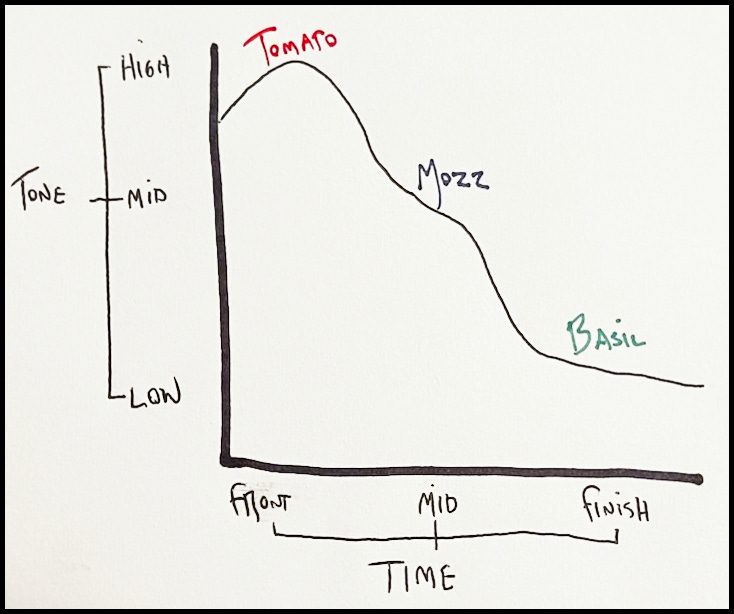
Now imagine that someone put those three in a blender and invited you to drink it with a straw. Still good? It’s the same flavors, right? Ignoring the fact that you’d be dealing with a psychopath, perhaps you take my point: remove texture from the equation and suddenly everything hits all at once, and while the flavors are still fine, you lose something essential of the dish.

Now consider a cocktail. Cocktails are homogeneous — every sip is exactly the same, and you taste every ingredient all at once. So if you want a drink with a distinct beginning, middle, and end — and what’s more, if you want it to have high notes, mid notes and low notes — you need to do it with the inherent character of the ingredients themselves. This is why great drinks are hard. Liquids react to each other in interesting and sometimes unpredictable ways, so to make something great, you need to either (1) know your ingredients preternaturally well, or (2) do a ton of trial and error.
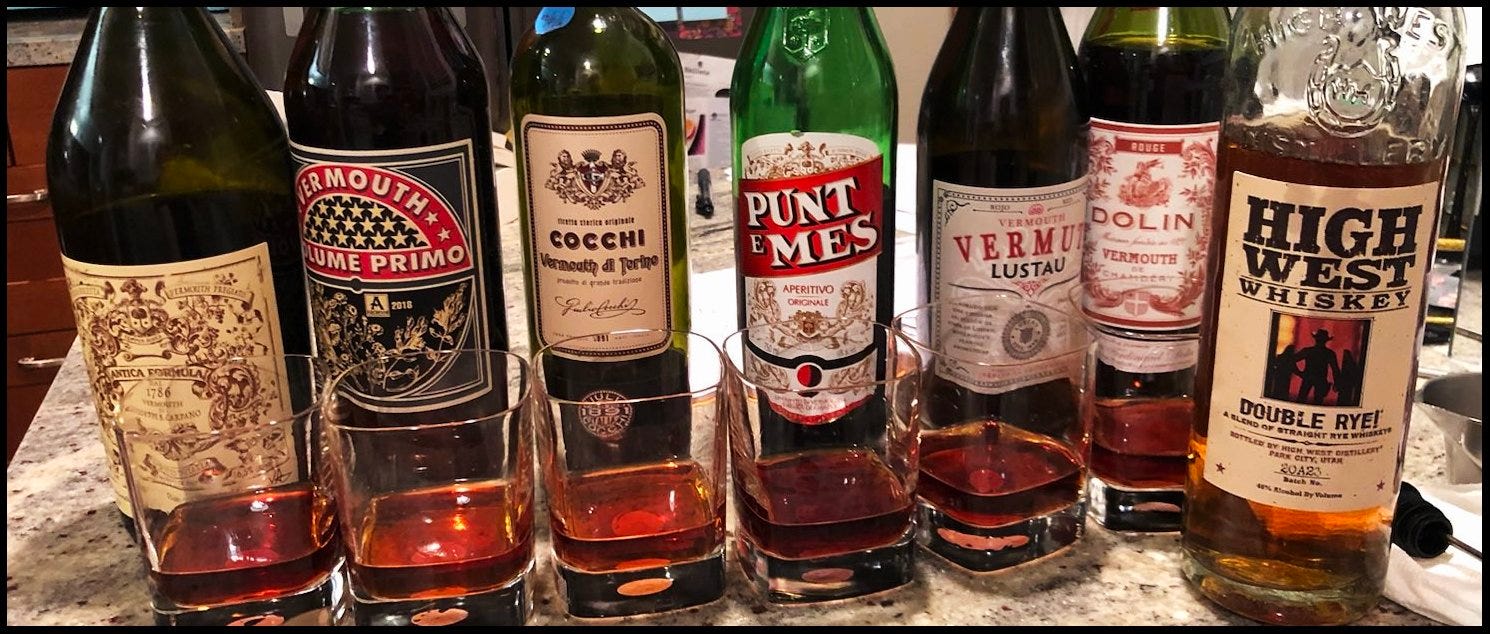
Pictured: a few scant ounces of the metric shit-ton of trial and error I’ve done on Manhattans, and how I spent pretty much all of April 2020.

The Problem with Most Recipes

This is why it drives me nuts to see cocktail recipes that don’t mention a style or a producer, and will be like: “use 2oz rye.”

I’m sorry, “RYE?

It’s all at least 51% rye and it’s all aged in oak, but beyond that, there are wild differences between the bottles. By “rye” do you mean punchy and full of corn like Rittenhouse? Or soft and green like Templeton? Or also soft and green but also heavily filtered like Dickel? Or fruity and a bit hollow like Old Overholt? Or chocolaty and deep with 100% malted rye like Old Potrero? Or aggressive and intense like Pikesville? Is the sweet rum barrel finish of Angel’s Envy OK? Any help on any of this? Nope. Just “rye.”
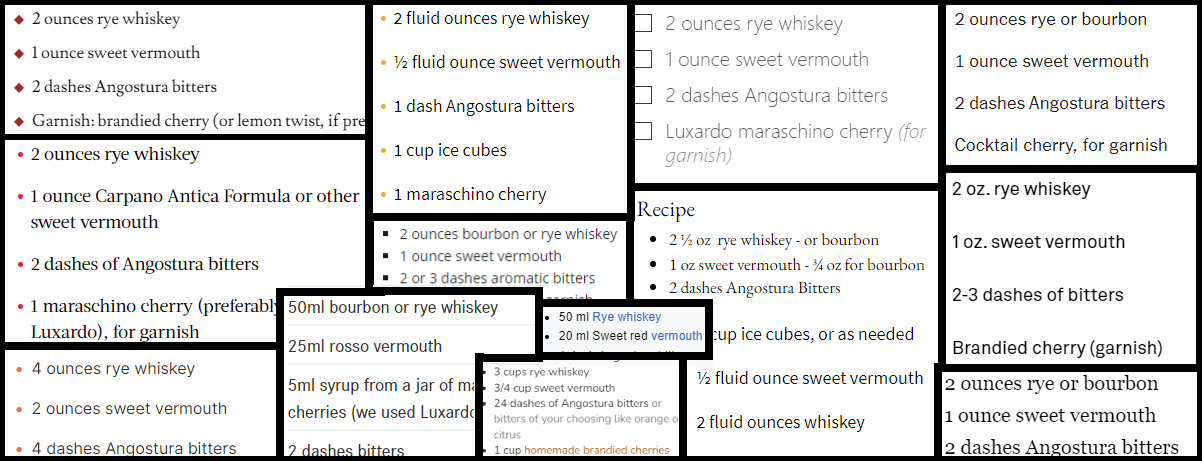
I’m not nitpicking here. This is the first 2 pages of Google.

Some cocktails, like the Whiskey Sour or Old Fashioned, are so basic and protean as to taste good with everything, but they’re the minority. When vermouth and juices and liqueurs start getting involved, just calling for a certain measure of “rye” is like giving up on the idea of greatness before you even start.

This is why I tend to get prescriptive about brands. Not because I take any money from them (I don’t), but because a cocktail recipe is like a biometric safe, and to make a great drink — what I’m always looking for, in accordance to those three goals at top — you need the specific fingerprint of a specific bottle or category to unlock it.

The Manhattan

My go-to Manhattan is for me the most dynamic, the one which takes me on the biggest and most satisfying flavor rollercoaster.

That being said, it’s important to note: I’m not here to say there’s one “best” version of each drink. There are, in fact, a bunch of truly great Manhattans, more than a few tall peaks on that particular flavor landscape. I’ve found three so far, and I know there are many, many more I’ve not yet discovered.

I’m going to show you the one I tend to reach for most often because of my particular tastes, but I’m not saying it’s better than other great Manhattans. What I’m saying is that all the great Manhattans are better than the ones that are merely good.
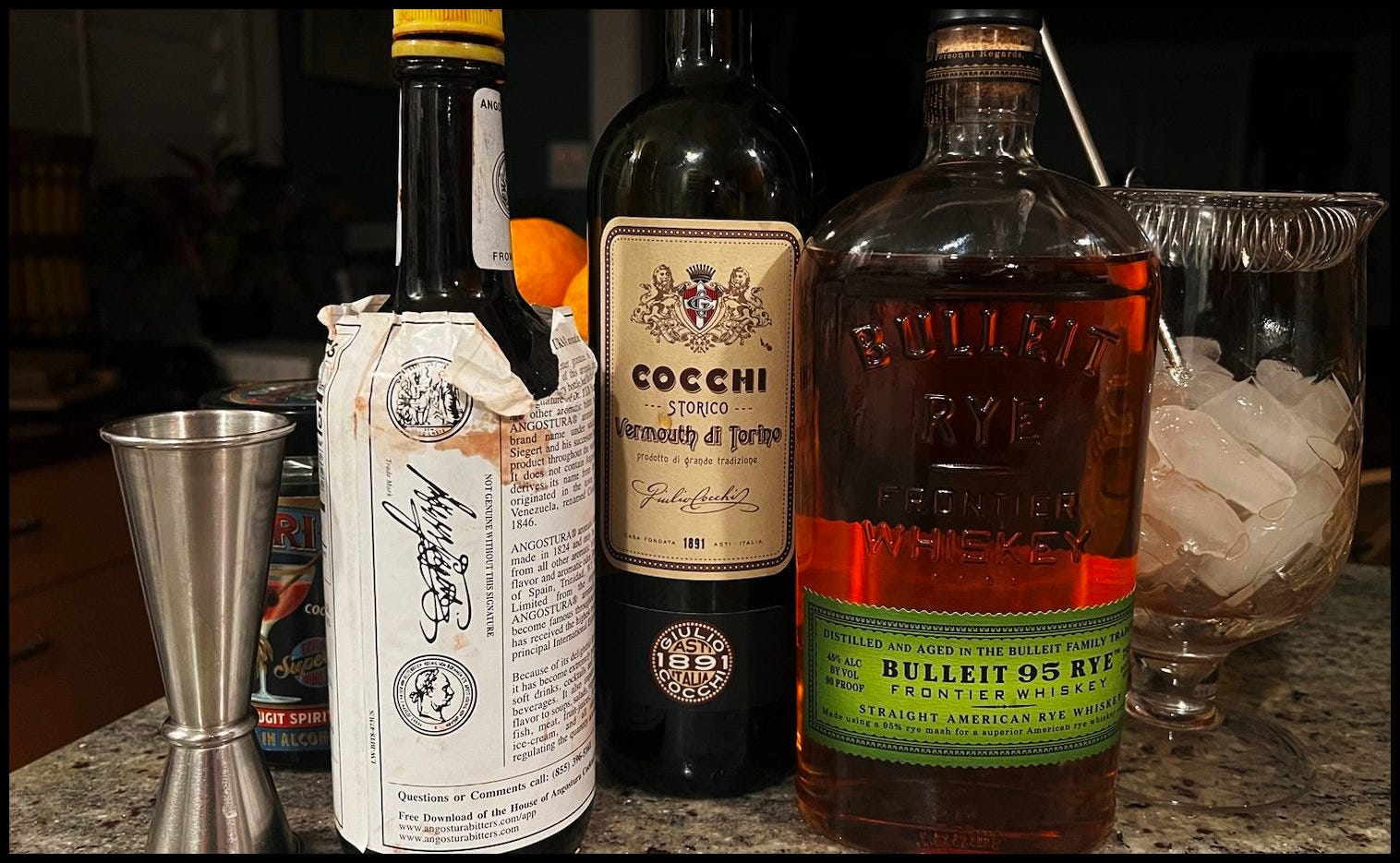
The one I tend to make the most is Bulleit Rye, Cocchi Vermouth di Torino, and Angostura Bitters. Every liquid ingredient has its own flavor curve, where and when on the palate it expresses itself. I think of their flavors like this:
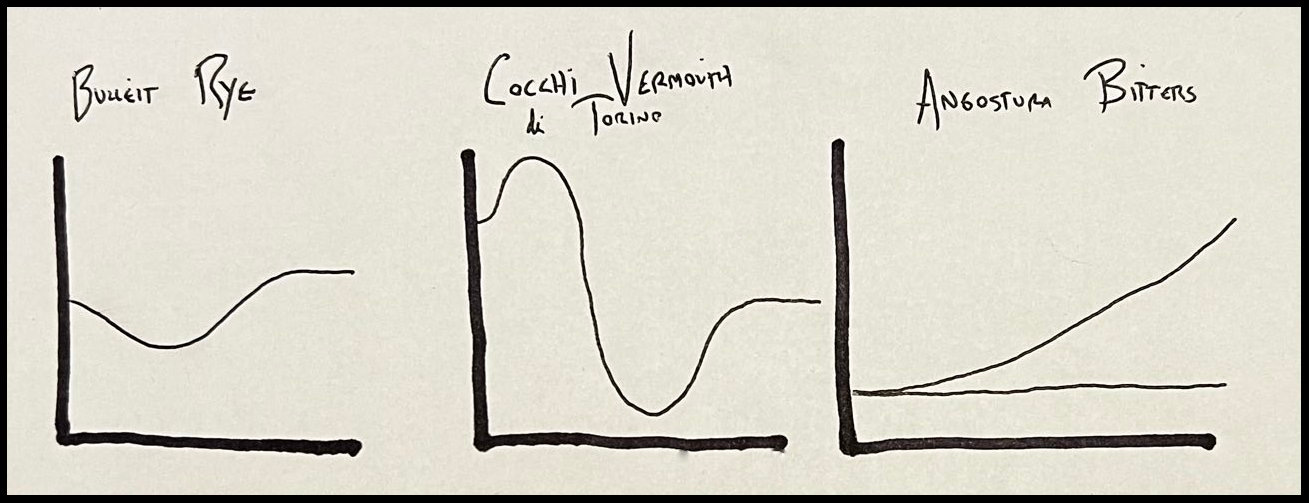
Bulleit Rye: Starts very quiet, with a gentle light grain sweetness, goes a touch low in the midpalate, and then finishes higher with textured oak and the rye’s spice.

Cocchi Vermouth di Torino: Sweet and high fruity up front, then the midpalate swings dramatically down with a low vanilla hum, then it comes up to the rest of the herbs and a lightly sweet, light bitter finish.

Angostura Bitters: There’s a low bitter floor that persists the whole way, but it also has non-bitter flavor notes, which rise in baking spices and citrus through the palate. This complexity is one of the reasons Angostura is perpetually better than its competitors.

The Manhattan, put together:
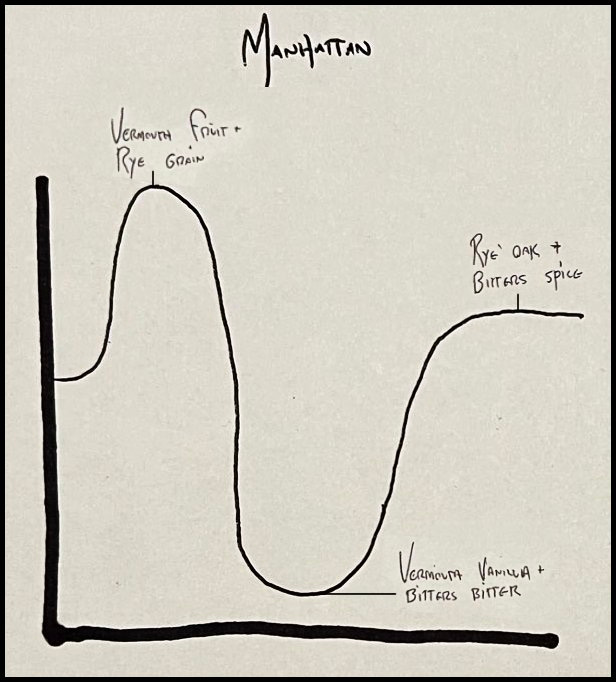
There’s just so much movement in this version. It goes high to low and then mid-high again, and each peeling off one-by-one. Remember that the liquid is completely mixed, and each sip is exactly the same, so when you can find ingredients that give you this kind of ride just through the interactions of their innate personalities, you, my friend, have found a great drink.
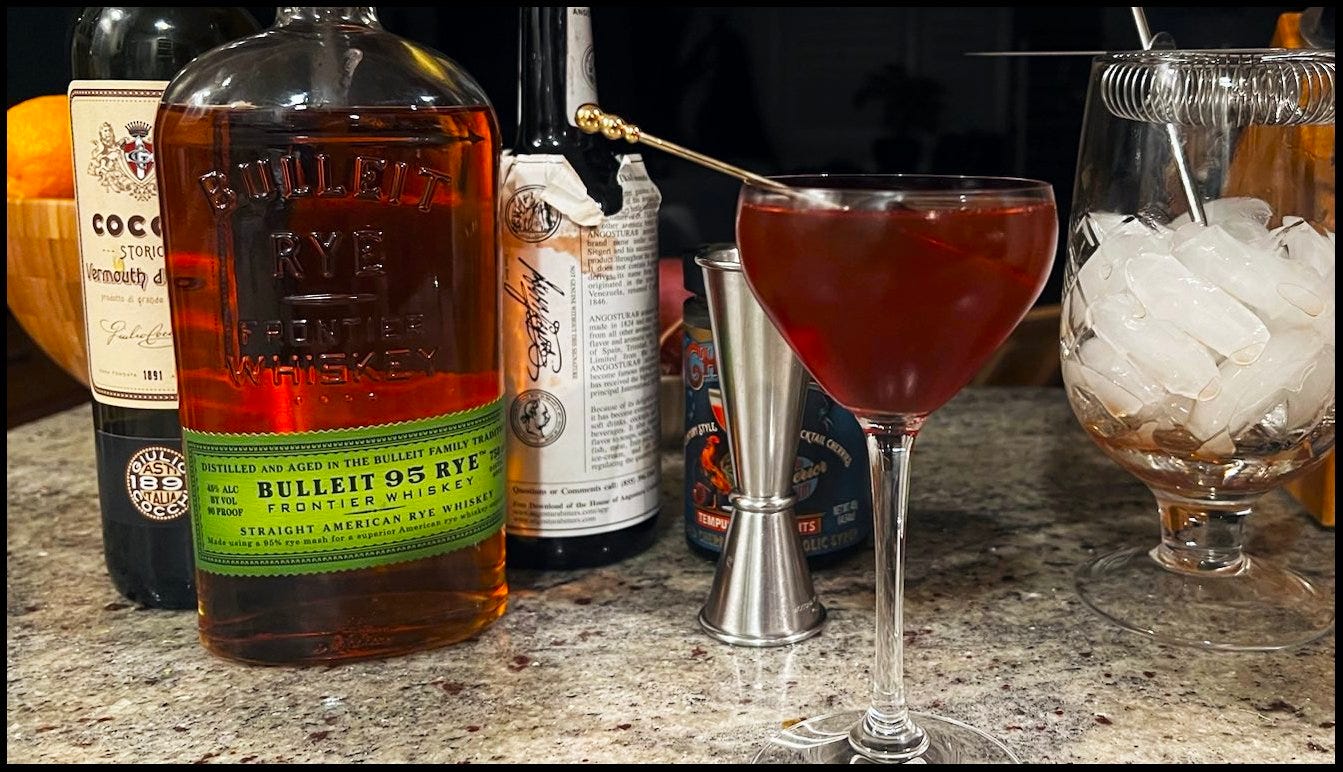
My favorite Manhattan (so far):

  • 2.25oz Bulleit Rye
  • 1oz Cocchi Vermouth di Torino
  • 3 dashes of Angostura Bitters

Chill a coupe or cocktail glass. Then add all the ingredients to a chilled mixing glass with ice, and stir for 15-20 seconds (on decent ice) or 10-15 seconds (on shitty ice). Taste before you strain — you’re looking for the flavors to be clear and articulate. If the ingredients are all trying to speak at the same time, stir for 5 more seconds, but try not to overdilute. The Manhattan is frustratingly easy to under- or over-dilute. It’s not that hard, just a little annoying in the beginning. Once you know what you’re looking for, you can hit it every time.

Two Parting Questions:

  1. What did you think about this? Do the visuals make sense to you? Do you think about tasting some other way?
  2. Do you have a favorite Manhattan? If so, DM me, or leave it as a comment. I’d love to try it out. The work is never over.

The 24 Whiskeys of Christmas

*** Fair warning: this is going to almost aggressively boring to those of you who aren’t into whiskey. And I mean, seriously into whiskey. ***

In the middle of December, the angelic Daniel Wootton sent a friend and me an advent calendar. One that was a bit more geared toward our particular interests.

[24] advent calendar

It was a gift to both of us, so my friend and I had to drink them together. The problem is that I don’t see him everyday… so instead of a half-ounce each of whiskey for 24 days, we did something like 4 ounces of whiskey in three successive rounds. Once we started approaching palate exhaustion — once the tasting notes became laborious and the camera started filling up with cute pictures of his dog Zygo (which happened all three times) — we’d retire and go again later.

Why share this? Why not? I mean, all these pictures and all these notes, n’ here somebody here gon’ post?

ROUND 1

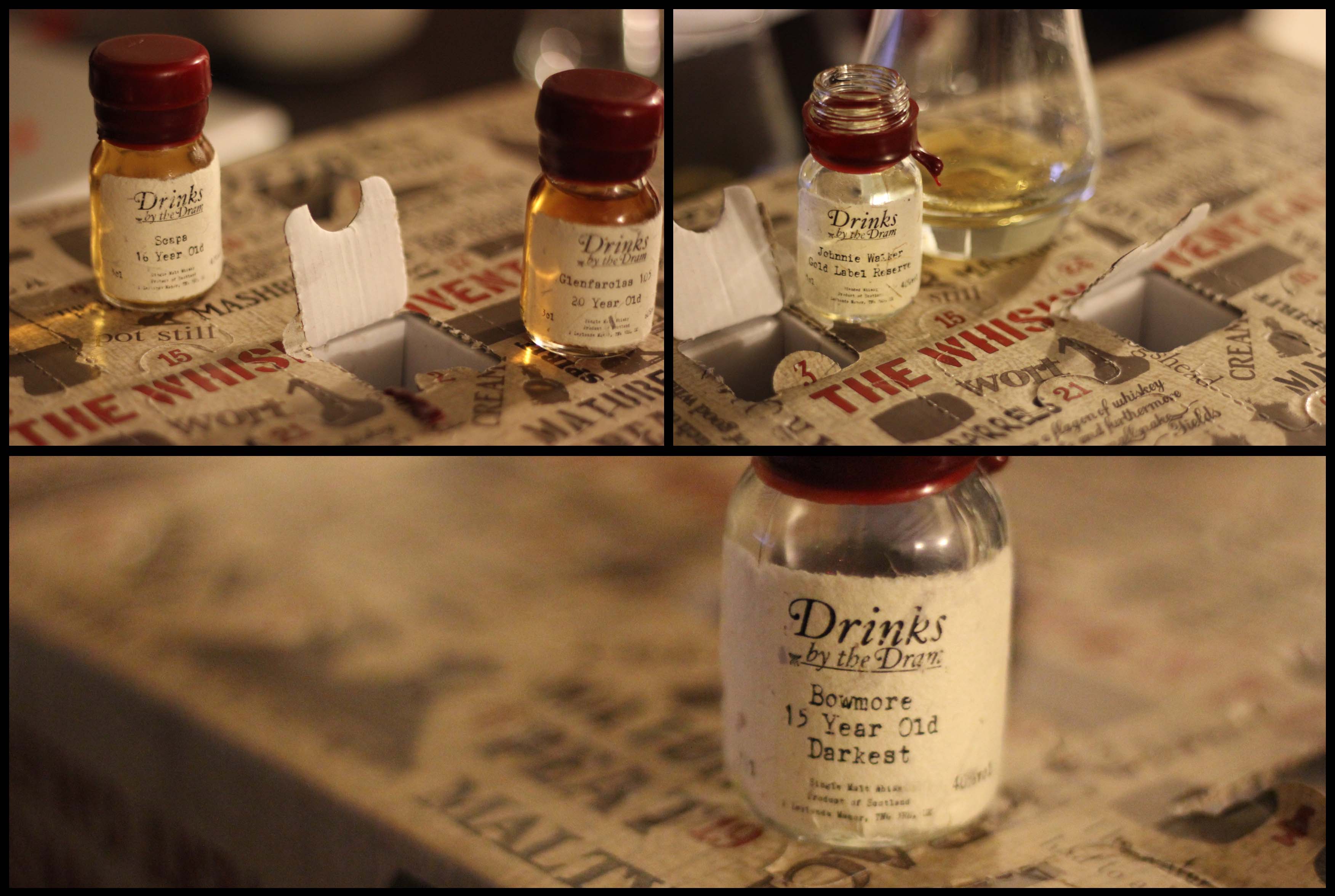
1. Scapa 16yr old — 40%

Color of light gold. Smells sweet and a little fruity. Like fruitcake. Color doesn’t suggest Sherry but flavor might. No smoke or peat. Honey a little. Tastes big and heavy. Sweet entry, full bodied. Candied fruit. Raisins. Rich and complex for an unpeated whiskey.

Wondering how I’d never heard of this. It’s delicious.

2. Glenfarclas 20 year — 60%

Quite a bit more earthy. Sherry entry. Dried fruit. Burnt gold color. Drier than the Scapa. Smells like dry hay. Water makes the flavors cascade, but it’s still a bit sharp on the finish. Tiny hint of peat.  

I expected to like this a lot more. Glenfarclas usually does such good work. Oh well.

3. Johnny Walker Gold — 40%

Color is… well… gold. Maybe they don’t caramel color this one. Nose has a hint of peat, but not much. Tastes of brown sugar. Caramel. Some peat. Flat at the end. 

Blended scotch is for peasants. Yes, I’m a snob.

4. Bowmore 15 year “Darkest” — 40%

BBQ smoky nose. A pulse of peat smoke. Tastes way smokier than it smells. Sam calls out a Mesquite BBQ taste, which is right on. Big beautiful sweet smoke. Chewy smoke. Caramel.

“Darkest” is a silly name for whiskey. Regardless, this is unexpectedly wonderful. I want a bottle.

1-4: The Dawning

5. Yamazaki 12 — 43%

Malty graininess. Hint of smoke and honey.Medium bodied, well balanced with a nice faint current of smoke throughout.

Fantastic, but I already knew that. Like all high quality Japanese flavors, delicate and complex. An old favorite.

6. Talisker 2000 Amoroso Finish Distiller’s Edition — 43%

Sea saltiness. Brinyness. Peat and smoke. Take all the normal Talisker loveliness and add a sherry cask finish. Candied fruit and caramel. Peppery finish.

Not necessarily better than the standard Talisker 10, but still good. Quite sweet, but with a lot of personality. Not unlike myself.

7. Tobermory 15 year — 46.3%

Bready nose. Grainy. Smells thin & peaty. Heat initially. Numbing prickliness.  Big empty peatiness leads into a honey sweet finish. Unbalanced.

Feels like it was sloppily distilled, but maybe I’ve been drinking. Then, maybe not. I hesitate to call it bad, but let’s say it’s unburdened by greatness. I won’t be back.

8. Four roses Single Barrel 2012 — 54.7%

Big caramel richness. Tropical fruits. Banana. It’s weird to spike all this malt with bourbon’s corn muscularity. Like bringing a linebacker onto a soccer field. All the same, long sweet finish. Woody spice. Intense grainy heat. Lingering woodiness. Creme Brûlée. Charcoal. Faint banana finish.

Four Roses makes damn good whiskey.

5-8: Even Whiskeyer

ROUND 2

9. Glenlivet Nadurra 16 – 0512T — 53%

Color is light straw. Like well-hydrated urine. On the nose, bruised yellow apples. Otherwise, I don’t smell a fucking thing. Sam blew past the nose and just started drinking. Taste is more present: yellow apples. Caramel. Peat finish. Lemon zest. Long finish. Full bodied. Bittersweet – oak dryness mixed with sweet finish.

Better than I expect from Glenlivet. Maybe because of the high proof. Cool.

10. Wasmund’s Single Malt — 48%

Gold. Shimmery. This one is from Copper Fox distillery in Virginia. Googling tells me it may have been aged for as long as 42 months. The notes for this one are best presented as quoted:

Nose:

Vikki: A garden.
Sam: A newly painted and remodeled kitchen.
Jason: Topsoil.
Vikki: Disturbingly chemical.

Taste:

Sam: I just licked the floor of that kitchen.
Vikki: It tastes like I just ate a flower.
Jason: Mulch. Heavy mulch. Kava.
Vikki: Moss. Peaches.

11. Caol Ila 12 — 43%

Very light in color. Equal parts sweet and salty and oily and peaty. Long finish. Medium bodied. Touch of sweetness. Perfectly balanced.

“Cool Eye-la.” As delicious as it is fun to say. One of my longtime favorites.

The Triumphant Return

12. Aultmore 5 year single cask — 66.8%

Smells funky. Like armagnac. Young and green. Still smells like it came from a carbon-based life form. Youth + proof = hot hot heat.  Watering down leads to some softer notes, but it’s still green.

Definitely needs more age. Doesn’t yet have its shit together.

13. Glendronach 15 revival — 46%

Now that’s age. Smells like old whiskey is supposed to smell. Taste is rich and dark. A little sherry influence? A little malt bitterness. Brief finish. What age does to scotch.

Slightly incomplex, though the sherry helps. All the same, this is a pretty good whiskey.

14. Hibiki 17 — 43%

Smells of brown sugar and plums. Hibiki is partially aged in old plum wine casks, more evident here than in the 12 year, which is a kind of obvious thing to say. Taste: restrained. How Japanese. Light with grain whiskey (it’s a blend i.e. not all malt). Glint of peat. Caramel brown sugar front palate.

Sam: “its a great dessert whiskey.” Agreed. I wouldn’t pay $100 for it, but I’d gladly accept if offered.

15. Jameson — 40%

Oh, for fuck’s sake.

16. Edradour 10 year — 40%

Solid. Sweet all the way though. Barley sweet, grainy, molasses like. Faint echo of peat – or is that heather? A plains flower.

This tastes like a plains flower, growing wild on the grassy, wind-swept Scottish plains. Probably trampled by sheep. Maybe we should stop for the night.

#12-#16: Things start to get a bit loopy

ROUND 3

17. Auchentoshan three wood — 43%

Very woody and surprisingly grainy. Grain overwhelms nose. Sip, and grain continues. You could sell me on this being a rye. Nice sweetness from barley develops at the end. A bit woody and very grain forward. I’m supposed to be getting sherry, but I’m not. Strange.

This one makes me wonder if a mistake could be made in filling these little 3cl bottles.

18. Lagavulin 16 — 43%

Full bodied. Oily even. Peat bomb. Smells like dried craft paint. To quote Brian Cox: “works like a depth charge.”

An epic whiskey. Not for the faint of heart. One of my favorites.

19. Compass Box Hedonism — 43%

Very pale. Watery yellowish. To me, it smells like nothing. Then faint bacon(?). But mostly nothing. Tastes extremely light. Unrelenting sweetness that endures front to back. I don’t know if it’s blended, but it tastes like it is. Lightly peaty. Kinda gross.

The connection between this whiskey and the concept of hedonism remains utterly opaque.

20. Aberlour 12 double cask — 43%

Unpeated. Light fruit. Honey sweetness. Tastes light and sweet. Same as the nose, lightly fruity and a bit of heather. Licorice notes. Light sherry leads to sweetness.

It’s certainly not bad, just not terribly interesting. Reminds me of the Balvenie Doublewood, except less engaging.

17-20: Baroque decadence, and the beginning of the end.

21. Dalwhinnie 15 — 43%

Nose is rich honey, spiked with faint agricultural graininess. Every once in a while, whiskey reminds you that it’s essentially an agricultural product. Very faint here, but still cool. That note vanishes for me in the actual palate… very light entry, then builds in flavor and heat to a full, honeyed, slightly hot mid palate explosion.

Like a sneeze, only better. I forgot about this one. I like this one.

22. Wild Turkey Rye — 50.5%

Sam: “now that’s rye.” Oh yes. Taste is big, kicking sweetness. Rye grain. Muscular. Peppery. After the last three honey sweet malts, this is a jolt.

Higher proof and bigger balls than anything we’ve had. USA! USA!

23. Glenfarclas 30 — 43%

Nose is subtle but expressive. Raisins. A bit of fruitiness. Definitely sherried. This is already better than that Glenfarclas 20 year back in #2. Taste: up front, peat and sherry and honey malt all at once. Then the flavors extend out, dropping off individually to highlight the others. Almost unbelievably long finish.

This is what you’d hope a 30 year old whiskey would be. The best one we’ve tried yet. Amazing.

24. Master of Malt 50 year old Speyside 3rd Edition —43%

50 fucking years? Wow. Color is light gold with curious tints of green. Smells of apples, raisins, and cinnamon spice. Basically, like a snack. These are mostly confirmed on the taste: raisins and spice and cinnamon, in that order. Super long finish as well.  Oak dryness to finish, despite the light color. Dried fruit. Honey. A little blunting on the finish, actually. I feel like you taste some tails in there.

I actually prefer #23, but still… phenomenal.

21-24: My only friend, the end.

What an incredible gift. This was a lot of fun.

We're gonna need a montage.

Thanks, Dan. You’re the best.

Seriously.

Cheers.