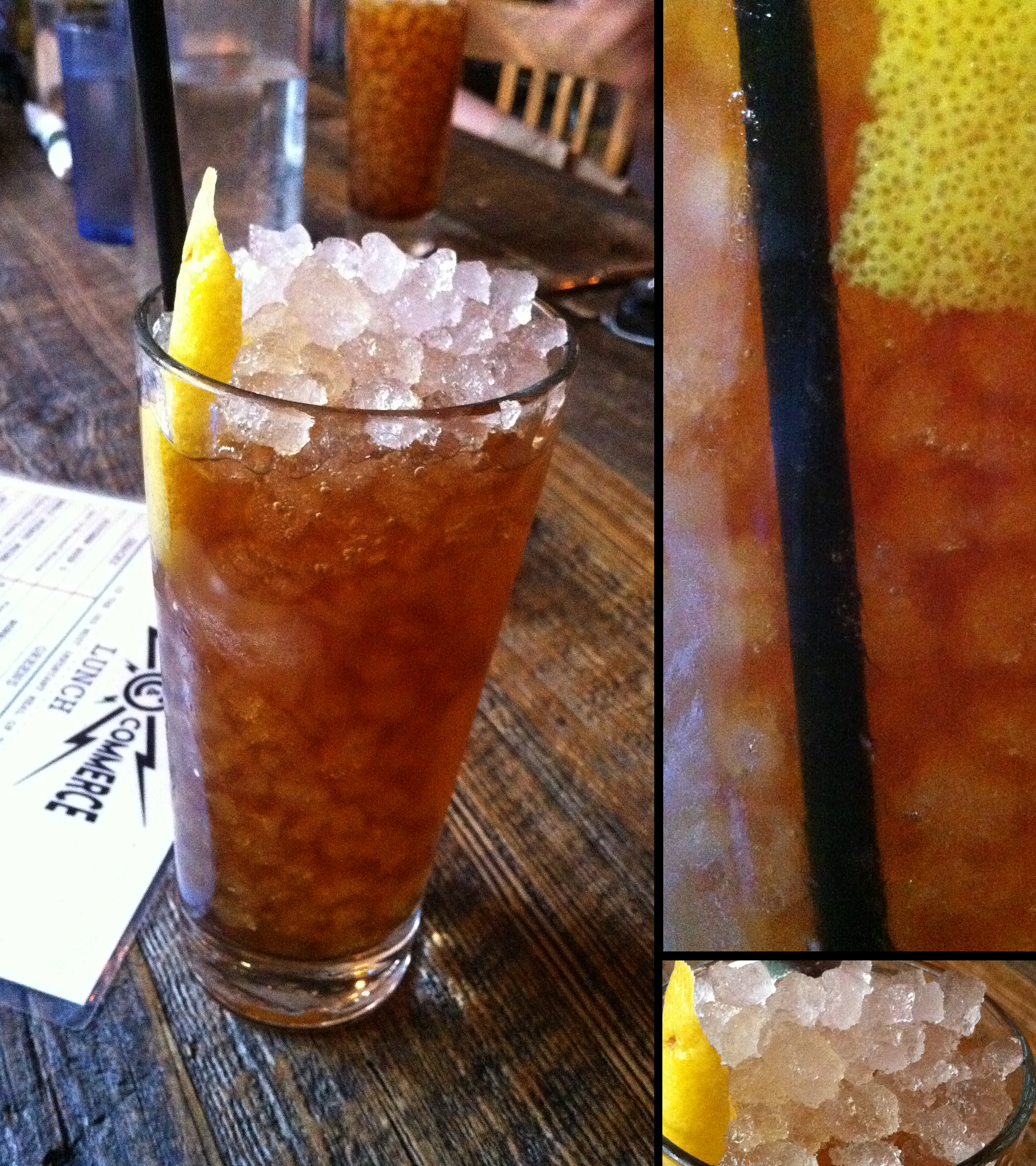
Autumn Negroni

When I was back in Chicago over Thanksgiving, Vikki, my sister Kelly and I took occasion to go to the Violet Hour — my favorite thus far of the Chicago cocktail bars, even if it is a faux-speakeasy. I’ve never really been into the whole  fake speakeasy idea, and am relieved that the trend seems to be dying. People sometimes forget that “pretense” is the root of “pretentious,” a fact I’m never more aware of as when I’m at a hidden, exclusive, “password-only” bar that I found by checking their address on yelp.

Regardless — once you find the stupid hidden door and wait at the stupid velvet curtain, actually being there is a very pleasant experience.

The standout drink I had there was called the Autumn Negroni, which on paper looked redundant. Five of the seven ingredients (71%) are bittering agents, and one could reasonably think that once you have Campari, Cynar, Fernet Branca, and Angostura Orange bitters, a dash of Peychaud’s seems like a waste of everyone’s time.

In practice, however, the bitters strip away individually and at different moments, yielding waves of flavors that make each each sip last like 10 seconds. Each ingredient picks up at the tails of the last one and carries the flavor for a while before handing off to another. It’s like a relay race, or cars of a train. This drink is so fucking good.
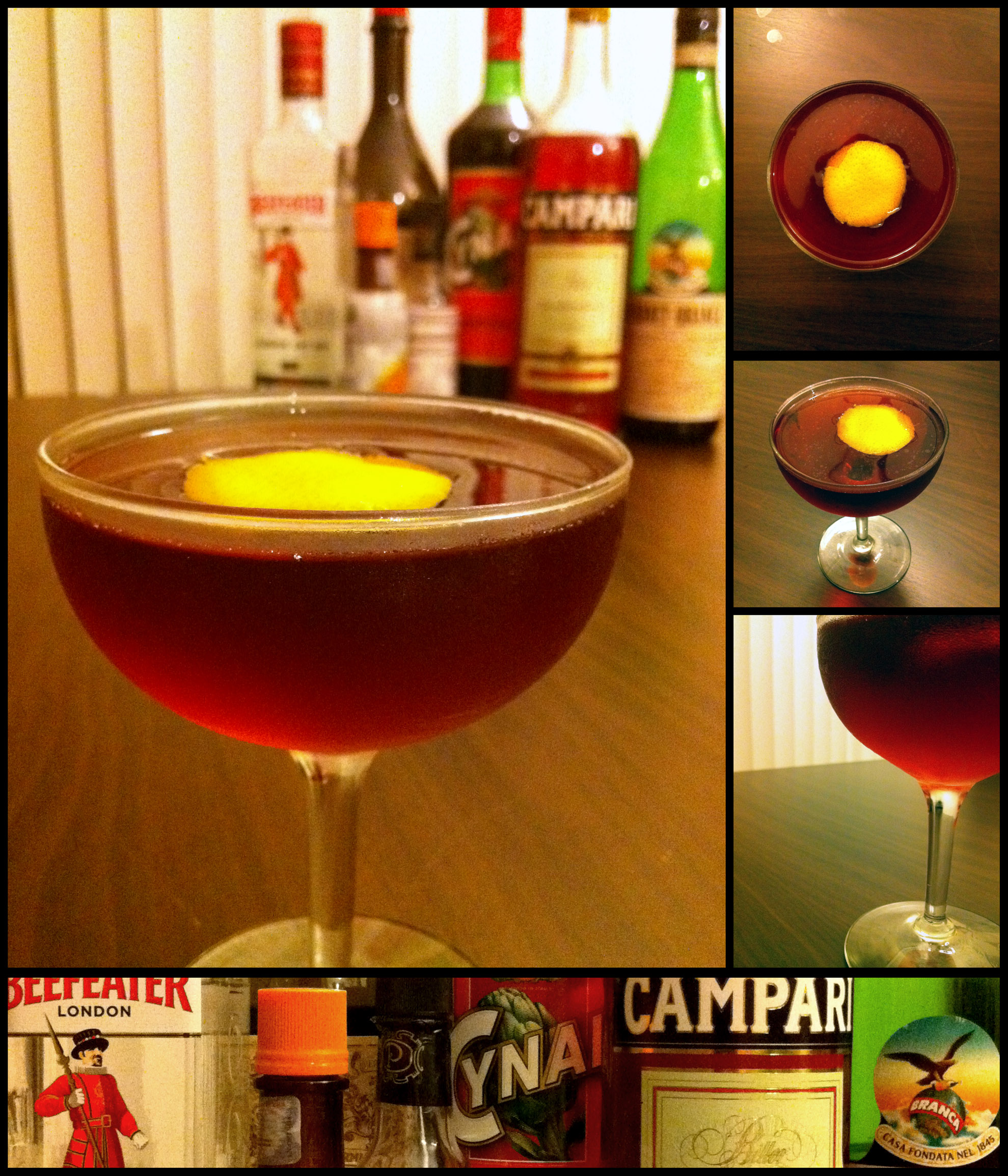
Autumn Negroni

2oz dry gin (Beefeater)
0.75oz Carpano Antica sweet vermouth
0.5oz Cynar
0.5oz Campari
0.25oz Fernet Branca
1 dash orange bitters (Angostura)
1 dash Peychaud’s bitters
Stir over ice and strain into coupe glass; garnish with orange peel.

I immediately asked them for the recipe, which they immediately gave me. Not to single out Saltbox, but I’ve made this drink for probably two dozen people, all of whom loved it, and all of whom now know where to get it if they ever find themselves in Chicago. I share recipes with anyone who asks. I firmly believe it makes all of us better.

Peychaud’s anise shows faintly on the nose alongside aromas of the sweet vermouth’s wine. But what’s so engaging about this drink is that you get to taste all the ingredients, more or less one after another. When taken, the sweetness of the amari mixes with the gin’s juniper, followed by the bittersweet Campari and the brightness of the orange bitters, but right when the Campari would turn rusty bitter that quarter ounce of Fernet Branca prickles up all peppermint and menthol, only to be batted back down by the long, earthy finish of the cynar.

Before this, I had no idea that bitters could layer in this way. I have since used this as the inspiration for the Mane of Needles, my favorite of the URBN cocktails and about which I’ll write soon.

This is the kind of drink that you keep going back to, keep taking small drinks because you identify something different in each sip, and when you feel like you’ve almost mapped all the flavors, you find there’s nothing left but sweetness on your lips and you have to do the whole thing all over again. Which is all I could ever ask from a cocktail. Four stars. A+.

Copper Monkey

The magnificently named Copper Monkey is a creation of Bek Allen, in-house bartender at Saltbox and the other half of Erin Williams’ Hush Cocktails. On paper, it looks like it has the potential to be the most offensive drink ever made. It features not one but three distinct ingredients that are found revolting by a significant cross-section of Americans. The Bols Genever with its malt & agricole funkiness, the briny smoke of Islay scotch, and of course the Vida mezcal, with all its lovely notes of smoked gasoline.

I’m crazy about scotch and mezcal and I tolerate genever, but even I wouldn’t imagine they would taste very good together. And I was, of course, wrong.

Copper Monkey

Bols Genever
Del Maguey Vida mezcal
Highland Park scotch
Bénédictine
“Ginger” (Canton ginger liqueur)
Highland bitters
Orange bitters

I asked for the proportions, and was rebuffed. Rebuffed! Apparently they don’t do that, which is kind of lame. It’s against my professional philosophy to keep recipes secret, but I do more or less understand. Also, Bek herself wasn’t there, so perhaps I can grab it from her personally next time I see her, seeing as she invented it and all.

For all of its bizarre and intimidating ingredients, the cocktail was surprisingly approachable. Faint genever and Bénédictine on the nose, and the first impression is strangely one of sweetness. It’s not a trivial amount of Bénédictine – probably 0.75 to 1oz – and the sweetness serves to make it complex instead of abrasive with a sweet, long finish.

The scotch shows up on the finish, along with a hint of the mezcal. Honestly I expected to taste the mezcal a lot more, making me wonder if it’s just a rinse. The agricole from the Bols Genever forms the backbone of the drink, with some fresh orange notes from the bitters along with a whisper of cinnamon here and there (I assume from the “highland bitters,” which are new to me). The only sensation that really steps out from the crowd of ingredients is one of sweetness. Aside from that, it’s a terrifically balanced and inventive cocktail.

Heering Flip

There are, believe me, no shortage of cocktail recipe books. And even someone with no experience with a single one of them could likely guess that most of them are complete garbage.

There are two easy ways to tell. The first is the easiest: generally speaking, the more recipes a book has, the worse those recipes will be. If the cover boasts more than, say, 750 of them, it’s probably an admittedly enormous collection of completely terrible drinks.  The second is almost as easy: flip to the recipe for a Margarita. If it calls for sweet and sour there (or really anywhere in the book), throw it away because it is worthless.

What we have left are the histories, the celebrated single-bar books, and the books with no recipe for a margarita (which is a promising sign). Beta Cocktails (formerly Rogue Cocktails) is an example of the latter. Written by Kirk Estopinal and Maksym Pazuniak, Beta Cocktails is a thin little number with about 40 recipes that range from imaginative to bizarre. It’s a fantastic and innovative mini-collection, great to jog the imagination, or just to try something totally new on a Sunday night.

Heering Flip

2oz Cherry Heering
0.5oz Bittermans Xocolatl Mole bitters
1 whole egg
1 pinch salt
Add all ingredients, shake with no ice to emulsify, add ice and shake the jesus out of it. Strain over fresh ice. Garnish the egg-foam head with three drops Mole bitters.

Yes, two ounces of Cherry Heering. Yes, a half ounce of bitters. See? Bizarre.

This isn’t so much a dessert drink as it is a dessert course. The nose was a predictable cherry and chocolate, but the first sip evoked chocolate milk and, strangely enough, pie. The egg serves to thicken the already very thick Heering base, and the salt only makes it more savory while offering a bit of sourness on the back end.

The overal impression was that the drink is cooler than it is delicious, but still very drinkable. And strangely balanced – while definitely a sweet drink, it’s not too sweet as the ingredients might suggest. It is, however, exceptionally thick and rich. This is for someone who’s done with their food but still hungry. I will definitely make this again.

Bitter Giuseppe

After the Milano Swizzle, I wanted more salt in cocktails, and thought back to a drink my friend Addison had made me some six months ago, the Bitter Giuseppe.

There are a few different versions of this drink floating around. According to this blog, the drink was created by Stephen Cole of Chicago’s wonderful The Violet Hour, and then made salty by Kirk Estopinal of Cure in New Orleans. Estopinal’s recipe calls for Punt e Mes with salt, Cole’s original with Carpano Antica without, but both share Cynar’s artichoke heart. At Craft and Commerce, they (predictably) do it their own way.

Bitter Giuseppe
2oz Cynar
1oz Carpano Antica sweet vermouth
2 small dashes of salt
Combine ingredients in Old Fashioned Glass over ice.
Cut a lemon peel with enough meat to extract about 10-15 drops of juice
Squeeze juice into the drink, express peel oils on top, stir, and serve.

As detailed in a marvelous post on beta cocktails, the extra salt reins in the Cynar — this cocktail has twice the Cynar but only half the bitterness of the Milano Swizzle. Apparently while reading French scientist Hervé This’s dense & detailed volume, Molecular Gastronomy, Estopinal found that salt curiously tempers bitterness in liquids even more than sugar.

In this case, the salt blunted the bitter effect, allowing the liqueur’s component ingredients to showcase their otherwise overpowered flavors. The nose is a bit unengaging, but the taste offers a complex and pleasing barrage of herbal notes (orange and artichoke, to name two of several) and deep salted umami that fades into soft and lingering bitterness at the finish.

Milano Swizzle

Every great once in a while, a happy accident aligns our schedules and all my best friends have the same afternoon off. Tuesday was such an afternoon, and never one to beat a dead gift horse, we all immediately descended upon Craft and Commerce for some sunshine cocktails.

It was gorgeous outside – we’ve had more summer this winter than we had all of last summer – so I plucked the Milano Swizzle off the menu for something bitter and refreshing before my embarrassingly bourgeois meal of bacon-wrapped corn dogs.

Milano Swizzle
0.25oz lemon juice
1oz Cynar
1oz Beefeater London Dry Gin
1oz Carpano Antica
pinch of cracked salt
Fill with crushed ice, swizzle or stir until glass frosts;
garnish with lemon peel.

I’m fairly confident that this is unrelated to Tony Abou Ganim’s Milano, and shares the Italian city only as a source for the lovely potable bitters – in this case, the earth and artichoke of the Cynar. This is essentially a Negroni with a different bitter and a bit of lemon juice. What really excited me about this drink was the salt, still a stone relatively unturned in my cocktail experience and used deliciously here.

The drink started tart and led to a complex orange and earth herbaceous that the salt made almost savory, with the alchemy of the ingredients intensifying the Cynar for a sharply bitter finish. The salt was mostly undetectable but for the savory effect, and definitely makes me want to play with it more.

Our bartender Ryan commented that salt and Cynar enjoy each other’s company. Drinking it, you can clearly see how it can be taken too far, but you can also get a glimpse of its potential.

Beached Bru

There was a period of about a week for which Nick, our manager, would sit downstairs alone watching this video series. It’s an Australian cartoon mocking the speech of New Zealanders, a beached kiwi whale who befriends an unhelpful pelican and bemoans the fact that he is, indeed, beached.

There are dozens of these things and Nick would watch them all, then run upstairs giggling and accost the employees with his impression of a beached Kiwi whale. This lasted roughly a week, long enough for the accent to infect the entire URBN staff. We’d approach each other unprovoked and say “Oh no, bru! I’m beached, bru!”

So in making the cocktail list, it became clear to me that I had to make a summer rum cocktail in the winter and call it Beached Bru, as a joke that is funny exclusively to the people who work at the restaurant. This is that cocktail.

Beached Bru

2oz Banks silver rum
1oz lime juice
¾ oz simple syrup
Muddled cucumber and mint
Shake and fine strain over fresh ice in an old fashioned glass. Garnish with a floating lime wedge.

This is probably the least inventive cocktail on the menu. It’s a short cucumber mojito, and the only reason I stand behind it is because the Banks rum is so goddamn delicious. I loved the rum when I tasted it and have been trying to mix with it, but everything I tried seemed to detract from the complexity of the spirit rather than add to it.

The cucumber and mint are so mild that to me, they don’t appear as flavor notes so much as like a breeze of flavor that gently sways the experience of an otherwise straightforward daiquiri. It starts with the rum’s sweetness and finishes with just the right amount of agricole funkiness. It’s accessible without being boring, and mildly dangerous only in that it seems to vanish out of the glass almost instantly.