The Bourbon Trail (6 of 6): Heaven Hill

Note: For brevity’s sake, I’m going to breeze over some of the finer points of distillation, as I’ve already written about them in part 1. For a more thorough breakdown of the bourbon process from grain to bottle, click here, or just type your question in the comments.

The Facts:

Distillery: Heaven Hill Distilleries, Inc.
Location: Louisville, Kentucky and Bardstown, Kentucky
Owned By:  Privately owned by the Shapira Family.
Major Products produced: Elijah Craig; Evan Williams; Rittenhouse Rye; Bernheim; Parker’s Heritage; Fighting Cock; Old Fitzgerald; Henry McKenna
Origin: Since 1935

The Tour:

Everybody’s owned by somebody. For all their talk about heritage and old bricks and father’s fathers, pretty much every major bourbon distillery is now owned by some massive, international corporation: Wild Turkey by the Italian Gruppo Campari, Buffalo Trace and 1792 Barton by Louisiana’s Sazerac, Four Roses by Kirin in Japan, etc., etc. So when I was doing research on Heaven Hill and found that they are “America’s Largest Independent Family Owned and Operated Distilled Spirits Company,” I was excited to see how that might change the experience.

Heaven Hill are also the only people who offer an in-depth tour to the general public, a $25, 3 hour “behind the scenes” experience. As someone who flew to Kentucky for semi-professional reasons, I was sincerely excited about this as well. Three hours! Family owned! We built the whole day around our Heaven Hill appointment, as I assumed it would be the most interesting, the most hands-on and educational.

As it turns out, it was none of those things. Which I’ll explain, but first, a quick aside about the alcohol business: warehouses can hold about 20,000 53 gallon barrels, which due to evaporation have various levels of fullness. But even if the warehouses were only half full of barrels, and each barrel was only half full of spirit, that’s still 2.5 million pounds of insanely flammable liquid. Fires happen. And when they do, they’re not minor.

So while Heaven Hill is based in Bardstown, KY, it has been fermented and distilled in Louisville since 1996, ever since their Bardstown Plant was ravaged by fire and burned to the ground.

What does that mean for your average bourbon tourist? It means that if you do a three-hour tour, you get a three-hour tour of a dumping & bottling plant. We learned almost nothing about bourbon; instead, we learned about the bourbon industry, the nuts and bolts of how such a massive production can be achieved, which is interesting in the way that patent law is interesting. It is conceptually interesting.

Actually immersing oneself in it for several hours, however, is a slightly different story.

MASH, FERMENTATION, and DISTILLATION

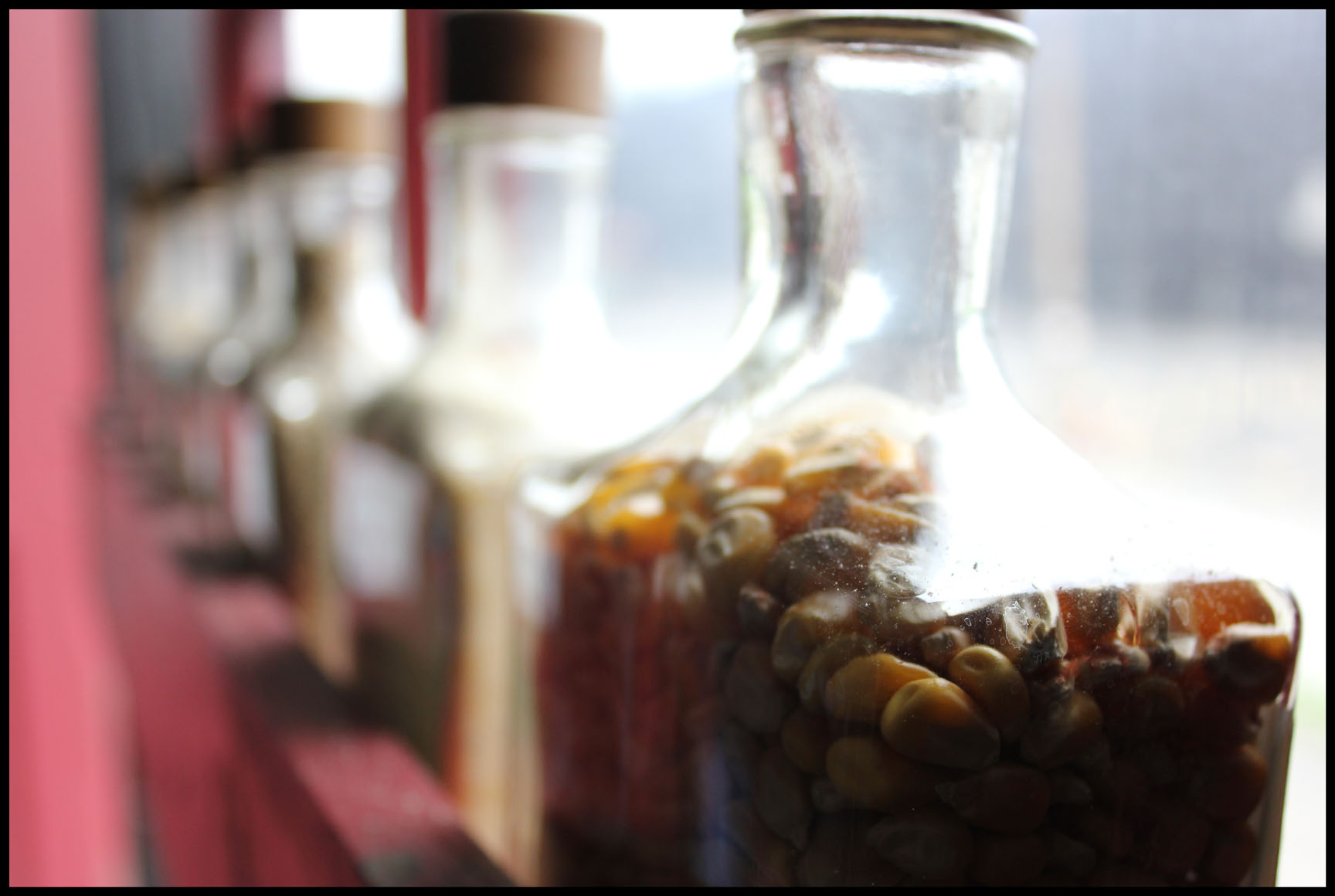
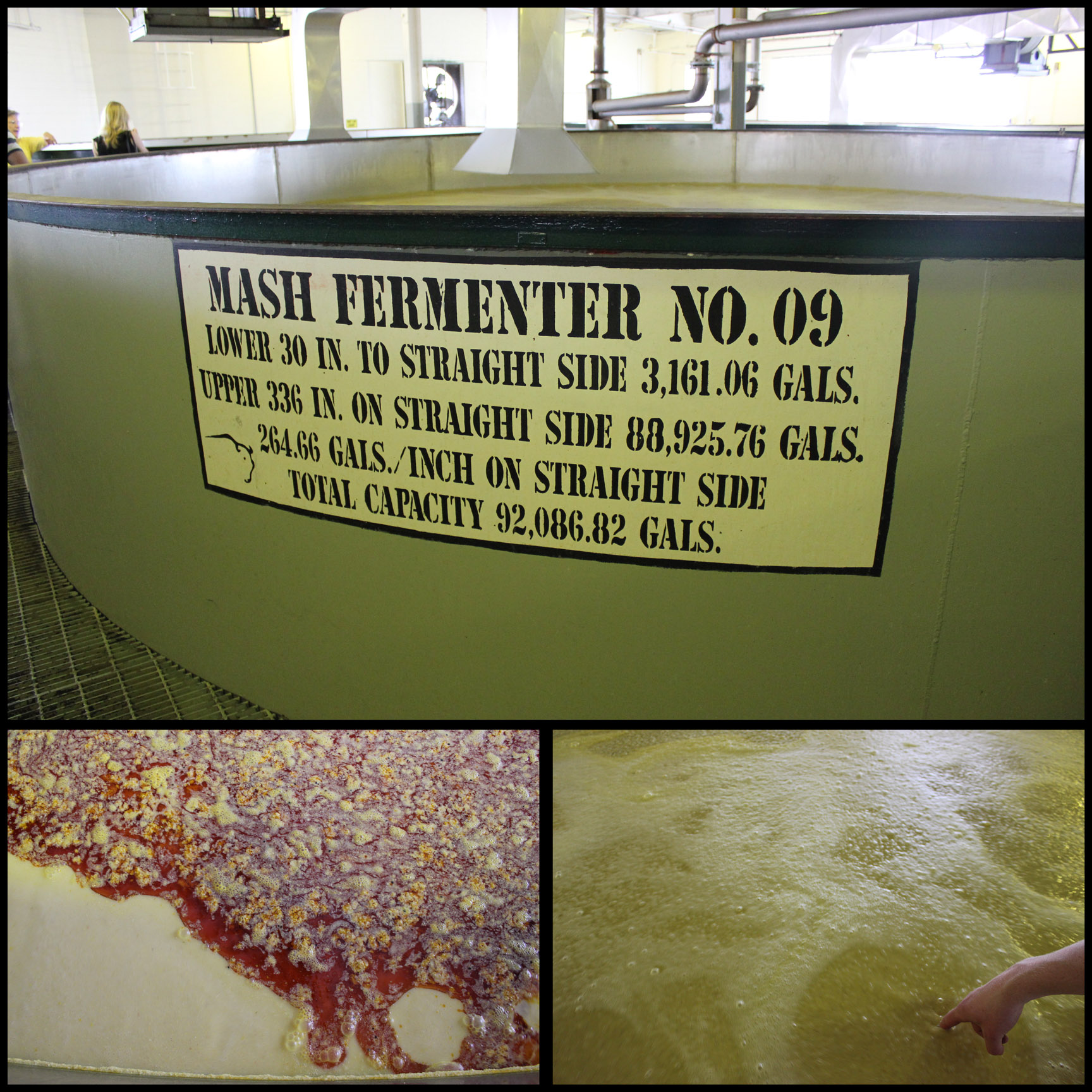
We were told that they use 78% corn and 11% each of rye and barley, but it may be 75/10/15 according to a strange little case off the factory floor (pictured above). I know it’s fermented in stainless steel, then it’s distilled via column to 138 proof before being trucked to Bardstown for barreling. And that is everything I know about production.

AGING:

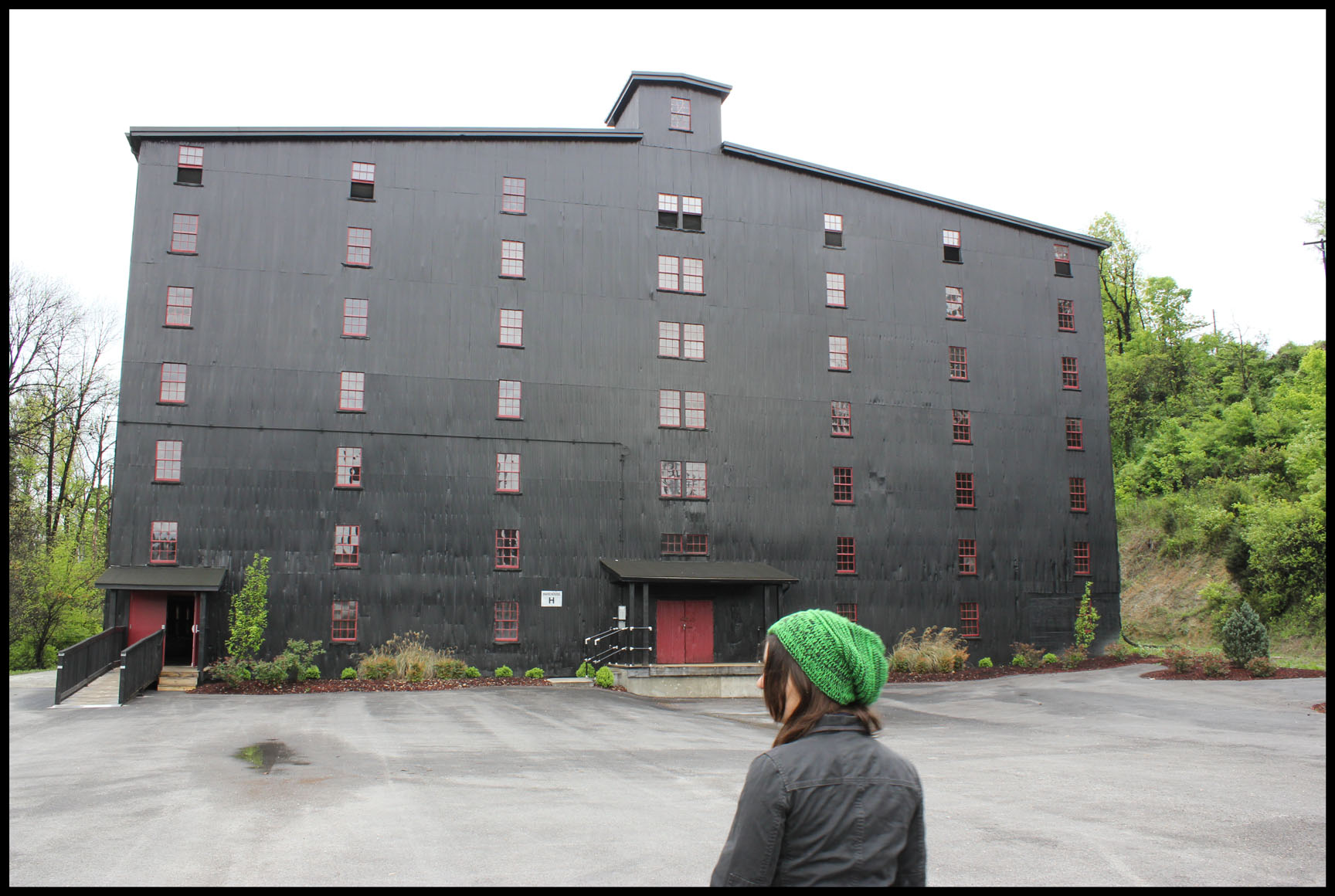
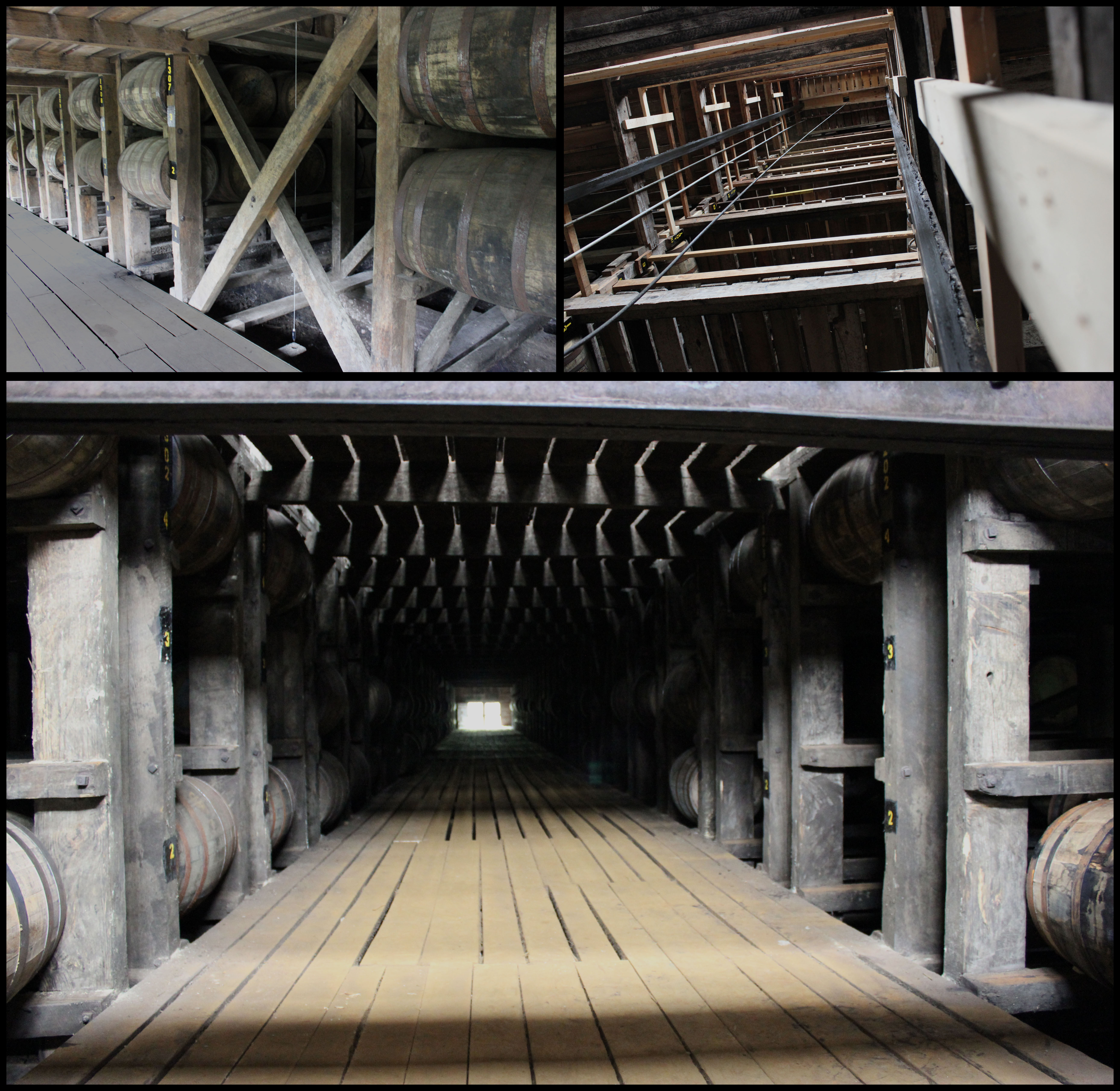
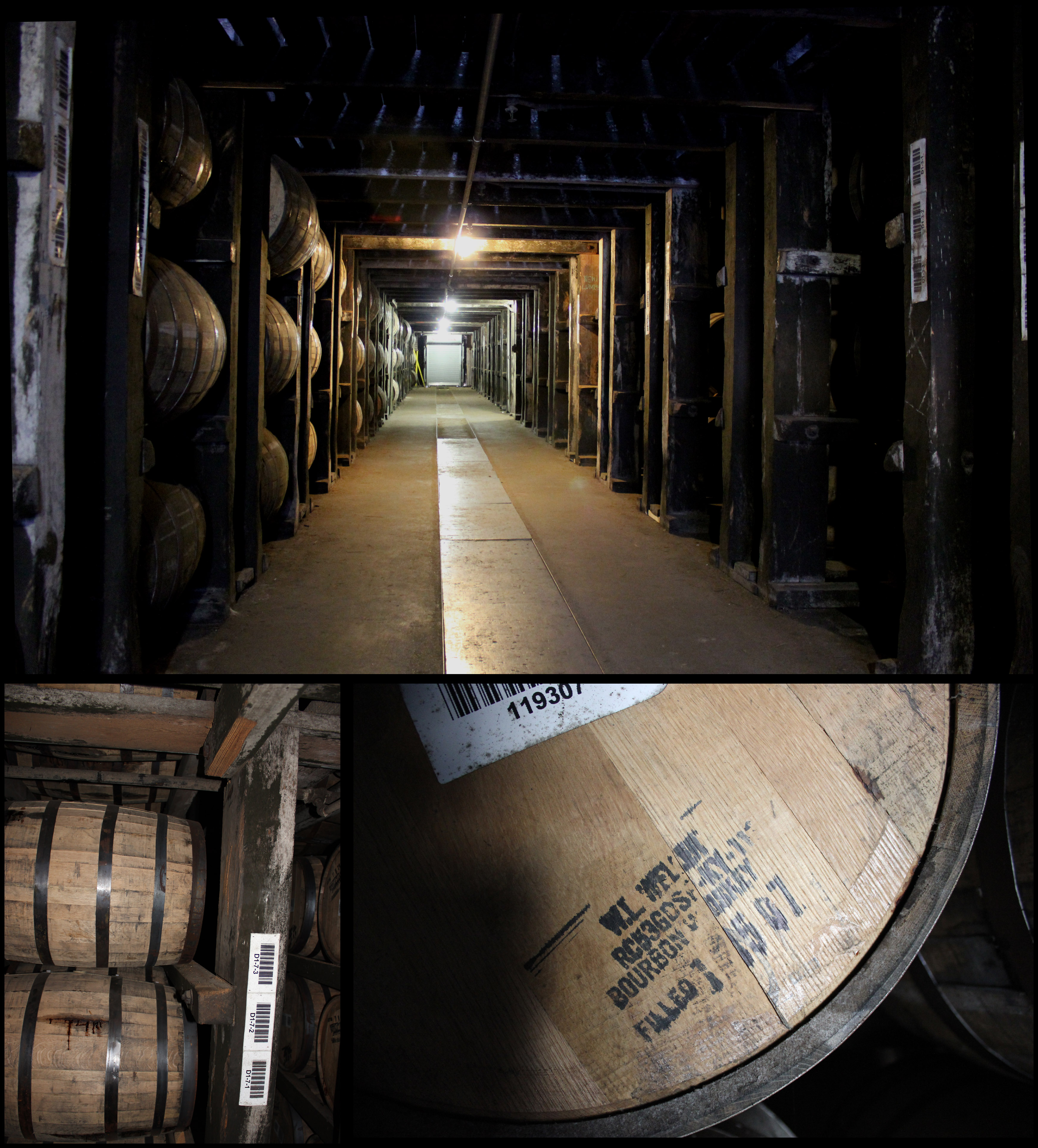
It may be “family owned,” but it’s not like the tour goes through someone’s kitchen. Heaven Hill is, in fact, the biggest distillery of the six we saw, and the second biggest in the state. They have a standing inventory of some 800,000 barrels and are distilling about 15 million gallons each year (or about 280,000 new barrels), which they keep in 49 aging warehouses that stand like monuments out on the open plains.

Notice how far apart they are? This is because fire is contagious.

BARRELING:

This was one cool thing we didn’t see anywhere else: how exactly does the whiskey get into barrel? Behold:

A giant series of tubes sucks the new spirit out of its holding tanks and impregnates the charred oak barrels with it, and then another machine taps the cork — or “bung” (seriously) — securely in. They filled 283,000 barrels in this manner last year, which is a whole lot of barrels. If these machines had been running 24 hours a day (they’re not), that would be more than one barrel every two minutes, nonstop for a year. Which, again, is a whole lot of barrels.

These giant tubes are a relatively new system — apparently, this room used to employ eight people, and the new machines have cut that to three. Our tour guide seemed strangely proud of this fact.

TESTING:
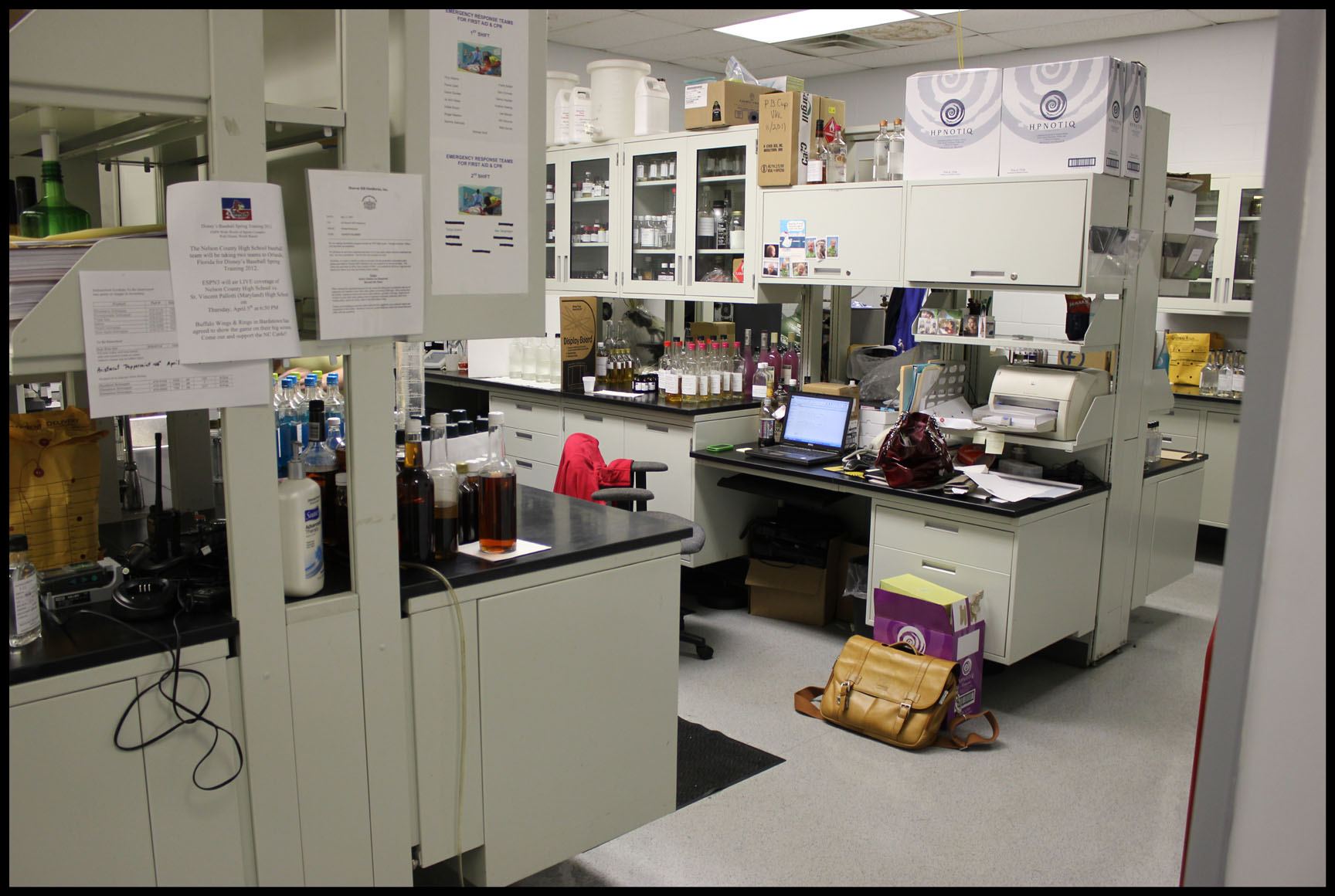
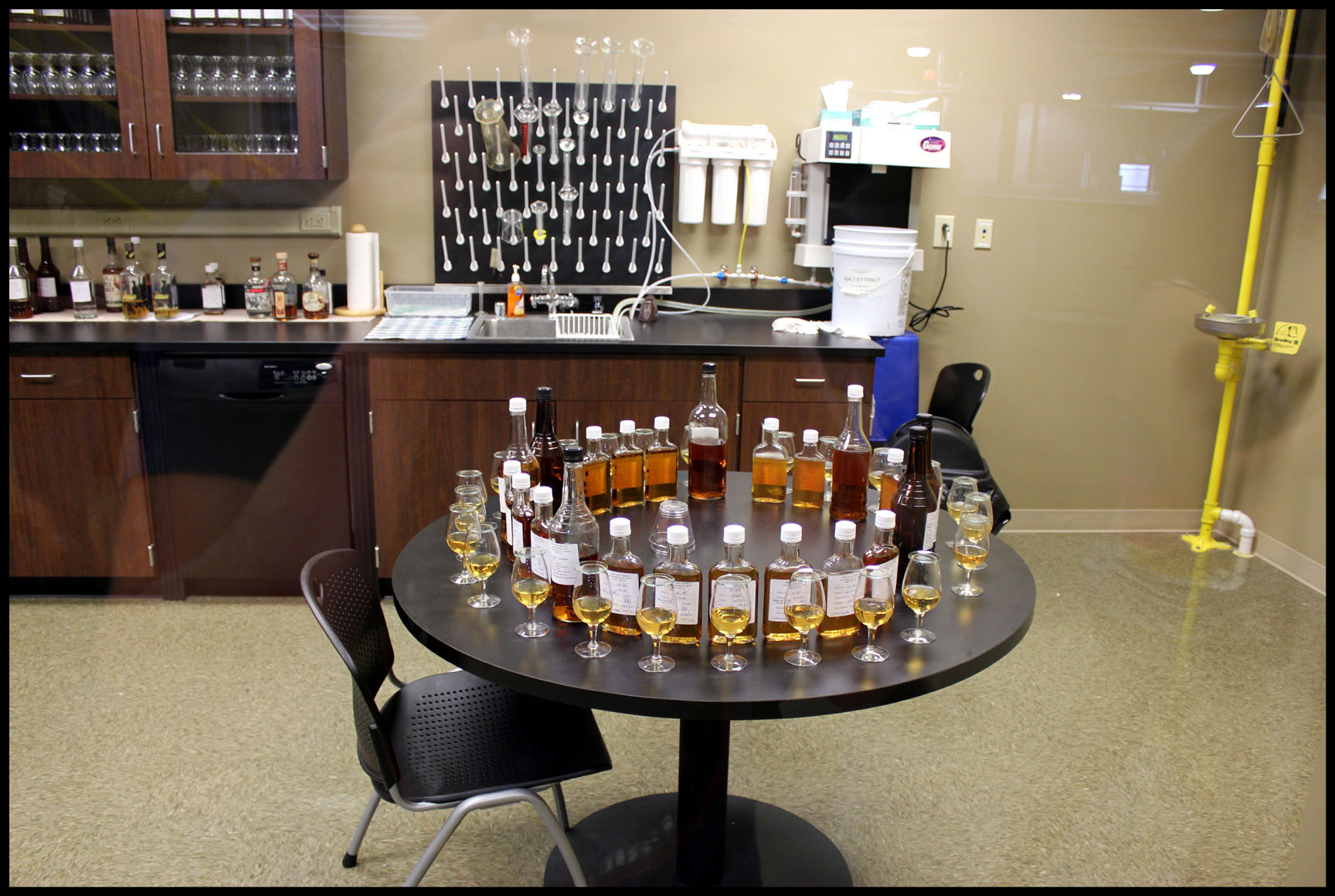
With such an expansive stock, they need to make sure nothing goes wrong. So they have a full-time laboratory on-site, where every single batch gets tested. Each batch (truck-full of barrels) is about 8000-9000 gallons, and before bottled, each one is rigorously tested for proof, chemical levels, etc. They answer directly to the Alcohol, Tobacco and Trade Bureau (TTB), which as it turns out is the ATF’s successor. The ATF doesn’t exist anymore. No more ATF. Huh.

LABELS:

We were taken to a  room the size of a high-school gymnasium and shown the label binders, where they keep master copies of every label for every size of every bottle they make. All 1400 of them. The actual labels to be fed into the hungry machines are stacked 15 feet high on row after row of industrial shelving.
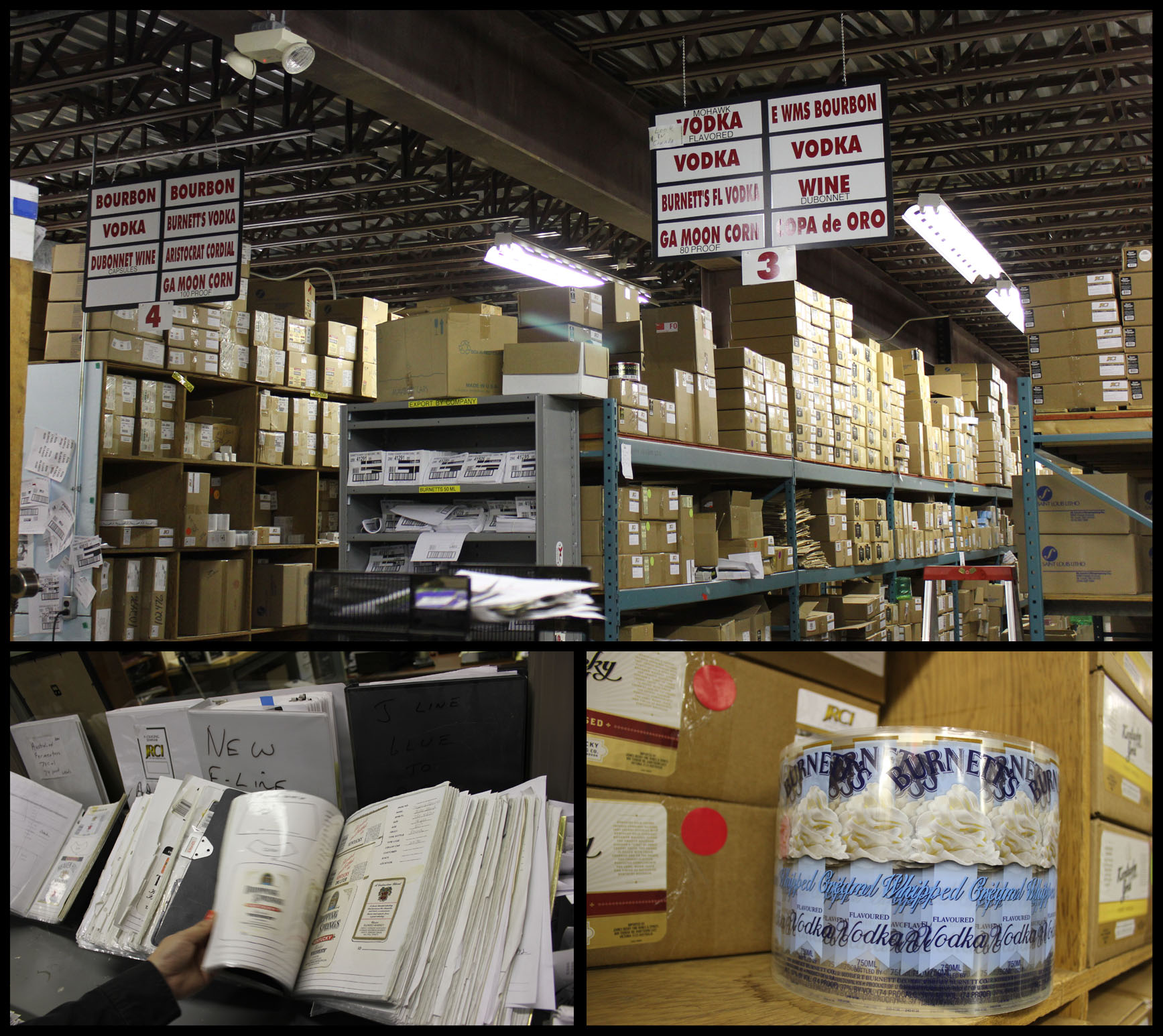
The label room is representative of the larger tour for three main reasons: (1) it had nothing whatsoever to do with what’s inside the bottle, (2) it’s a side of the whole business that we didn’t see anywhere else, and (3) it was oppressively fucking dull.

BOTTLING PLANT:

Their bottling operation is truly enormous. There is an entire capacious warehouse where they just make and store nips, the little 50ml airplane bottles. They were churning out pink-limonade flavored vodka ones while we were there. There are a series of 25-foot tall hydraulic claws to stack pallets, in a room designated just to deal with empty bottles waiting to be filled. On the belts, they’ve got high-speed digital cameras which quality-check the bottles for fullness, label straightness, etc, that can scan 400 bottles per minute for 12 different quality points, automatically discarding flawed ones. It is loud and busy and hopelessly complex, thousands of things going in all different directions of 3-dimensional space, and going there very quickly.

The overall impression is of an operation so big, no one could possibly know everything about it. We never did get to find out of that was true, because after more than an hour of our guide pointing proudly at machinery, it was time for a drink.

TASTING:

We tried two single barrel offerings, The Evan Williams 12 and the Elijah Craig 18. I will say this about Heaven Hill: for all their size and relative tedium, they can make a good whiskey.

  • The Evan Williams 12-year was recently inducted as one of now eight total spirits in F. Paul Pecault’s “Hall of Fame,” which is a not-insignificant honor. It is delicious — bright and almost fruity, very full bodied with oak and age mixing perfectly, and at $25 is a hell of a deal.
  • The Elijah Craig is a bit less complex, but it’s gift is age: there’s something distinctly inimitable about long-aged bourbon. It gets a full richness to the oak that can’t be simulated by aging in smaller barrels or under more extreme conditions, and the Elijah Craig 18 hits that note hard. That’s more or less all there is to it, actually… which is an overstatement, but not a big one. It’s been recently discontinued but is still around, and at $40/bottle, it’s the cheapest fix for lovers of old whiskey.
  • Rittenhouse Rye: we didn’t taste the Rittenhouse that day, but this is the only other product out of Heaven Hill that I have extensive experience with, and note it here because it is noteworthy. Rittenhouse is 100 proof, big and spicy, and at $20 is a steal. I personally don’t like to sip it, but it’s my go-to for Manhattans, even compared to bottles three times its price. A marvelous cocktail rye.

The Bourbon Trail (5 of 6): Maker’s Mark

Note: For brevity’s sake, I’m going to breeze over some of the finer points of distillation, as I’ve already written about them in part 1. For a more thorough breakdown of the bourbon process from grain to bottle, click here, or just type your question in the comments.

The Facts:

Distillery: Maker’s Mark
Location: Loretto, Kentucky
Owned By: Beam, Inc. (formerly Fortune Brands), since 2005
Major Products produced: Maker’s Mark; Maker’s 46.
Origin: Since 1954

The Tour:

The Maker’s Mark distillery sits in Loretto, Kentucky, a town generously described as “remote,” which means that there’s a 30-minute layer of Nothing insulating it on every direction. While Bardstown and Frankfort aren’t exactly cosmopolitan, one could at least find, say, a cup of coffee at noon on a Wednesday.  Not so much in Loretto, population 662. Loretto’s the kind of place you have to pack for.

All the same, Maker’s Mark is a tremendously popular destination, and practically a necessity for anyone on a serious bourbon pilgrimage. I don’t have any special fondness for their bourbon, but we decided early that we had to go, for two reasons: (1) they have been singularly successful in carving out a status as a “premium” spirit, and it’s equally interesting and informative to see how they represent themselves, and (2) it’s big, and people call for it, and as a professional I want to know how it’s made.

On paper, they draw a number of comparisons with Woodford Reserve. Both put out essentially one product (both with one barrel finished product newly debuted), both ferment in cypress wood tanks instead of stainless steel, both are relatively small and yet both are owned by titanic corporations. Both have a similar price point and are direct competitors with one another. And yet everything about them, from the tour to the bourbon itself, couldn’t be more different. While Woodford keeps the cold sterility of a museum, Maker’s Mark affects a manufactured charm, a bit gaudy in it’s quaintness, and as such reminds one of some kind of Bourbon Disneyland.

That being said, the tour was one of the best we had, in part because we had a kickass tour guide, and in part because as it turns out, Maker’s Mark isn’t just a pretty face. While it may not be my personal taste, no one could say it’s not well made. If for no other reason, I’m glad I went because I left considerably more impressed with their product than I was when I arrived.

MASH:

Maker’s is a “wheated” bourbon. To explain: pretty much all bourbon will have 3 grains — corn, a bit of malted barley, and a third, “flavoring” grain. Most distillers will use rye for its drying spice, but a few (W.L. Weller, Old Fitzgerald, the whole Van Winkle line, and Maker’s Mark) use the smoother, sweeter wheat, yielding a smoother, sweeter product. Personally, I feel like the lack of spice makes Maker’s Mark a bit flat, but for people who think that smoothness equals quality (and have only had Jim Beam), it must taste like deliverance.

In any event, the good people at Maker’s Mark are more than happy to tell you their mashbill: 70% corn, 16% winter wheat, 14% barley. While most distilleries grind these into a fine powder with a hammer mill, Maker’s uses something called a roller mill, which grinds to a coarser grain, the type usually used by breweries rather than distilleries. This is more difficult to extract the sugars, but they believe not pulverizing the grain yields a smoother product.

They cook the corn at boiling temperatures, then lower the heat to 160° and add the wheat, then lower again to 150° before adding the barley. All told, cooking takes about 3 hours before it’s shipped off to the fermentation tanks.

FERMENTATION:

They ferment their thick cereal mash to 10% ABV over about 3 days. They too roll with a handsome set of six cypress wood tanks, cypress used for its inert, water resistant grains. These tanks are relatively small, about 9600 gallons — again surprising me by actually earning the “artisan” title their marketing department tries so hard to claim.

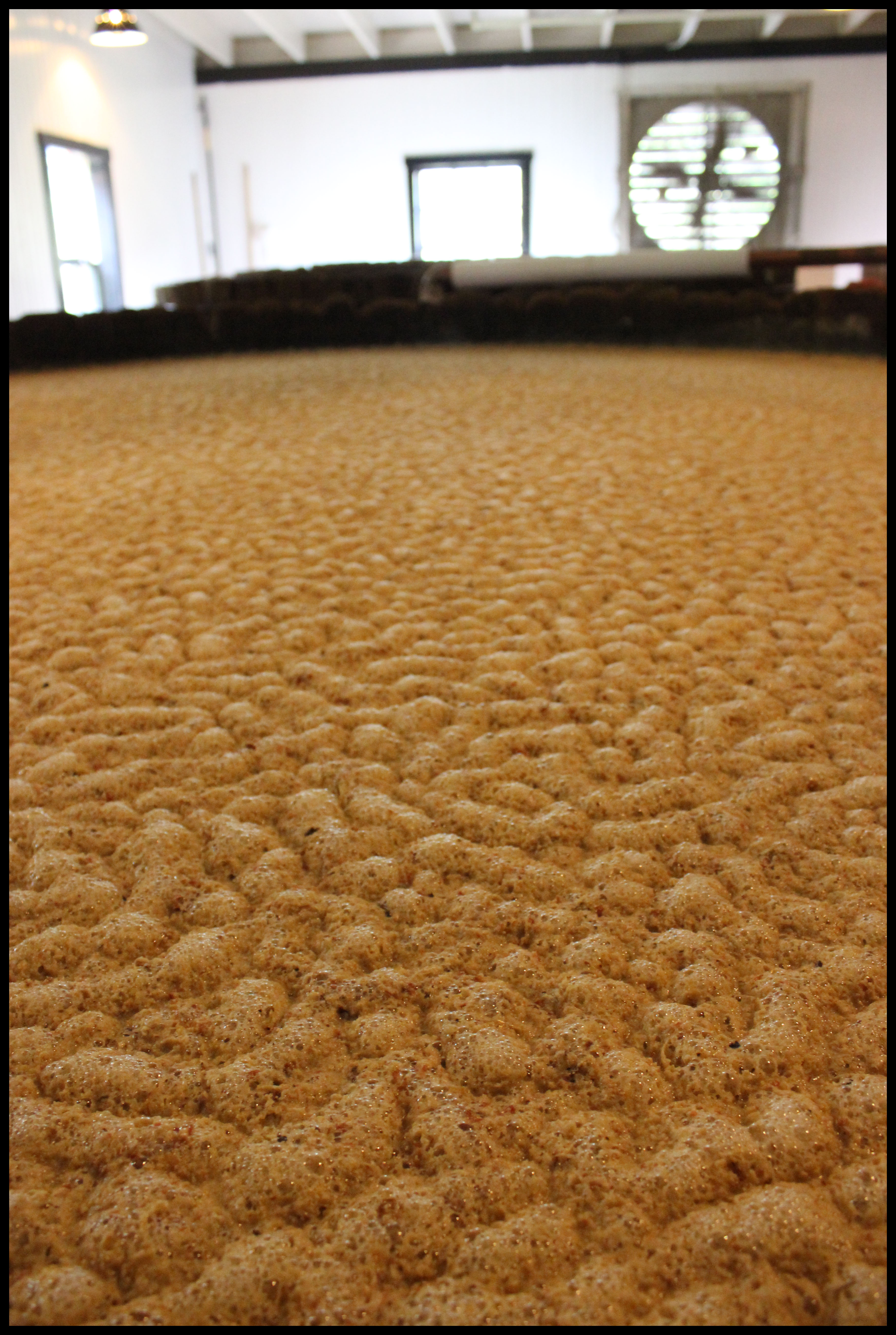
In close detail, not only does it look like a living cerebal cortex (which is awesome), but you can actually see the coarse grains percolating in the foam. Obviously you can’t tell in still frame, but the surface is constantly teeming and crawling while the yeast works its beautiful magic.

DISTILLATION:

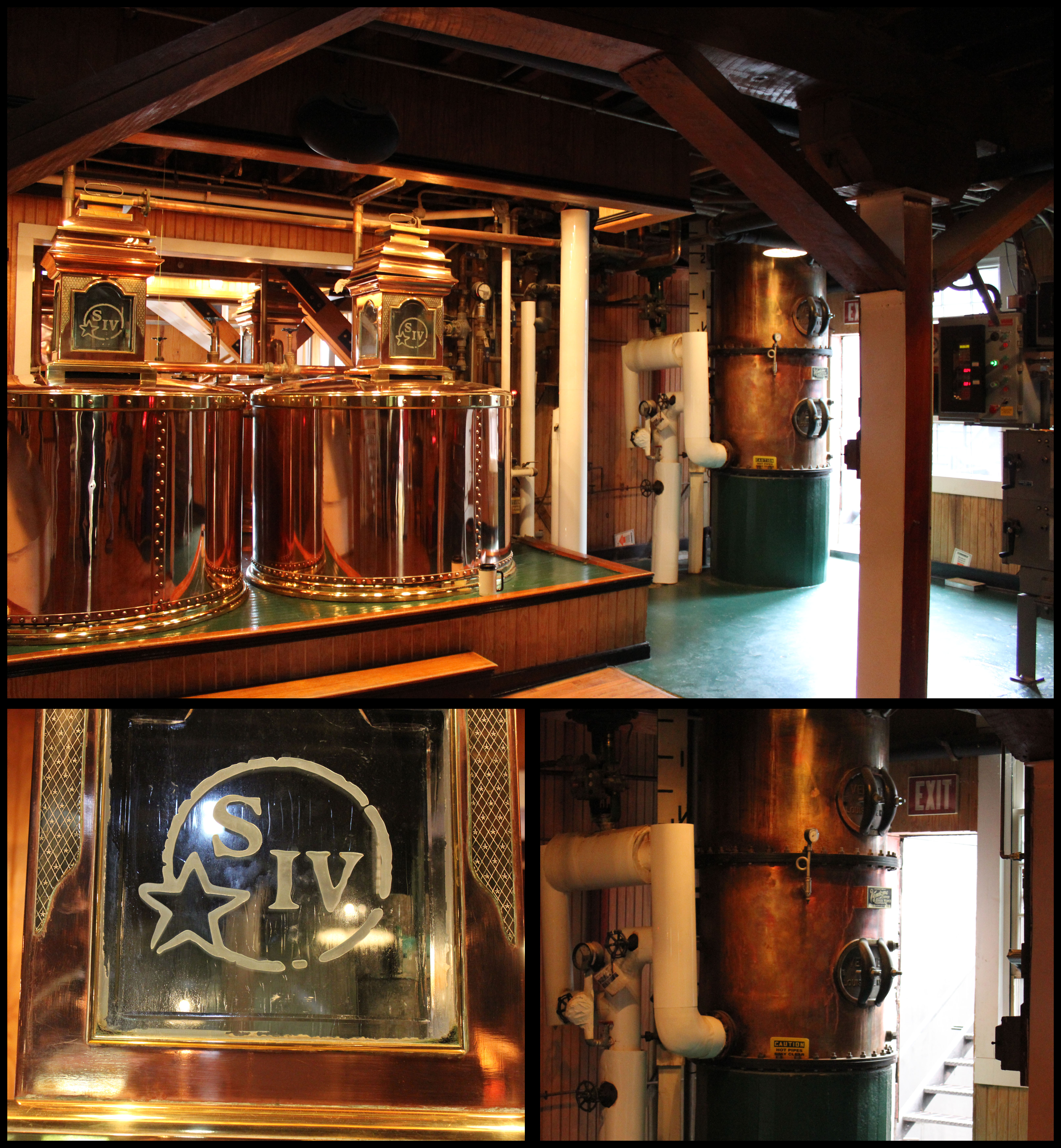
Pretty much everything happens under one smallish roof, and the distillation room doubles as the foyer of what feels like a gilded bourbon cabin. From their 10% distiller’s beer, they first pump it through a copper column still up to 120 proof, then into a pot “doubler”  still to 130 proof, which is, in terms of proof, on the medium-low side. To their credit, they don’t distill as high as they are legally allowed (159 proof), missing an opportunity for smoothness but keeping more flavor instead.

Lower left, the maker’s mark of Maker’s Mark: S for Samuels, the last name of the founder Bill Samuels Sr., and IV for being the 4th generation to distill whiskey.

Their spirit safe (where the whiskey is held) is a couple of large copper tubs. They’ll get about 1000 gallons of alcohol out of each fermentation tank, which they water down to 110 proof (also lower than the legal maximum of 125, for reasons that were never explained) and rolled into the aging warehouses.

AGING:

We were hungry, and didn’t care to see our 5th aging warehouse in something like 28 hours, mostly because they all look exactly the same. They have 26 warehouses. Enough said.

To not be robbed of the chance to genuflect at wooden circles, we were shown to a barrel full of staves (below), in order to illustrate the story of Maker’s 46. Both products, apparently, start exactly the same. Both are aged in a heavily charred barrel (#3 char) for at least 5 years and 9 months, at which point they’re tasted for the first time. The late bloomers might need as long as 9 years, and if a whiskey is aging too slowly, or too quickly for that matter, they’ll shuffle barrels around on different floors, a process that happens once every three years. Once it’s ready — if it’s going to be Maker’s Mark — that’s it. It’s batched and bottled.

Maker’s 46 takes a slightly more circuitous path to bottle. The mature whiskey is kept in the barrel, to which are added are 10 barrel staves of new, seared French oak.  It gets an extra 2.5 to 3 months of what’s called “finishing” like this before bottling.

As for the name. It does not, as I had previously believed, refer to the alcohol percentage, as Maker’s 46 is actually 47% alcohol. The number 46 refers to the 46th page of the experiment notebook, where they finally figured out how to get the flavor they were after. A ha.

BOTTLING:

The bottling line is like a relief sculpture: one long, linear process with a worn groove on the floor denoting the path for their 100,000 yearly visitors. It’s mostly women on the line, with the expressionless efficiency of workers who’ve long ago accepted that getting photographed by total strangers, once an hour, every single fucking day, is just another annoying thing about their job.

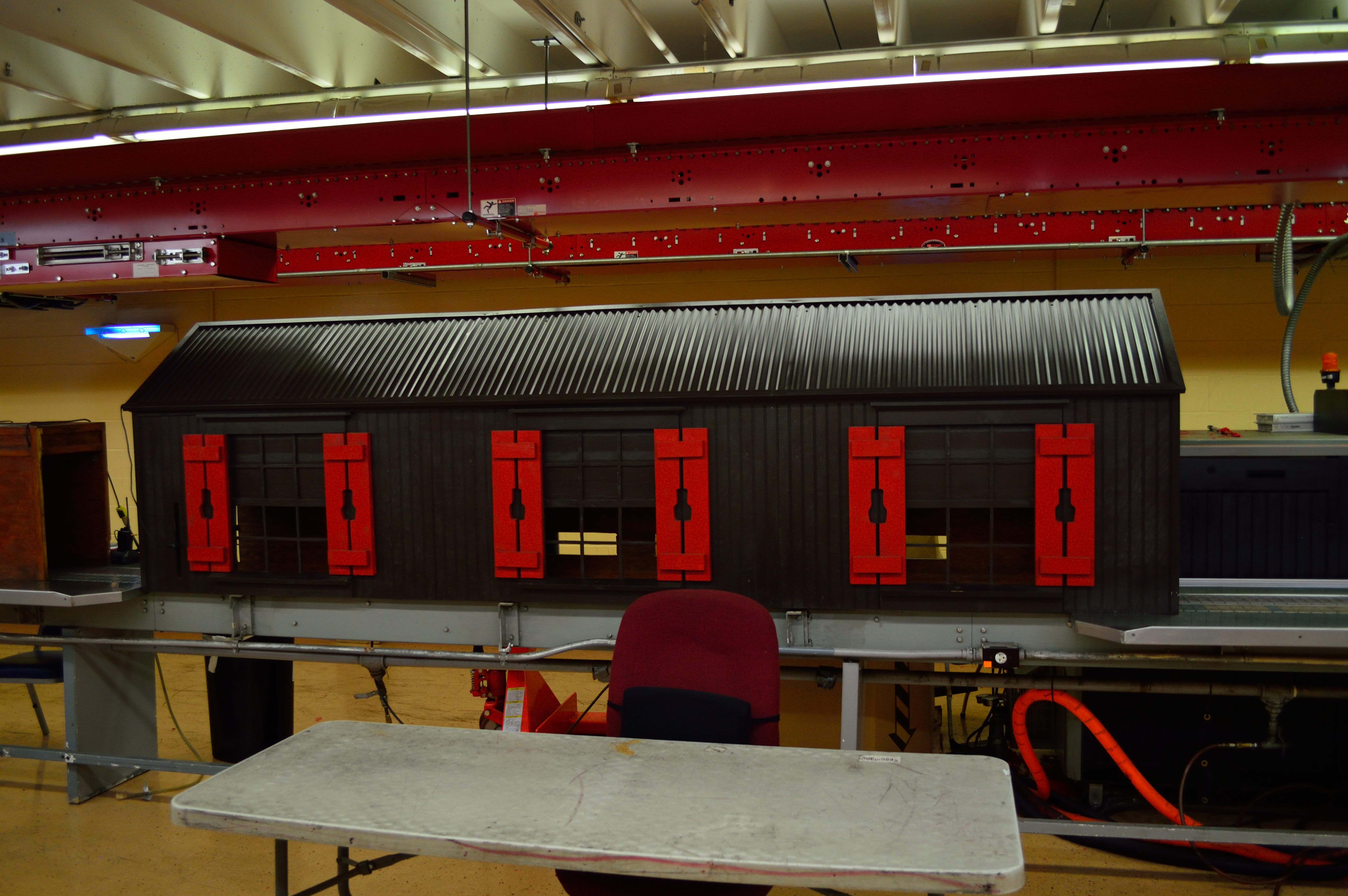
As for the famous wax, every bottle really is hand dipped. They dip, then twist, then put back on the line as the wax drips down. The bottles are then immediately conveyed just past dipper #2, out of frame left, into a little enclosure that looks like an expensive doll house, a cooling hut where the wax solidifies. I have no excuse for missing a picture of this. Forgive me.

EDIT 8/8/12: The talented Alex Scott just did the tour and sent me a picture of the cooling hut. Thanks!:

OVERALL:

Like I said, Maker’s Mark has never been my taste. I’m not against wheated bourbons, it’s just something about Maker’s in particular that tastes flat to me. Its got spice on the nose but the taste is sweet smoothness, a hint of caramel and butterscotch, and not a terribly long finish.

I was however pleasantly surprised by the Maker’s 46; it’s their first new product in 50 years and you can tell why they chose it. Apparently, Rob Samuels had an idea of how he wanted his new product to go, and tried a bunch of things until it hit. The barrel staves introduce much more spice and color; the nose is all butterscotch and that’s confirmed in taste along with some of that missing spice and some interesting heat before moving back into that familiar sweetness. More oak means more spice but also more sweetness, and it does risk being too sweet… but all the same, I’d take Maker’s 46 over Maker’s Mark 9 times out of 10.

The Bourbon Trail (4 of 6): Barton 1792

Note: For brevity’s sake, I’m going to breeze over some of the finer points of distillation, as I’ve already written about them in part 1. For a more thorough breakdown of the bourbon process from grain to bottle, click here, or just type your question in the comments.

The Facts:

Distillery: Barton 1792
Location: Bardstown, Kentucky
Owned By: Sazerac, since 2009
Major Products produced: Very Old Barton; 1792 Ridgemont Reserve
Origin: Since 1879; current factory rebuilt in 1946; rechristened Barton 1792 in 2009.

The Tour:

Our loose itenerary called for three distilleries per day. This seems modest in theory, but is actually a bit manic in practice considering  that (1) most only run tours on the hour, (2) they keep the hours of a credit union, and (3) that these places are spread thin across the sprawling Kentucky farmscape. Our second day was to begin at the Barton 1792 distillery in Bardstown, and penciled in next to the schedule is a note: “motivation permitting.”

This shrug is exactly how I felt about Barton 1792 going in. Their products aren’t particularly celebrated or even carried by many. I know Very Old Barton is a bourbon and I remember I think once trying the 1792, but I personally had little experience or connection with anything they do. We ended up going because of this last point — the less I know going in, the more likely that I’ll learn something. This proved true in an unexpected way: the tour itself was fairly useless, but as it turns out, the 1792 Ridgemont Reserve bourbon is pretty damn good.

The useless of the tour wasn’t our guide’s fault, not that he really helped at all. Most distilleries shut down for about two months in the summer, when temperatures get too hot for efficient fermentation. Sazerac bought the distillery in 2009 — “for our warehouse space,” our tour guide grumbled — and the suits down in New Orleans decreed that they would shut down for the summer a bit early. Which apparently, this year, meant late March.

So by the time we got there, they had already been shut down for two weeks. No sights, no smells, everything dark and gray, our footsteps echoing in places where just last month we’d have to shout to be heard. And it was rainy and overcast and generally unpleasant, a sensation enhanced by the bitterness of our tour guide, who spoke of Sazerac a little like the way Ukrainians speak of Stalin. All the same, we did learn how the bourbon is made, and after tasting it, that information became dramatically more interesting.

MASH:

Like the others, they wouldn’t tell us the mashbill. He did say, however, that they’ll go through about 300,000 lbs of corn, 70,000 of rye and 30,000 of barley (in proportion is 75% corn, 17.5% rye, and 7.5% barley) which makes sense: 17.5% is a relatively high percentage of rye, which comes through in the taste.

But they also cook it differently; after milling (up to 400lbs/minute in hammer mills), most people cook the corn first and for longer, but Barton 1792 cook the rye and corn together, at 200° for about 9 minutes, before bringing it down to 186° and adding the barley malt. This means that there’s no special emphasis on the corn sugars, and where one would usually get a chord of caramel and corn flavors in the front palate, 1792 is tempered at the gate by the rye.

Also interesting is that while most people add the sour mash to the fermenters, the Barton folks add a whole bunch of it (up to 20%, or roughly 10x more than Buffalo Trace) to the mash as it cooks. In addition to catalyzing fermentation and ensuring regularity, the sour mash ensures against too much sweetness, and part of 1792’s intriguing character comes from this decision.

FERMENTATION:

At their peak, the’ll run all 18 of their 50,000 gallon stainless steel fermenters/week. It’s a 3-5 day fermentation up to about 9 or 10%.

I have nothing else for this; we didn’t see them, because they’re currently big empty drums.

DISTILLATION:

Their column still is 6′ around and 50′ tall, steel lined with copper. Of the 50,000 gallons of distiller’s beer, they’ll get about 10,000g of proof whiskey, which they double distill to a pot-ish still that everyone down there calls a “doubler” up to 135 proof, before watering down to 125 and putting into barrel.

AGING:

They keep 28 aging warehouses, holding 20,000 barrels each for more than 460,000 barrel capacity. Which is, if you’re wondering about relative size, a fuckload of barrels, as they’re the 3rd largest producer of bourbon whiskey in the state.

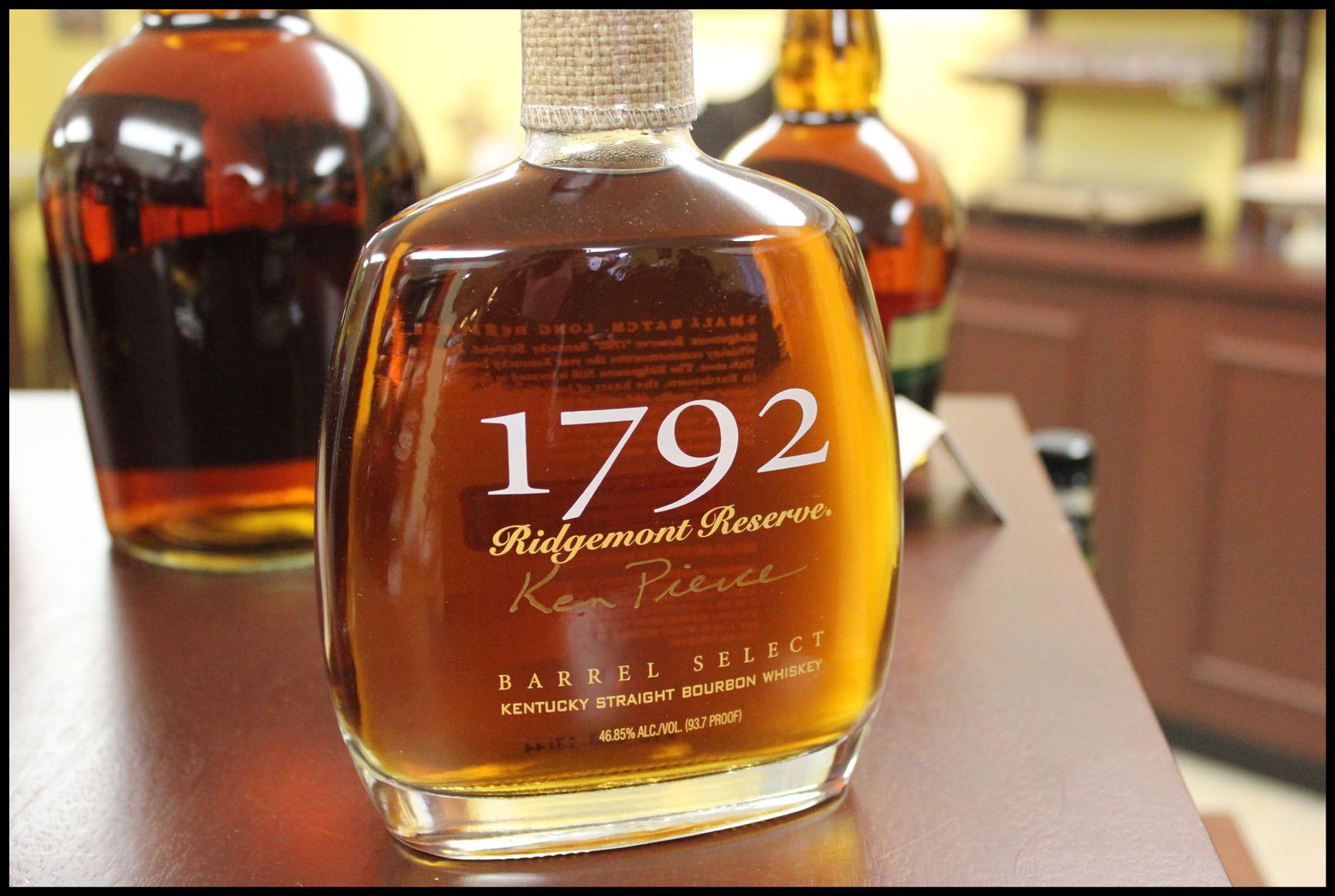
All bourbon barrels have to be new, charred oak, but the level of char is up to the distiller. Light to heavy is ranked from 0-4, which all seems a little abstract but for the helpful display case in the warehouse (right).  Barton’s new oak barrels get a 3.5 (or very heavy) char, before getting filled and sent to the warehouses for detention. The 1792 Ridgemont Reserve will stay in warehouse Z (their best warehouse, or so they say) for at least 8 years before being small batched with maybe 100 other barrels, then bottled at 93.7 proof.

Note: see the string hanging between the beams in the upper left picture? It’s to make sure the building doesn’t fall down. A full barrel is about 500lbs, so these old wooden buildings have to support up to 10 million pounds of cargo. These weighted strings are the canaries in the coal mine, placed strategically to show warehouse managers if the building is tilting too much to one side.

OVERALL:

The distillery itself is large and engaging. They run their own coal-fired power plant on site, and all the buildings are a unadorned dark red brick, evoking the late-40s, postwar determination to quit messing around and get back to work. They make bourbon there, but run a massive bottling plant of more than 300 different brands, with modern conveyor belts whipping a galaxy of fifth-tier labels I’ve never heard of into bottles into cases into pallets.

It’s an often-overlooked distillery and is worth the stop, though I’d highly recommend going when they’re in production. It’s the only distillery we visited that wasn’t making bourbon at the time, and I can’t help but wonder how much more we would’ve gotten out of it.

TASTING:

The 1792 Ridgemont Reserve has all the trappings of a gimmick. 1792 is the year Kentucky became a state, and predates any distilling on that site by almost 90 years. Additionally, it was originally 1792 Ridgeford Reserve, but they were sued by Woodford Reserve, and not without cause. It’s like how Captain Morgan’s Rum gets popular, then all of a sudden pops up a low class rival called Admiral Nelson – we’ve been trained as consumers to appraise these posers as low-rent horseshit and move on, so imagine my surprise when tasting 1792 Ridgemont Reserve to find that it was delicious.

The nose is incredible, full oak and very balanced rye. Drinking leads to slight burn, oak, and a mighty rye note that persists throughout the entire experience, with an extremely dry finish and lingering cinnamon and woody notes. It’s not the best bourbon I’ve ever had, but it’s a solid entry (particularly for the price) and has earned a semi-permanent place on my shelves.

The Bourbon Trail (3 of 6): Wild Turkey

Note: For brevity’s sake, I’m going to breeze over some of the finer points of distillation, as I’ve already written about them in part 1. For a more thorough breakdown of the bourbon process from grain to bottle, click here, or just type your question in the comments.

The Facts:

Distillery: Wild Turkey Distillery
Location: Lawrenceburg, Kentucky
Owned By: Gruppo Campari, since 2009
Major Products produced: Wild Turkey 101, Wild Turkey Kentucky Spirit, Wild Turkey Rare Breed, etc.; Russel’s Reserve
Origin: Since 1869; rechristened Wild Turkey in 1940.

The Tour:

The Wild Turkey distillery sits — or at least used to sit — up on Wild Turkey Hill, overlooking a 19th century railroad bridge about 18 miles upriver from Frankfort. The old distillery has been demolished, the site is bare now but for turned dirt and a few enormous aging warehouses. It’s a beautiful view and the tour still goes up there, but first, we bourbon pilgrims are loaded onto a small bus from the visitor’s center and taken a couple minutes up the road to the monstrous new distillery, gleaming stark and treeless in the afternoon sun.

The new facilities are one year old, and are a prayer to the gods of efficiency. Everything is clean and new and sparsely populated. Where the others generally had some blend of softened aesthetics and age-seasoned brick, Wild Turkey is produced in what is essentially a giant concrete cube. It’s industrial minimalism at its most logical: they make a product there, they make a lot of it and they make it well. It’s as if they’re saying that the bourbon doesn’t taste any better if the walls are covered in old photographs, so who gives a shit?

Strangely absent were not just personal touches but almost any people at all. We asked our tour guide about this, and she told us that the entire massive operation, churning out up to 11 million gallons of bourbon annually (about 30,000 gallons/day), is run chiefly by three people in a control room. It’s a triumph of mechanical industry and a powerfully impersonal experience, and while it again doesn’t speak to the final taste at all, we kind of felt like we were touring a bumper factory.

I am aware that asking a factory to be charming is like asking a child to be wise. It’s a self-consciously absurd disappointment, and I should underline, for the record, that the bourbon isn’t any better or worse because the building was built in the current century.

MASH:

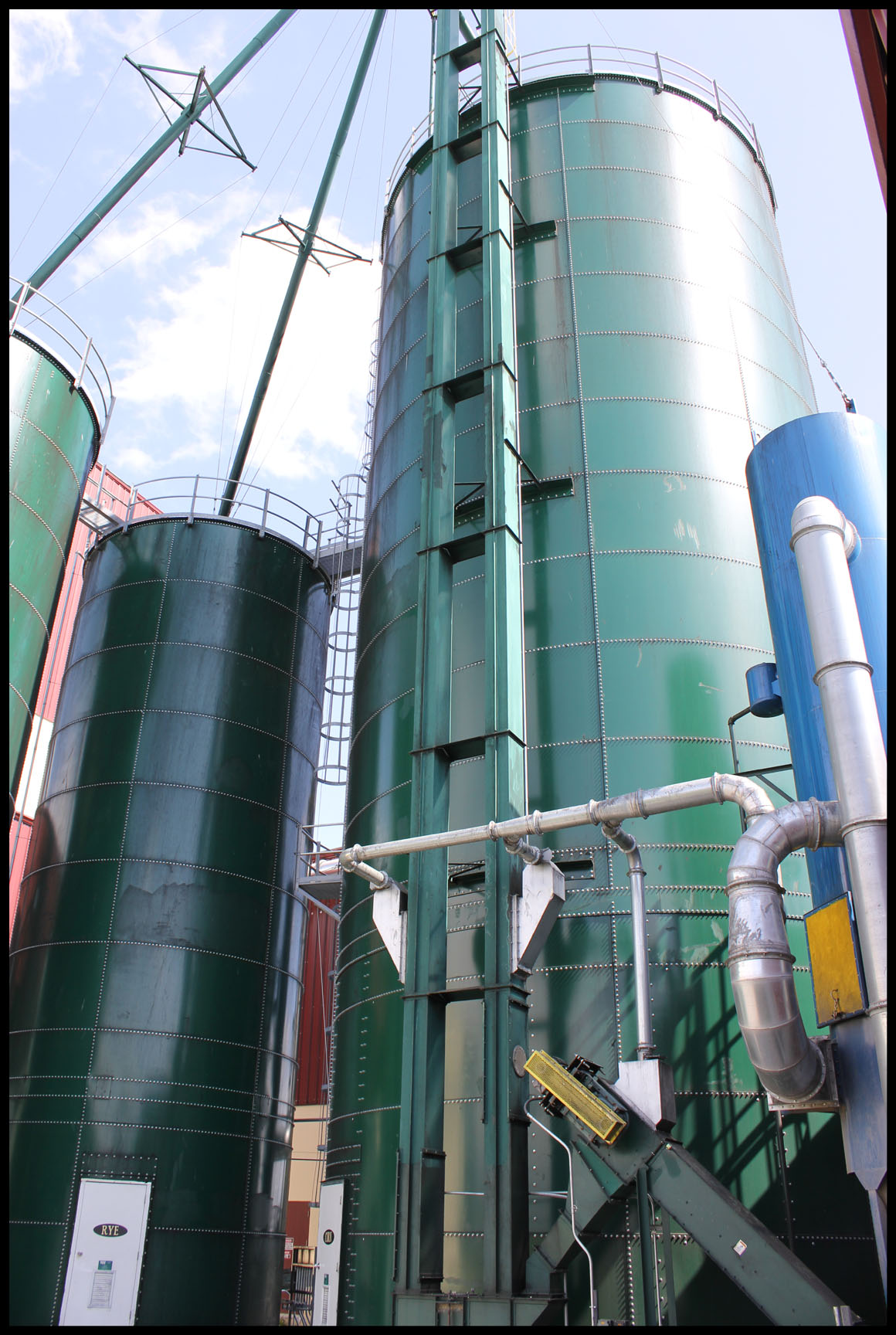
They use local Kentucky corn, German rye and Dakota/Montana/Minnesota barley, and excess grain is stored in the towering silos out front. Like most of the others, the exact mashbill is a secret, but they would tell us that all of the five bourbons coming out of the distillery use the same recipe. In other words, it’s all the exact same product coming out of the still; whether it ends its journey as Wild Turkey 101 or Wild Turkey Rare Breed (or whatever) depends on where and how it’s aged.

Alongside the mash room is our first tour stop, a little screening room where we learn how the bourbon is made. Jimmy Russel is the face of Wild Turkey and has been with the company for 58 years, but his son Eddie is now the master distiller and controls the day-to-day, taking us through essentially the whole process in a 7 minute DVD. Eddie Russel is visibly uncomfortable in front of a camera and it makes it all feel a little homemade, which is a nice touch. Their video is a little more suave than the one at Buffalo Trace, but then, so’s a middle-school talent show.

FERMENTATION:

The Wild Turkey fermentation room is a capatious expanse of steel tubs, tubes, and grates. They keep twenty-three 30,000 gallon fermentation tanks, and each at a different stage of operation guarantees that while it may look like nondescript, the smell betrays what’s being made there.

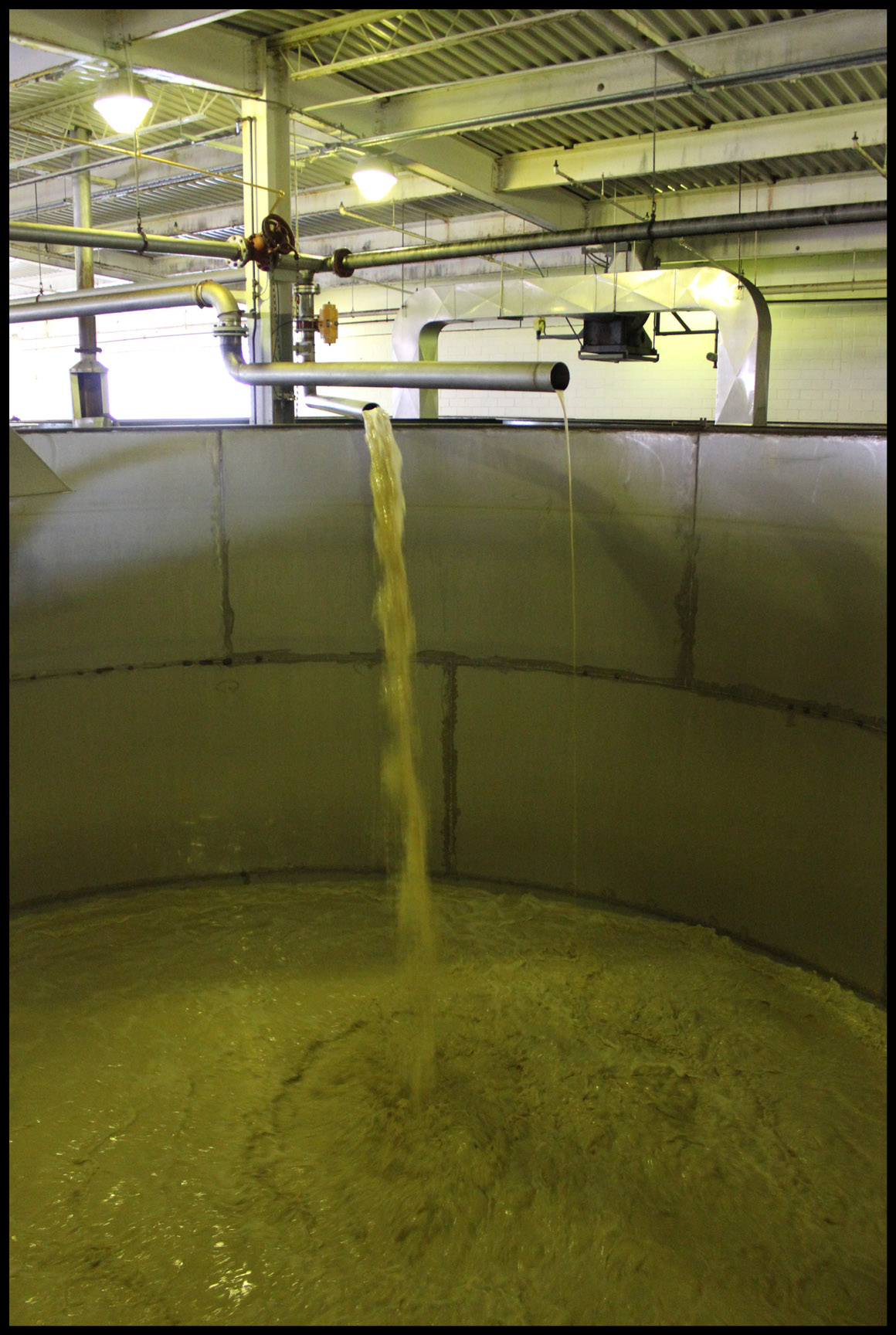
As with the others, the 3 day sour-mash fermentation process brings it up to about 9% alcohol. I don’t know if  it’s unique or if the others just didn’t mention it, but one of the features of their fermentation tanks are little boat propellers at the bottom, so the distiller’s beer can be mixed  automatically before being drained automatically into distillation.

DISTILLATION:

All of their equipment is kept in a dark room behind thick glass, but you can still see that their 45′ still is made of copper. This is a traditional choice and a better one than stainless steel, for some metaphysical reason most people embrace but can’t explain. Those who can explain it say that copper catalyzes the breakdown of bad flavors and sulpheric compounds in a way that steel doesn’t. Specifically, copper reacts with the naturally occurring sulfuric compounds to create copper sulfate, which precipitates (turns solid) and therefore doesn’t end up in your bottle.

And if that’s more than you need to know, just know that copper, when available, is the tradition everywhere distillation is practiced.

Anyway. The column brings the spirit up to 115 proof, and it is pumped to a “doubler” pot still that brings it up to a modest 130. Woodford Reserve by contrast brings their spirit all the way up to 158 and then dilutes it back down for aging, but Wild Turkey keeps it low, they say, to retain more of the flavor. They only need to add a touch of water to get it down to 125, at which point they pour it in barrels and send it to age.

AGING:

Wild Turkey keeps 20 aging warehouses scattered about their grounds, each with a 20,000 barrel capacity (for400,000 barrels, or roughly 20,000,000 gallons of bourbon — you’re welcome). They’ll rotate the barrels from floor to floor as required, if some are aging too slowly, and taste every year to make sure the wood and heat are doing God’s work.

Wild Turkey 101 used to be all an 8 year old product, but now I’m told it’s a batch of 4, 6, and 8 year products.

BATCHING & BOTTLING:

If you take an identical spirit and put it in seemingly identical wood barrels, and put those barrels at different spots even on the same floor of the warehouse, after 6 years they can taste vastly different. Air flow in the warehouse, exact temperature and evaporation, density of wood grains and leakage can all change the flavor of the bourbon inside. So in order to keep the flavor of Wild Turkey 101 the same every single time, they’ll batch as many barrels as they need to.

This is achieved by the master distiller and a team of professional bourbon drinkers, which sounds at once like a great and terrible job. Although this looks like a pretty cool room in which to work.

OVERALL:

Honestly, I wasn’t too excited for Wild Turkey. I’ve always viewed it as a solid but ultimately unexceptional bourbon, and the tour itself did little to dispel that opinion. The tasting, though, was another story. I realized in the tasting room that I’d never really examined Wild Turkey 101, and as it turns out I liked it quite a bit more than I thought I did.

It comes first with a sweet cereal and caramel blast which the high-rye content almost immediately dries out. The finish tingles, probably from the rye but also a lingering alcohol burn that I find just a little bit unpleasant. It’s a huge bourbon that the rye prevents from being rich… my main complaint is the same as that of Bulleit, which is that it’s a bit jagged for my taste. A bit hot in the sweetness and in the finish, and it just kind of feels rough around the edges. But when you consider that it’s only a $20 bottle, it all becomes quite a bit better.

The Bourbon Trail (2 of 6): Woodford Reserve

Note: For brevity’s sake, I’m going to breeze over some of the finer points of distillation, as I’ve already written about them in part 1. For a more thorough breakdown of the bourbon process from grain to bottle, click here, or just type your question in the comments.

The Facts:

Distillery: Woodford Reserve Distillery
Location: Versailles, Kentucky
Owned By: Brown Foreman
Major Products produced: Woodford Reserve
Origin: Distillery building erected in 1838; rechristened Woodford Reserve in 1996.

The Tour:

It’s 10 miles of road between downtown Frankfort and the Woodford Reserve Distillery, but it takes about 25 minutes to drive it, and that’s if you don’t get lost. Beautiful as it is, these people need to work on their signage. It’s all rolling country, bluegrass (I think) and horse farms, and like so many of the others, the verdant, pastoral homogeny gives way suddenly and without warning to a distillery that sees a couple hundred thousand visitors every year.

The Woodford Reserve visitor’s center is nice to the point of strangeness, particularly compared to all the others. It feels like Napa, but upper-crust Napa. If Jim Beam is Mondavi, then Woodford Reserve is Opus One.

The immediate impression is one of slick corporate professionalism, and it’s no mystery why: Woodford is owned by Brown Foreman which makes it brothers to Jack Daniels, and though it’s the smallest distillery we saw — indeed, one of the smallest in Kentucky — you can feel the money in the walls. It’s all scrubbed rocks and the perfectly placed tree, the visitor’s center clean and well kept, with expensive looking infographics on the bourbon process and a pleasant lunch stand in the corner selling sloppy joes made from all natural grass-fed beef.

None of this is a bad thing, it just stands in sharp relief to the rest. Woodford Reserve is small but is also the most polished, and reminds me of the cold perfection of a museum, or your rich uncle’s living room that was always really clean and you were never allowed to touch anything.

They’re also ostensibly comfortable with being the only distillery in Kentucky to charge money for the basic tour: a reasonable, if still puzzling, $5. I don’t know why they do, or why the others don’t, but it’s a somewhat inauspicious title to hold.

The tour begins as we’re loaded on a small bus that takes us less than 100 feet down a small hill. The buildings are terribly handsome: old, speckled stone that wear their age with dignity, and one is tempted to refer to the grounds as a “manor” rather than a factory. But there were nonetheless telltale signs that people actually work there — in our case, the newly filled barrels being rolled into the aging warehouse.

Those barrels weigh over 500 pounds and yet one person can easily move them, illustrating one of the many benefits of the circle.

MASH:

The distillery building is squat and long, old stone and wide passages with mash, fermentation, and distillation all taking place within 50 feet of each other. Entering leads directly to the mash exhibit: with the exception of some experimental bottlings and the “Double Oaked” that might gain traction, Woodford Reserve essentially makes one product, and unlike most, they are more than happy to tell you their exact mashbill. Their particular ratio is 72% local corn, 18% Dakota rye, and 10% Milwaukee barley.

FERMENTATION:

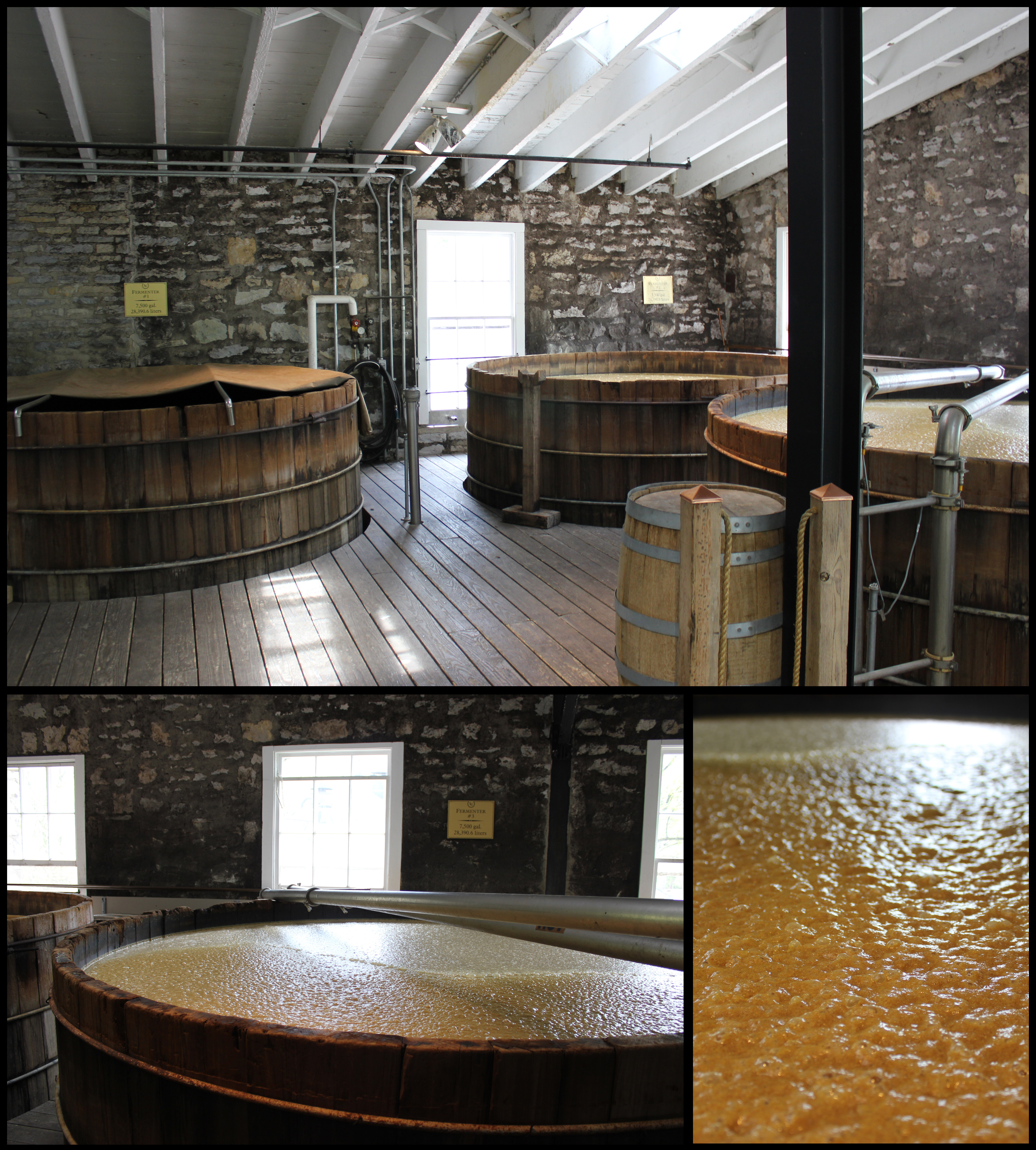
Woodford keeps some of the smallest fermenting tanks in the business. Also unusual is that, like Maker’s Mark, they’re made from cypress wood as opposed to stainless steel. Cypress is chosen for its locality, and doubly because it is inert (adds nothing to the flavor of the mash) and virtually immune to water, with tanks lasting 100 years or more. Every once in a while I’ll hear someone say that stainless steel somehow adds a metallic flavor to the mash, but I don’t buy it and Woodford doesn’t claim it — cypress wood is merely traditional. Plus, it looks cool.

In 7500 gallon tanks, they use 400 gallons of sour mash, or 5% of the total. Like the others, it is distilled up to 9% in a process that takes between 3 and 7 days. We were instructed for some reason to stay at least 3 feet back from the tanks, but Vikki, camera in hand, bravely ignored them for the sake of the art.

DISTILLATION:

Woodford Reserve is, as far as I know, unique among mass-produced bourbons in that they exclusively use copper pot stills, an attractive trio imported from Scotland to occupy the far wall of the distillation room.

Again, this was another time when I forgot I was standing in a working distillery. Everything is so clean and neat, I only remembered when I leaned against the spirits still and found that — like most copper pots with large fires under them — it was incredibly hot.

The first still in the corner, called the Beer Still, holds 2500 gallons and takes the distiller’s beer up to 40 proof. That distillate is then pumped into the middle one, the 1650 gallon High Wine Still, which brings it up to 110 proof, which in turn goes into the final, 1650 gallon Spirits Still, which takes the distillate up to 158 proof, just 1% lower than the upper limit of what is allowed, by law, to be called bourbon.

Generally speaking, the higher proof to which you distill, the more flavors you remove. Some of these are bad flavors, but some are good. That rule taken to it’s logical conclusion gives us vodka, distilled as high as 195 proof and tasting as close to nothing as is scientifically possible. So Woodford Reserve’s high proof distillation helps to explain its relatively mild taste. Again, not better or worse, just a choice in production.

And where Buffalo Trace had a novelty barrel and a Buffalo head tap handle, Woodford Reserve ropes off a stately, gilded spirit safe pouring the white dog into holding tanks, where it prepares itself for barreling.

AGING:

All their whiskey is aged in wood that has been air dried for 9 months, a laborious but superior process to the quick & dirty kiln drying some others do. The tour guide didn’t have the slightest problem telling me the exact mashbill and precisely how much of the fermentation is sour mash, but when I asked about the char level on the barrels, he responded as if I had asked him the size of his sister’s waist. All I could glean is that the barrels see a heavy char, between 3 and 4 on a 0-4 scale, which is pretty standard. What’s uncommon is that their barrels are toasted before they’re charred, a small step but one that helps explain the heavy vanilla and butterscotch flavors in the final product.

They take the 158 proof spirit and add distilled water (they call this watering down “gauging,” the first and last time I heard that word on our trip) until the spirit is down to 110 proof, at which point the whiskey is put it into barrel and sent up to it’s lengthy silent detention.

All the Woodford Reserve anyone has ever had comes from but one modestly sized warehouse, sitting just short roll from the distillation room. The general solemnity of these buildings were somewhat disturbed by the 30 or so pairs of feet shuffling their way through, but there was still plenty of the angel’s share to go around.

Like Buffalo Trace, Woodford Reserve’s warehouse is heated, to hasten the aging of the spirit in the winter. The barrels are not moved once they land in their appointed rick, and depending on their location they linger for between 7 and 9 years, at which point they are removed, batched (“blended” means something else in Whiskey World, so mixing barrels is not blending, or so we were prematurely admonished…  it is batching), bottled, and sold as Woodford Reserve.

OVERALL:

Woodford Reserve is bottled at 90.4 proof (45.2% ABV), but it doesn’t taste it. It is smooth enough that I’d recommend it to fans of Jameson aiming for a bit more patriotism in their drinking habits, although it’s much sweeter, with more going on.

I kind of can’t believe their little tasting card didn’t mention butterscotch, as the taste, to me, is a full blast of butterscotch candy, with vanilla and maple notes supplementing. While an 18% rye could be called relatively high, the inherent spice of the rye is batted down by the high proof distillation, and the rye flavors seem to hide behind bitter oak tannins on the finish. The rye comes on the exhale.

The Woodford Reserve “Double Oaked” is a new release that may become part of the permanent line-up, in which they finish Woodford Reserve in a second new oak barrel, this one heavily toasted and lightly charred. The effect of this is even more butterscotch and vanilla flavors, and as such I find it a bit redundant. It is, however, an interesting lesson on the effect of toasted wood to  taste them side by side.

Overall, I think Woodford Reserve is a solid bourbon with well integrated flavors. The candied flavors may be too much for some, but I think there’s a place for that. My complaint is that I wish they didn’t distill it so high because the lightness of body, for me, makes it rich without being full. Nonetheless, it remains a tasty bourbon that I would always graciously accept.

Bottom line: I always enjoy it, but I never seek it out.

The Bourbon Trail (1 of 6): Buffalo Trace

The Facts:

Distillery: Buffalo Trace Distillery
Location: Frankfort, Kentucky
Owned By: Sazerac Company
Major Products produced: Buffalo Trace, Eagle Rare, Van Winkle, W.L. Weller, Blanton’s, Elmer T. Lee, Sazerac, Rock Hill Farms, Ancient Age
Origin: Continued distillation since 1787; rechristened Buffalo Trace in 1999.

The Tour:

Nestled up next to the Kentucky River, the Buffalo Trace compound is an expansive mix of tended grounds, antique warehouses and modern factory equipment. They keep the oldest aging warehouse in Kentucky and all that, but the surprising things are the niceties, flowering trees and gardens and such, which blend well with the structures and were installed in the early 20th century by Colonel Albert Blanton, who decreed that fine bourbon should have fine surroundings.

Everyone who works there places a premium on history and tradition, and are visibly proud of the distillery heritage. The buildings themselves, particularly the warehouses, wear their age with dignity. Like John Huston said in Chinatown, “politicians, ugly buildings, and whores all get respectable if they last long enough.”

Our tour opened with a delightfully hokey, completely unironic video of actors in cheap synthetic pelts aiming prop rifles at off-screen buffalo. The bearded frontiersman on screen then stopped to sip from a bubbling creek at his feet before righting himself for some stoic squinting off-camera left. It’s the type of video that they showed 3rd graders in the early 90s, and it betrays a charming void where slick marketing prowess would otherwise be.

We found this to be a constant, especially when compared to other distilleries. Buffalo Trace is a big distillery owned by an even bigger company, and yet they maintain a homey, oh-put-that-anywhere nature that pervaded every minute of the 2.5 hours we spent there. They are, in other words, unassuming — especially so when considering that they make what is arguably the best bourbon in the world.

The history of the distillery is incredibly long. First this, pioneers in that. They’ll say things like “this is the oldest freestanding house in Franklin County!,” and we dutifully pretended to care. We were much more interested in the process, so from here on out I’m going to completely ignore history, as much as a favor to you as to myself.

MASH:

Buffalo Trace produces three mashbills for their bourbon: Mash#1 is higher corn, and makes Buffalo Trace, Eagle Rare, and George T. Stagg. Mash#2 is a bit more rye-heavy, and makes Blantons, Elmer T. Lee, Rock Hill Farms, and others. There’s additionally a wheated bourbon, which uses wheat instead of rye, and makes W.L. Weller and the whole Van Winkle line, and yet another recipe for their Sazerac ryes.

The far right picture is the texture of the final mill, ready to be cooked.

Bourbon by law has to be 51% corn, and Buffalo Trace (indeed, all the distilleries we spoke to) gets their corn locally. It’s no mystery why Kentucky’s native spirit is a corn-based one, as it grows voraciously in this part of the world and is delivered here daily on 18 wheels, along with Dakota rye and Dakota/Minnasota barley. It is inspected, and if passed, pumped into the milling room where it’s ground via hammer mill into a fine, flour-like powder before entering one of their enormous, 10,000 gallon pressure cookers that rattle the brick walls and sound like a brewing catastrophe.

One of the ways to control the final taste is to monitor exactly how the mill cooks: when to add the corn, barley, and malt. Buffalo Trace pressure cooks the corn separately from the rye, at 240 degrees for about 45 minutes. They’re then combined, and barley is added after it all cools a bit — barley is already malted, so there’s no need to render the sugars quite so violently.

FERMENTATION:

Like all the others, Buffalo Trace is fermented by sour mash process. Some of the old mash (about 2% of the total) is added to the new to catalyze the process of fermentation. They have a proprietary yeast that is made off site, and it takes 66lbs of yeast to complete fermentation in Buffalo Trace’s gargantuan 92,000 gallon stainless steel tanks. There are 12 of these massive things, and they’ll typically fill two/day.

The little tube is the sour mash back from the still.

It takes 3 to 5 days for the bubbling mash to reach 9% alcohol. At the distillery, they let you stick your finger in the fermentation tanks and taste the brew, called “distiller’s beer.” We saw different tanks at different stages of the process: sometimes there’s a deep red oil (I assume corn oil) hovering on top that tastes terrible, sometimes it’s wrinkled and teeming and looks like a living cerebral cortex, and sometimes it’s a milder yellow brew that tastes like a sweet corn beer. I’ve never really tasted the corn in bourbon before — it’s definitely there, but not prevalent for me — and it wasn’t until trying this missing link that I really got it.

DISTILLATION:

The distillation room in Buffalo Trace is loud and busy, wires and pipes everywhere, with everything clear made musty opaque with liquor and heat. The mash is pumped into a 40′, 60,000 gallon column still which roars away and drains off a product that’s about 120 proof but yet unfinished. That goes to a pot still which double distills it up to between 130-144 proof.

Lower left is the ≈135 proof alcohol spewing out of the pot still, and on the right is that tap out of which you can drink cups of it.

From 184,000 gallons of mash, distillation yields only 1,800 gallons of product  — about 1% — which gets diluted to a maximum of 125 proof (Bourbon Law) and put into barrel.

AGING:

All bourbon must be aged in charred, new, 53 gallon white oak barrels. The level of char, source of barrels, method of drying wood, and pretty much everything else is up to the individual distillery. Buffalo Trace insists all their barrel staves get air-dried for at least 6 months before giving them an “alligator char,” very heavy, 3.5 or 3.8 out of 4.

The barrels are rolled into the brick aging warehouses, stacked 3 or 6 tall into ricks, and left to contemplate the passage of time. The barrels do not move until it’s time to be bottled. Buffalo Trace has over a dozen different warehouses, each with its own distinct personality. Some have better air flow than others, some concrete floors, some wooden, some 9 stories others 6, etc., as which part of which warehouse each barrel is in will dramatically influence aging and therefore final taste.

What they do all share is steam heating, which is significant for the following reason: Kentucky’s seasons are what hasten bourbon aging. The liquid soaks up into the wood in the warm summer and comes out of the wood in the cold winter, again and again, over and over (or, as we experienced, 80-degree Wednesday and 45-degree Thursday) As it leaves the wood grains, the spirit keeps some of the barrel’s color and flavor as a souvenir, which is essentially the whole significance of aging. Heated warehouses simulate this phenomenon, so in the winter, they oscillate the temperature between 40 and 68, up and down, in and out, creating mini-seasons and making the whiskey mature beyond its years. So by the time Buffalo Trace is bottled, at between just 8 and 11 years old, it’s already taking classes at the local community college.

That dark line in the wood is where the whiskey took the barrel’s own char and color, before taking it back.

Touring the warehouses is a quiet experience. All that wood reminds me of an old church, as if the hot, immature spirit goes there for years of silent reflection. There’s something about it: the endless rows of solemn barrels, the darkness, and the still thickness of the air that is, literally and otherwise, intoxicating. Oak is semi-porous, so about 3-5% of the spirit will evaporate out of each barrel every year. This is called the “angel’s share” and it’s like breathing true love.

BOTTLING:

For their namesake whiskey, they select somewhere between 20 and 120 barrels to blend together to achieve the desired taste. The less excellent barrels will find their way into the less excellent products, and the single barrel selections speak for themselves.

The nicer, single barrel products are hand bottled, and the more mass produced stuff is done by machine. And one last thing: all Buffalo Trace’s whiskey is chill-filtered. In the world of Scotch, these are dirty words, and yet our tour guide said it with a measure of pride. Chill filtering ensures the bourbon doesn’t cloud up in transit or storage, and is purely cosmetic. Purists cry blasphemy, and others just shrug.

For what it’s worth, I haven’t personally tasted a difference in chill-filtering, though I’ve never tasted two otherwise identical whiskies side by side. I can’t imagine it wouldn’t effect the flavor, but that’s just a guess. I can only speak to the finished product, which is fantastic.

Overall:

It’s hard to say what exactly Buffalo Trace does to produce such a phenomenal product. At Fortaleza in Mexico, the differences were clear as day. Not so here. All Scotch buzzwords are more or less uniformly ignored: high-malt, pot-still, small production, low-proof distillation, chill filtration… it could be that they make more substantial cuts in the distillation, choosing quality over cost. Or maybe their proprietary yeast strain is extra good. I don’t know. Aside from aging their barrel staves (as opposed to kiln-drying them) and that steam-heating business, they seem to do the same shit everyone else does. They just do it better.

I claimed in my Fortaleza post that industrial processes make an inferior product, and I don’t extend that truth to bourbon. This is an example of mass-production done very, very right.

Some products are better than others, but I’d recommend at least trying anything coming out of this distillery. Their portfolio is too broad to go into the specifics of everything, but a couple highlights:

  • Buffalo Trace is one of my favorite bourbons, and the price ($25) just makes it even more so. It’s sweet but not too sweet, the predictable caramel and vanilla with corn graininess and fully textured oak, which takes over the finish with a layer of rye. Elegant, powerful, and with complexity that belies its age and price.
  • Eagle Rare is a 10-year, single barrel Buffalo Trace, and as it’s single barrel will vary bottle to bottle. I must say though that on the whole, I like it a bit less than the other.
  • W.L. Weller 12-year is one of the better wheat bourbons on the market, again for an incredibly low price. A good side-by-side with Buffalo Trace to see how wheated bourbons compare.
  • The Antique Collection (Sazerac 18, Eagle Rare 17, William Larue Weller, George T. Stagg, and Thomas Handy Sazerac) are vintage, put out every fall, rarer than they are expensive, and better than they are both. Excellent whiskeys all, with the Sazerac, Stagg, and Weller frequently cited every year among the world’s best whiskeys.
  • The Van Winkle line needs to introduction from me. Wheated bourbons, they are exceptional and extremely rare. Bourbon aficionados look on the Van Winkle products with almost sexual glee, and bourbon message boards will frequently devolve into an orgiastic litany of photographs of Pappy Van Winkle products, with captions like “look what I had last night! :-}}}!!!”

Mane of Needles

“…soft as a mane of needles…”
The Mars Volta
Miranda That Ghost Just Isn’t Holy Anymore — B. Pour Another Icepick

At URBN, we take a measure of pride at being one of the only places in North Park to get a proper drink. Regardless of their individual background knowledge or off-menu skills, everyone behind our bar can make a great Old Fashioned, Manhattan, Negroni, etc. No one could legitimately call us a cocktail bar, and yet we’re a bar that can make great cocktails.

This is a tool in our belt that I refuse to give up. I don’t care one fucking bit that the nuance and balance of our drinks are wasted on 99% of our clientele. We don’t maintain quality just for them; it’s for us too. Or, at least, for me. Tending bar is not an inherently cerebral activity, and craft cocktails, for me, are what forestall the fungal ennui that grows on everything that doesn’t progress.

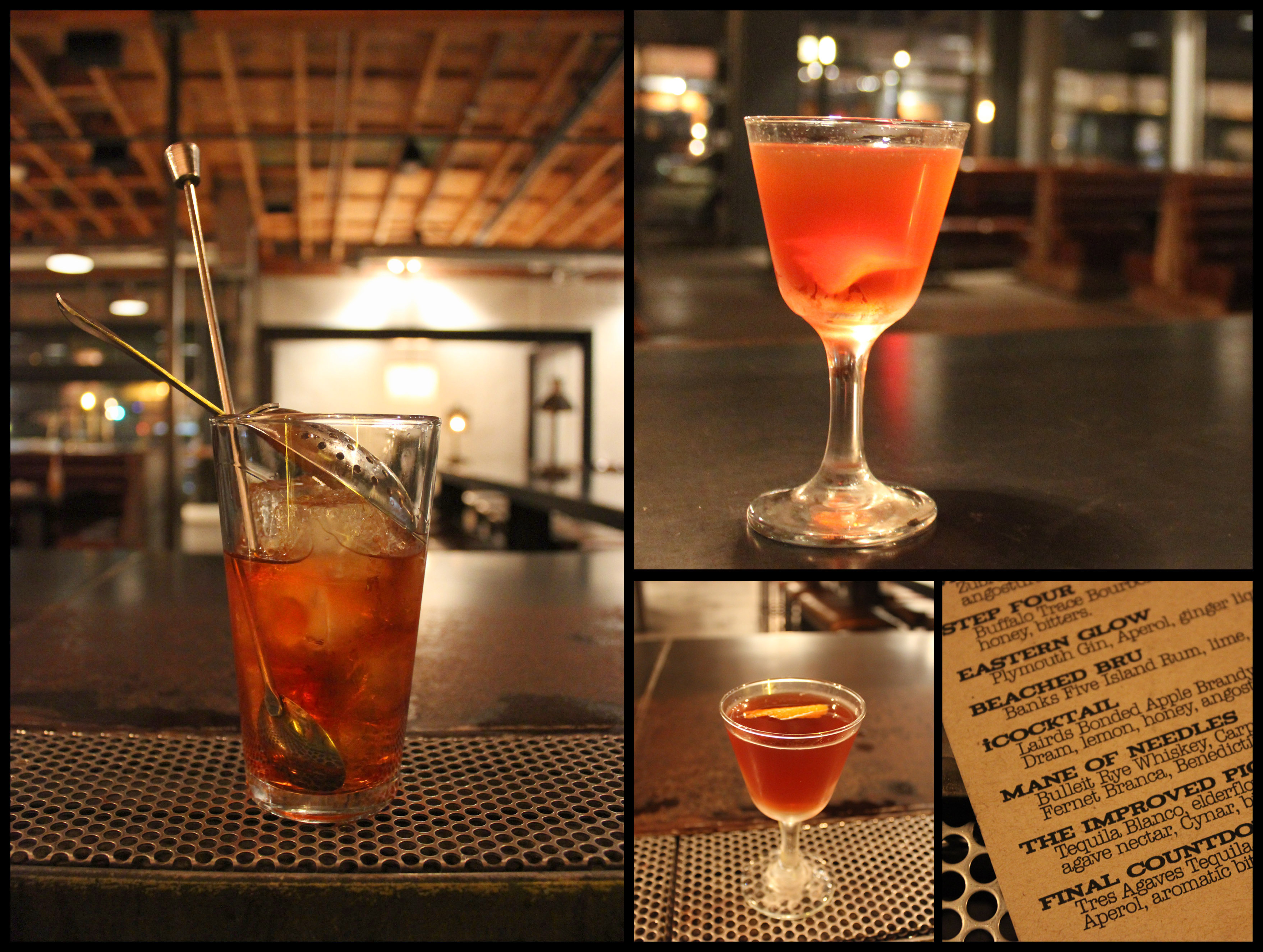
In that spirit, we left one spot on the winter cocktail menu for an drinker’s drink, something whiskey and potent. That drink is the Mane of Needles. Of the 10 or so cocktails on the new menu, this is the one I really like, the one for the enthusiastic minority of our customers that share my taste. It’s the only one I’d happily make for Scott Holliday or Misty Kalkofan or Tom Schlesinger-Guidelli or any of the other Boston greats who introduced me to this world. Borrowing inspiration from the Violet Hour’s wonderful Autumn Negroni, I combined my initial goal of marrying Fernet Branca and Benedictine with the layered-bitter thing that they did so well, and thus:

Mane of Needles
2oz Bulleit Rye
0.75oz Carpano Antica
0.5oz Campari
0.25oz Bénédictine
0.25oz Fernet Branca
1 dash Angostura Orange bitters

Stir ingredients in a mixing glass for 30 seconds; strain into a chilled cocktail glass; garnish with orange peel.

There’s something soft and accessible about Bulleit Rye, but at 90 proof it’s study enough to provide the infrastructure for this drink. I think of Carpano in this case as an emulsifier, with Campari’s robust bitterness playing against the sweet; the Bénédictine and Fernet, though just at a quarter-ounce each, are co-dependent enablers that play off each other to add spice and flourish. But it’s devil Fernet, with its peppermint oil and menthol, gives the Mane of Needles its name. The drink is, on the whole, soft and smooth with gentle bitterness and enough liqueur to make it silky, and yet while drinking it, the Fernet jumps up to offer little bridled pinpricks along the way.

This was also, of all the cocktails, the easiest to name. The experience of drinking it immediately reminded me of the Mars Volta lyric. It’s like petting a porcupine. But a delicious one.

Note: at URBN, we slightly modify the proportions to make it (1) easier to construct in a hurry, (2) less expensive for the consumer, and (3) not so much damn booze. The Mane of Needles (Album Version) is 1.5oz of Bulleit Rye, and 1.25oz of a 3:2:1:1 Carpano / Campari /Fernet / Bénédictine batch that we pre-make, with a dash of Angostura Orange bitters. This has the added effect of slightly increasing the ratio of rye to liqueur, which in the end makes the whole thing taste a little better anyway.

Trivia!“Soft as a mane of needles” is six words, which is the maximum amount of consecutive words you can quote from the Mars Volta — from any part of any of their songs — before you start getting strange looks. The full stanza, by way of proof:

“Punctuated by her decrepit prowl she, washed down the hatching gizzard.
Soft as a mane of needles, his orifice icicles hemorrhaged by combing her torso to a pile.”

See?

Fortaleza Tequila

Disclosure: I recently returned from a trip to Tequila, Mexico, hosted by the good people at Fortaleza Tequila. They don’t advertise; instead, they sponsor biannual groups of industry professionals to come down and see how their tequila is made. Their bet is that when we see the quality of the product they’re producing, we’ll feel compelled to proselytize. They’re not wrong.

The Facts:

Name: Fortaleza Blanco, —Reposado, and —Añejo
Category: Tequila
Proof: 80 (40% ABV)
Origin: Tequila, Jalisco Mexico, since 2002
Distinguishing characteristics: buttery mouthfeel; vanilla cream, minerality, spice; smoothness; elegance

The Story:

I’m going to do my best to keep this brief:

In the 1860s, a man named Don Cenobio Sauza moved to Tequila, Mexico and started distilling.  While sugars rendered from the agave plant have been getting people drunk since before Cortez and his rats showed up, Don Cenobio was the first to name it after the town of Tequila, and the first to export to the U.S. His son Eladio Sauza joined the family business and expanded, but it was Eladio’s son, Francisco Javier Sauza, that took the brand international. Don Javier was the real businessman in the lineage: he’s the one who got John Wayne drinking tequila, the main force in elevating its international perception to a refined spirit, and the reason anyone outside of Jalisco knows the name Sauza.

Sauza tequila is of course still made today, albeit in wildly different form. In 1976, Don Javier sold his eponymous tequila brand, ultimately ending up in the multinational hands of [Jim] Beam, Inc. Beam continues to run it today with capitalistic efficiency, bulldozing agave hearts into atomizing shredders, powering a diffuser the size of a small church, storing distillate in 500,000 liter drums and pumping out products that range from decent to hideous. This is to say, that is what the Sauza name currently means.

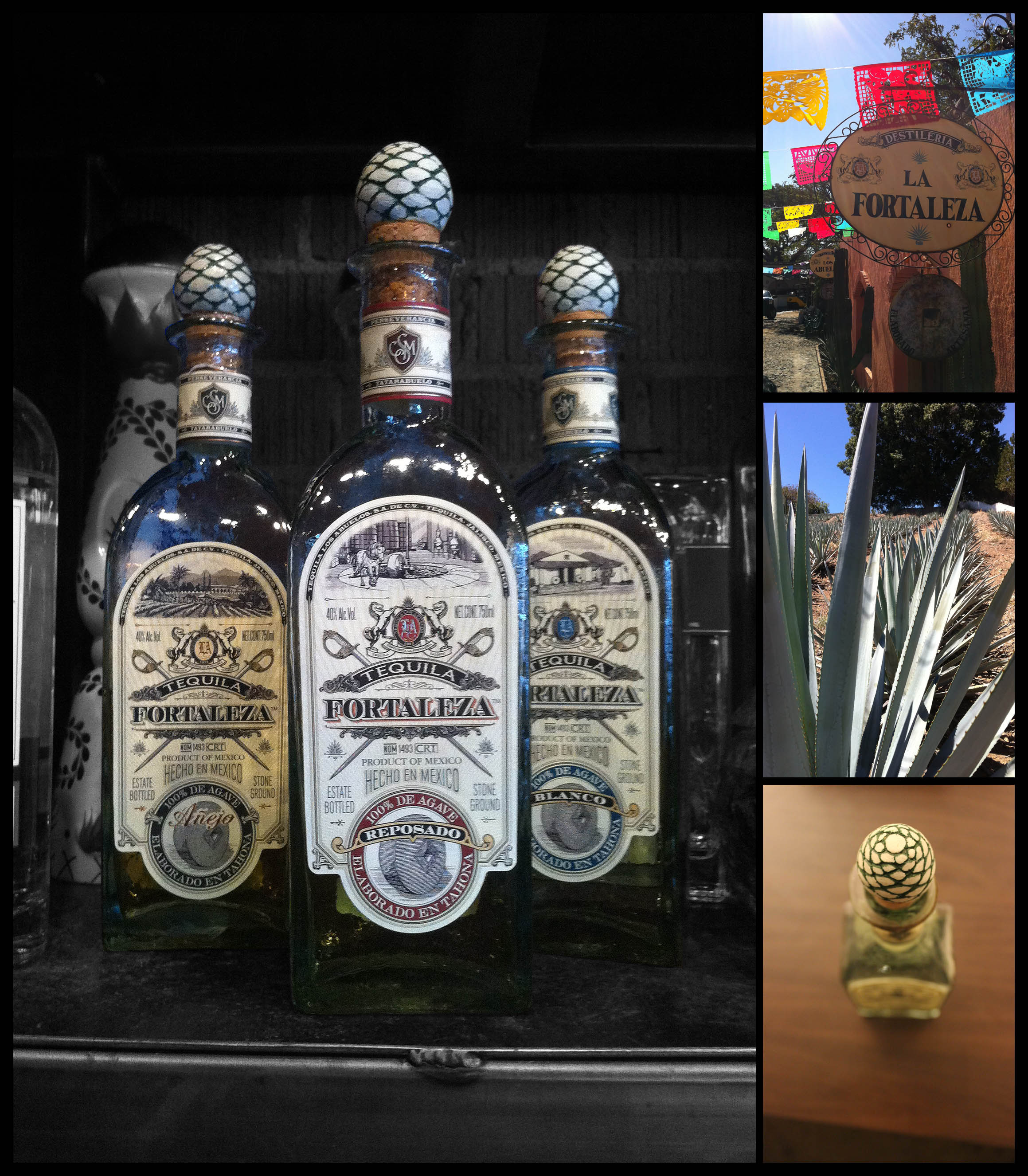
But in 2002, Guillermo Sauza — the fifth generation, whose grandfather Don Javier sold the company when he was 20 — resurrected the family business under the name “Los Abuelos” meaning “The Grandfathers,” in homage to the way his family used to make tequila (“Fortaleza,” meaning “Fortitude” on this side of the border due to a copyright complaint). The family still owned a bunch of dusty distillation equipment from one of Cenobio’s original aquisitions, and Guillermo kicked it back into production. Aside from the fact that they finally retired their donkey in favor of a tractor, Guillermo still makes tequila the way his family did 100 years ago.

Now, it’s important to note that industrialization does not axiomatically produce an inferior product. I have little interest in hand-made paper or an artisan television. But in the world of tequila, yes, industrial processes produce an inferior product. To explain:

The Process:

The Agave: Like all good tequilas, Fortaleza is 100% blue agave. The cheaper brands are allowed to throw 49% corn-syrup or sugar into the fermenting tanks and still call themselves tequila, but cannot claim “100% agave” on the bottle. Always look for this. If it doesn’t say “100% de agave,” I advise against buying it. It’s literally filler.

Because Fortaleza’s processes limit them to a maximum of three tons of agave/day, they can afford to know where all their plants come from. Their agave is a mixture of small local farmers and their own estate.

The Rendering: The agave hearts — called “piñas” (pee-nyas) — are hard as wood, and the sugars need to be rendered. So they are tossed into a brick oven with meter-thick walls, stacked up, and steam cooked for 33 hours.

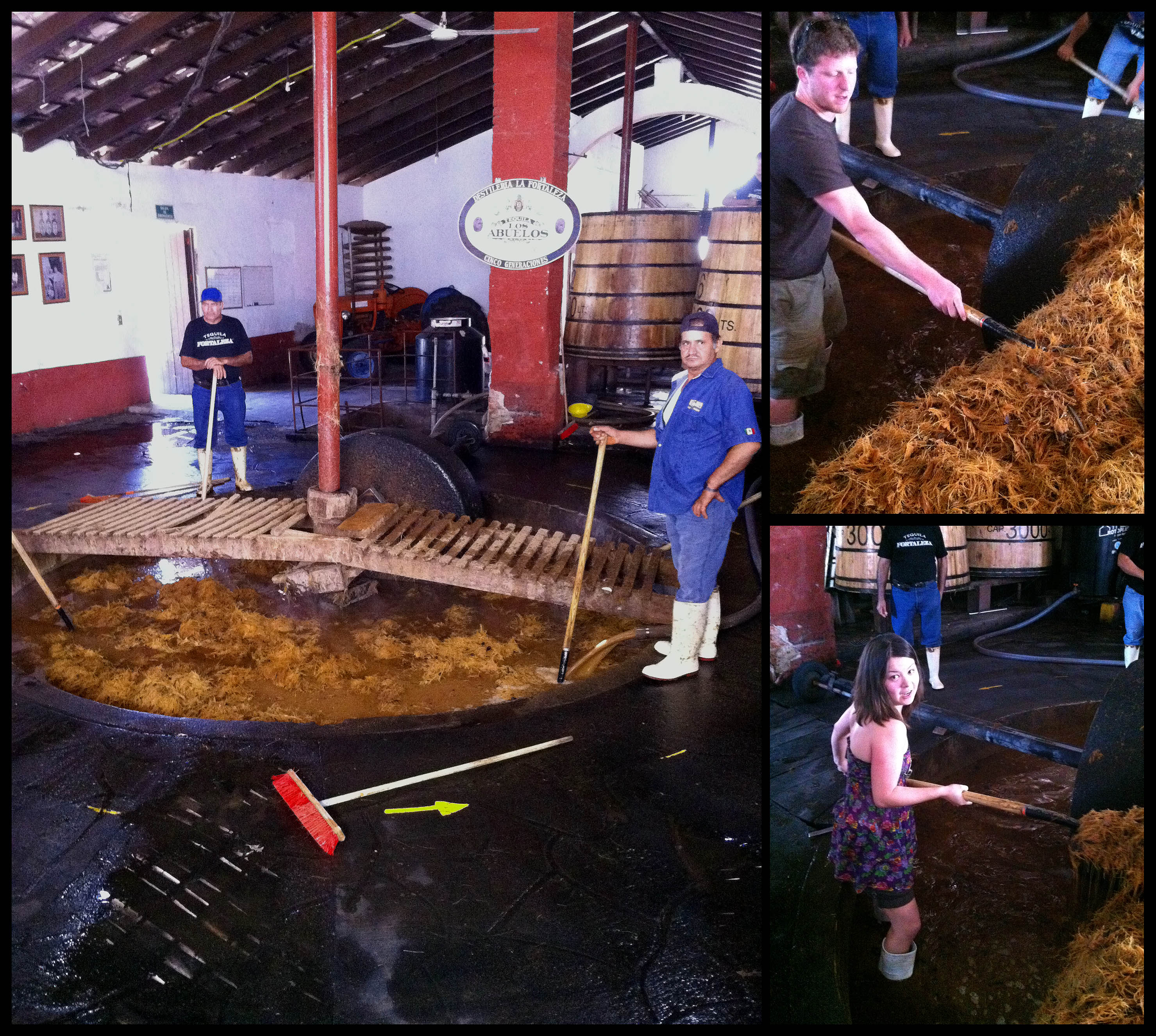
Then, the soft, sweet hearts are placed in a waist-high circular pit to face-off against several thousand pound stone called a “tahona.”

Sauza, by comparison (and not to jump all over Sauza, who were very gracious and welcoming, but that’s the industrial comparison), pulverizes the raw agave hearts to dust in a shredder before pumping them into a machine called a diffuser that pressure-cooks in 45 minutes what it takes Fortaleza 36 hours to do. The analogous reference is like a crock pot vs. a microwave: different process, different result.

Any time one is attempting to get the juice out of a plant, the less violently it is squeezed, higher quality the juice will be. This is the idea behind extra virgin olive oil and gravity press on wine, and it’s what they try to do with the mash of Fortaleza. In the pit, the piñas are crushed three times with a giant stone before separating the pulp from the juice. This fairly laborious task is accomplished over about 5 hours by four guys with pitchforks.

It’s not done this way merely because of tradition, or a punishment of some kind, but rather to not pulverize the tiny fibers of the agave. While the yield could be dramatically increased by machine pressing all the juice out of the pulp, that machine would also crush the smallest veins of the plant, out of which would come bitter & astringent compounds, like methanol, that would remain in the finished product.

Fermentation & Distillation:

From there, the agave juice is pumped into 3000L pinewood tanks, and fermentation is started with a bit of the sour mash from the last run. It takes a couple days for the yeast to work its magic until the brew reaches around 5% ABV, at which point it’s time for distillation.

The tequila is twice distilled in just the cutest little copper pot-stills I’ve ever seen. Because their production methods are so laborious, they have less “heads” (harmful methyl) than most – about a liter, I was told (which is insanely low, and I’m now wondering if I heard it wrong. But it’s unusually small, regardless). The first distillation runs the liquid to about 25%, and the second to about 45%. And here they stop.

45% is an uncommonly low ABV to distil to, but a desirable one. All three incarnations of Fortaleza are bottled at 40%, which means it requires merely 10% water to cut it back to bottle proof. The significance of this fairly obvious. The cutting water has nothing whatsoever to do with agave, mash, fermentation, or distillation, so water is just an inert mixer. The less water is required, the more one tastes the actual heart of the spirit.

One more important note: for some bizarre reason, the Tequila Regulatory Council of Mexico allows that even if the bottle says 100% agave, it only needs to be 99% agave. Yes, really. This leaves each distillery 1% wiggle room to add one or more of the following permitted mixers: oak-essence, caramel, sugar syrup, or glycerin. And if that sounds like a bunch of bullshit to you, well, you’re not alone. It is apparently taboo to mention it, but this is why Clase Azul Reposado tastes like soft caramels and as far as I’m concerned, the entire thing is stupid from top to bottom. Fortaleza, along with Casa Noble, Siete Leguas, and many other high-end brands, participates in no such assholery.

Aging:
The blanco is unaged, straight into the bottle. The reposado (“rested”) is permitted between 2 and 12 months, and Guillermo ages his for at least six (each batch is different). The añejo (“old”) can be aged for 1-3 years. He ages his for 2, all in used whiskey barrels he picks up from Jim Beam and Jack Daniels.

Drinking:

Whenever possible.

The Uses:

I’d be intensely interested to find out just how much each factor effects taste, but it’s unfortunately not possible. All I know is that taken in conjunction, Fortaleza is a remarkable spirit. It’s full bodied and creamy (probably due to the adorableness of the stills — though Adam Stemmler believes it’s from fermenting in pine, a byproduct of how the liquid reacts with the wood), and even the blanco has bright vanilla, almost cream soda notes, complementing pepper, sweet agave, citrus and minerals. The reposado (my favorite of the three) introduces wood and baking spices and is softer, more elegant. In the añejo, the softness of the wood takes over and the creamyness becomes buttery, with cinnamon, oak, and vanilla.

The blanco is the only of the three I’ll mix without reservation. It makes a killer margarita of course, as well as great paloma, but it really shines in stirred, citrus-less drinks. The only time I wouldn’t use it is when I want something a little more powerful, like if I’m setting the tequila up against huge flavors and want the spirit to shine. In cases like that, smoothness works against you.

The reposado and the añejo are good mixers as well. Down at Syrah, Stemmler made a reposado play on an Aviation that I hear is delicious, and they both can make decent stand-ins for whiskey — particularly as the base of a Oaxacan Old Fashioned, which is transcendent with either.

Banks 5-Island Rum

The Facts:

Name: Banks 5-Island Rum
Category: Rum — silver (clear)
Proof: 80 (40% ABV)
Origin: Trinidad, Jamaica, Guyana, Barbados, and Java, with offices out of Singapore, since 2010.
Nose: grassy, vegetal, agricole funkiness
Taste: dry and complex; agricole hits with its green pepper & vegetable notes, but also black pepper, ginger, tropical fruits; long, complex, and re-inviting finish

The Story:

He pours out a bit more than a thimbleful into a glass, and I bring it under my nose. It’s not in the least medicinal, but complex and inviting. I sip. My word. It’s like tasting in Technicolor — it’s full, complex, and not too flowery, but also lacking any trace of unpleasant heaviness. It’s unlike any white rum I’ve tasted.

Remsberg was grinning at my inability to hide my shock. “So you can see why Prohibition-starved Americans flooding El Floridita would have said, “This is good!” There was something about those early Cuban cocktail rums. They were just better rums than the world had seen. Nobody is producing a white rum today as pleasing as this.

Wayne Curtis wrote this in his excellent book And a Bottle of Rum: A History of the New World in Ten Cocktails, describing a sample of Bacardi silver rum from 1925, back when it was made in Cuba. Cuban Bacardi was what reintroduced America to rum in the 20th Century, and apparently it used to be amazing. And Curtis is no debutante… if he says it’s great, it’s great.

This quote also highlights one of the many differences between international beverage entrepreneurs and me. Both John Pellaton and I read this book, and both from this passage realized that we’ve never tasted a truly dynamic clear rum. When I read it, I got a little sad, and then went on with my day. When Pellaton read it, he decided to invent one.

Pellaton is the former president of Hine Cognac, and along with “master blender” Arnaud de Trabuc and mixologist Jim Meehan of Please Dont Tell (PDT) New York, set about to create an excellent white rum. After some 18 months of tinkering, it ended up as a blend of 21 different rums from five countries. The different countries bit is anomalous in the mildly jingoistic rum world, where Jamaican rum and Martinique rhum are barely considered, by Jamaicans and Martinicans anyway, to be the same spirit. But both Trabuc and Pellaton came from Cognac where blending is the norm, so they set out to create an all-star.

Each of the component rums are aged between 3 and 12 years, charcoal filtered to remove the color, and blended. According to Banks’ own promotional materials, it starts with the light black-strap molassas of Trinidad rum (over 50%), then added heavy Jamaican, earthy Guyanese, aged and “flavorful” Barbados, and spicy arrack Java. Some are pot-distilled, some column. There is a wonderful bucking of tradition in the assembly of Banks, and Pellaton & Co. seem to understand that to create something different, you have to do things differently.

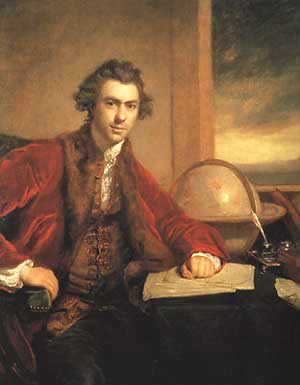
Oh yes, the name. The finished product is named after the famed explorer Joseph Banks (pictured, right) for some completely artificial reason I couldn’t care less about. 

The Uses:

Overwrought marketing aside, Banks is a phenomenal rum. It is floral and complex, and has just enough vegetal arrack notes to add flavor without controlling it. The hint of arrack is what sells it for me. Too much (as in actual Batavia Arrack or Rhum Agricole) overpowers everything and is unpleasant, but just a hint adds an entirely new flavor dimension to the spirit. I would feel comfortable using Banks whenever any clear rum is called for. It won mojito awards, it makes the best daiquiri I’ve ever tasted, and won Best New Spirit at Tales of the Cocktail 2011. It is, simply, an incredible product.

At URBN, we make a Beached Bru with it. My only problem is that there are so many things I love about the rum, it’s hard to mix because the mixers divert from the rum’s complexity rather than add to it. Which is, as they say, one of them good problems.

Pellaton told me that he gave a sample to Mr. Remsberg from the above quote who owned the bottle of 1925 Bacardi. Remsberg said that Banks, while not  as good as the ancient Bacardi, was the closest thing he’d had to it in a modern product. Cuban Bacardi bottles run £2000 where you can find them, while Banks is about $28. Which is plenty good enough for me.

Full list of Banks 5-Island Rum cocktails here.

Note: Curtis himself has written about Banks here.

Trivia1!: Guyana, one of the “five islands,” is not an island. It’s a country hanging out on the northern coast of South America. Also, Batavia Arrack is a rice and sugar-cane spirit from Indonesia, and is not rum. But who cares? Banks 4-Island and 1-Country  Mostly-Rum-but-some-Proto-Rum doesn’t really have the same ring to it.

Trivia2!: Joseph Banks, unsurprisingly, has no relation with Joseph A. Banks, the upper-middle-class haberdashery.

Corpse Reviver #2

There aren’t, within any given field, a lot of things that are suitable for both novices and professionals. We generally refer to this gap as experience. Whether it’s tennis rackets or sex toys, kitchen knives or high explosives, the introductory item is something of easy pleasures that will, with time, get outgrown.

Not so with the Corpse Reviver #2. Such is its charm. It’s a fantastic introduction to both gin specifically and mixology in general, but it’s also a favorite of a good many of us who live in this cloistered little cocktail world.

Ted Haigh recounts, in the introduction to his book, how he first encountered the Corpse Reviver #2:

“To my amazement, it was the finest thing to ever pass my palate. I could taste every ingredient. It was subtle, it was fresh, it was complex, and it was delicious. My research and acquisitions continued with renewed vigor.”

Despite the fact that he writes like he’s dispatching from a 19th century ship, Haigh was on to something. This drink is delicious.

It appears originally in the Savoy Cocktail Book, Harry Craddock’s 1930 weighty harem of recipes. The “Corpse Reviver” was a popular style of cocktail from the late 1800s to around 1920, when prohibition knocked it out. It is, as you’d imagine, a morning drink. This particular one is tart, bright, and complex, light and unfilling, yet with enough punch to overpower even the worst hangover.

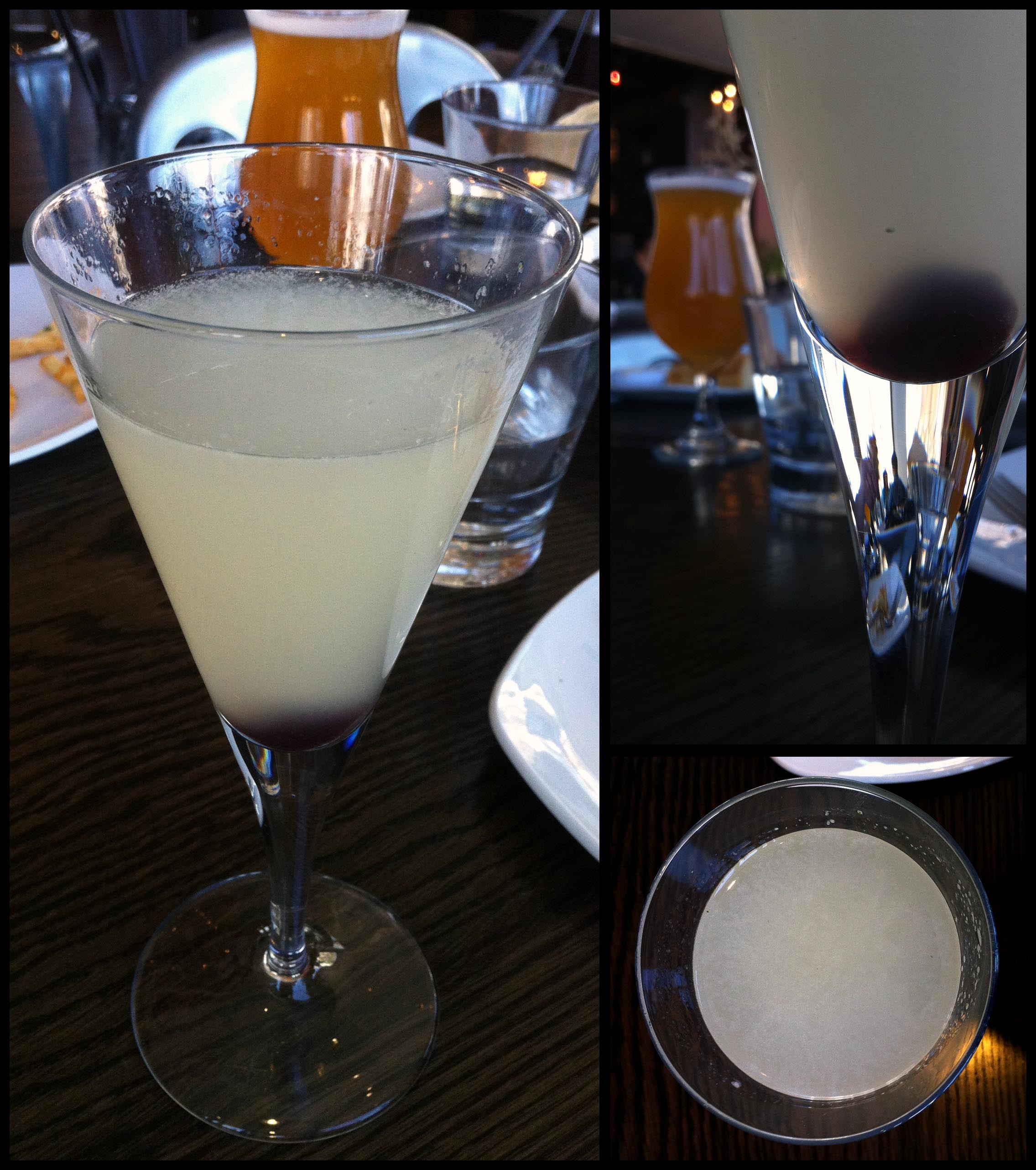
At Little Italy’s newly opened Prep Kitchen, they wisely put it on their brunch cocktail menu. It was Sunday morning, I had fallen asleep at 5:30am the night before, and while I would’ve loved to try something they invented themselves, I saw it on their list and couldn’t help myself.

Corpse Reviver #2
1oz gin
1oz Cointreau
1oz Lillet Blanc
1oz lemon juice
dash absinthe
Shake, strain into martini glass, garnish with a maraschino cherry.

I had two that morning, but because no one in this town measures their goddamn drinks, the first was great and the second was not. For this cocktail, the delicate balance is whole point. The stong lemon and Cointreau mix with the weak Lillet and gin and are all complemented by a shadow of absinthe, and when mixed correctly, it’s like a symphony. The overall impression comes tart at first, then fresh sweet orange and spices from the gin and absinthe with a drying finish of Lillet, but this is one of those drinks that you keep drinking because every sip highlights something new.

The Savoy Cocktail Book didn’t offer a garnish: most people drop in a maraschino cherry just for the pure aesthetic fuck of it, though Jeffrey Morganthaler, who’s almost never wrong, suggests an orange peel. Personally, I agree – the orange helps the Cointreau pop and generally enhances the flavors, while the cherry — pretty as it is —is just pretty.

Harry Craddock didn’t editoralize much; his was more in the vein of the “10,001 Recipes!” that we see so frequently these days. He only added one sentence by way of explaining the Corpse Reviver #2: “Four of these taken in straight succession will unrevive the corpse again.”

Trivia!: Corpse reviver #2, you say? What of the Corpse Reviver #1?

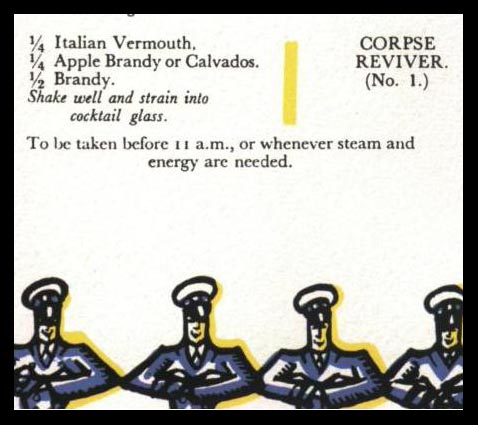
The Corpse Reviver #1 is 2 parts Brandy, 1 part Apple Brandy or Calvados, and 1 part Italian (sweet) Vermouth, also in Craddock’s book. This one is puzzling. First of all, it’s not terribly good. It’s not bad, but there’s a reason we all talk about #2.

My question is why anyone would think this was a good morning drink. Corpse Revivers were supposed to be hair-of-the-dog, and this is a thick, sweet, rich drink that I’d barely want after dinner. Who wants a big cup of brandy in the morning? Bizarre.