Old Fashioned

INTRODUCTION to the OLD FASHIONED WHISKEY COCKTAIL (PART I)

I remember the exact moment when I learned how to drink.

I was a Jack & Coke kid all through college. Tequila shots, Jameson rocks, Vodka Redbull. I’d get the cheapest single malt on the menu for special occasions. I learned to drink straight whiskey, but mostly because I wanted to be the type of guy who could drink straight whiskey. I once spent an entire night drinking Jäger bombs (never again), and was elated when I discovered that the dueling piano bar sold Long Island Ice Teas by the bucket. I looked down on Miller Light in favor of Bud Light. I believed in the idea of “ultra-premium vodka.” In short, I knew nothing.

It wasn’t until I left Los Angeles for Boston that I had a conversion experience. Winter hit quickly for those of us who’d just spent four years in southern California, and it was already brisk in early October when my sister took me out to the neighborhood bar, Green Street Grille, for a drink. Our bartender was Misty Kalkofan – Misty, half-sleeve tattoo, bellowing infectious laugh, with a M.A. from Harvard Divinity School and one of the best bartenders in the city.

I ask for a Jack and coke, but Misty tells me they don’t have Jack. I ask her what she has. She asks me what I like.

“Whiskey.”
“Spirit forward or more drinkable?” she asks. I revert to my college mentality, one of cool and uncool, and order straight whiskey as if the syllables themselves are laced with pheromones.
“Jameson,” I say, “Neat.”

Bartenders deal with this chest-puffing horseshit all day long, and in hindsight, Misty treated me with a truly profound kindness.

“Have you ever had an Old Fashioned?”

This was pre-Mad Men, though I had heard of it but never tried one, and acquiesced. A couple dashes of those weird bitters things, a sugar cube, orange peel and rye whiskey, and that was it for me. I was sold on cocktails forever. I had never tasted anything like it.

I don’t remember the drink I had before that Old Fashioned, but whatever it was, it was the last time I’d take a drink without thinking about it. Without weighing it’s taste, complexity, and balance. I plainly didn’t realize drinks could be that good.

It’s been more than four years since then. It’s what turned drinks from object to subject, and what changed bartending from a job to a career. It is the drink I have the most respect for, one of the pantheon of cocktails on which, when ordered on the 4-deep, cash waving insanity of a busy Saturday night, I will never cut corners. It is what I order to test knowledge or skill of a new bar or bartender. The Old Fashioned – short for Old Fashioned Whiskey Cocktail – was, and remains, the best drink I’ve ever had.

WHAT IS IT, and WHY IS IT SO DAMN GOOD? (PART II)

When Humphery Bogart died and went to Whiskey Heaven, the bartender greeted him warmly, and slipped an Old Fashioned into his hand.

It is not a classic cocktail, it is the classic cocktail. To explain:

While the term “cocktail” might today refer as equally to a Sazerac as an Appletini, in the beginning, everything had an exact definition. There were Slings (spirit, sugar, and cold water), Toddies (spirit, sugar, and warm water), various citrus Punches and such, but no cocktail. It wouldn’t be until 1806 that the “cock-tail” was defined in print*. Then, it was “spirits of any kind, sugar, water, and bitters.” Those four ingredients made a cocktail. Anything else, tasty as it may be, wasn’t a cocktail.

But over the next 75 years, people kept tweaking the cocktail, hanging ornaments on it. There was the “fancy cocktail,” with curacao. Then the “improved cocktail,” with maraschino liqueur and absinthe. Then “what if we throw some Chartreuse in there?” and “here’s a float of red wine,” and people started using pineapple sticks and raspberry syrup and muddling in fruit slices – what would be referred to, later, as “the garbage.” It’s an enormously malleable template, and can be mangled as many different ways as there are bottles on the back bar… and while it was likely all delicious, it was not a cocktail as it was originally defined.

So when a reference to “old-fashioned cocktails” appears in print in The Chicago Tribune in 1880, it’s not that someone invented a drink that felt quaint and homey, and named it an Old Fashioned. It was a curmudgeon with a healthy dose of grump and thirst to go with it, who wanted a cocktail, the kind he used to get. The Old Fashioned kind. The only change he’d accept from the original 1806 cocktail was ice. All else was heresy.

(It’s worth noting that any claim to have “invented” the Old Fashioned is absurd, seeing as it was being made for at least 75 years, as a “cocktail” before it earned its latter name. But extra bullshit points go to the Pendennis Club of Louisville, who maintain their paternity claim even though they opened their doors in 1881, a full year after it first appeared in print.)

As it was, so it is.

The Old Fashioned (Whiskey Cocktail)
2oz. rye whiskey (or bourbon)
2 dashes angostaura bitters,
1 small sugar cube, muddled or ~1/4oz simple syrup (a hair less for the inherently sweeter bourbon)
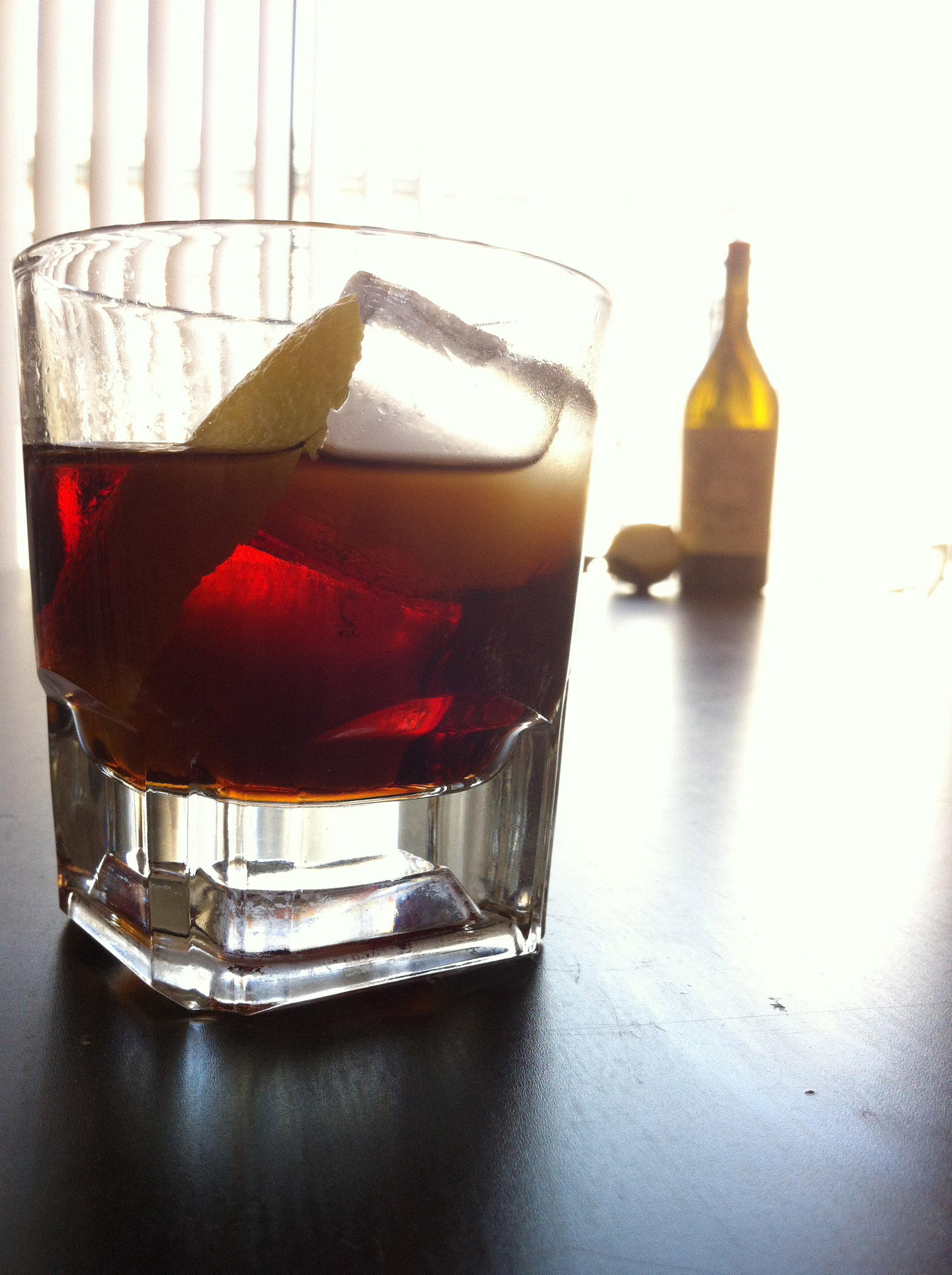
Add ice and stir briskly for 30 seconds or so. Express oils from a long strip of orange peel, drop peel in drink. Garnish with a maraschino cherry. Drink. Melt.

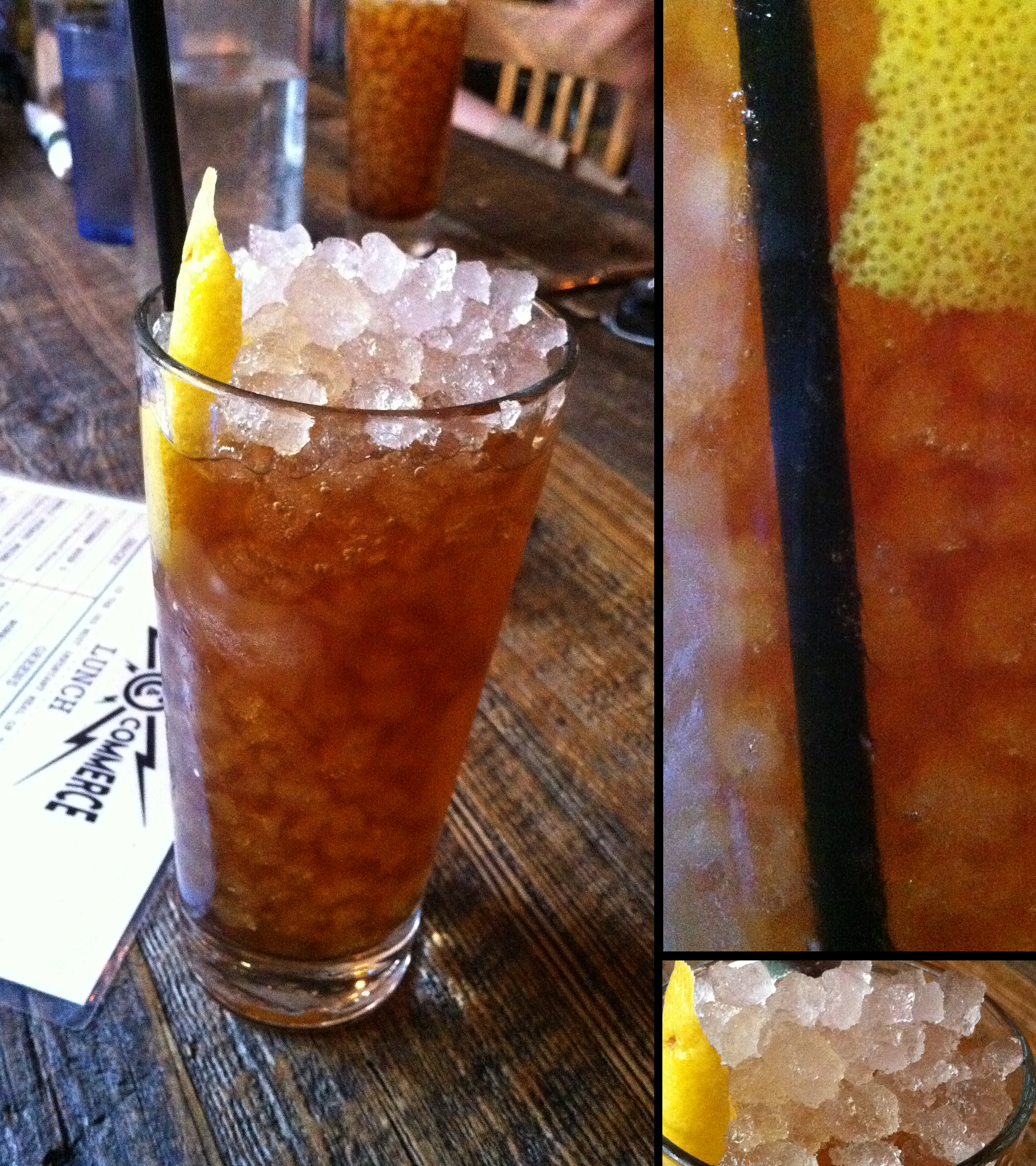
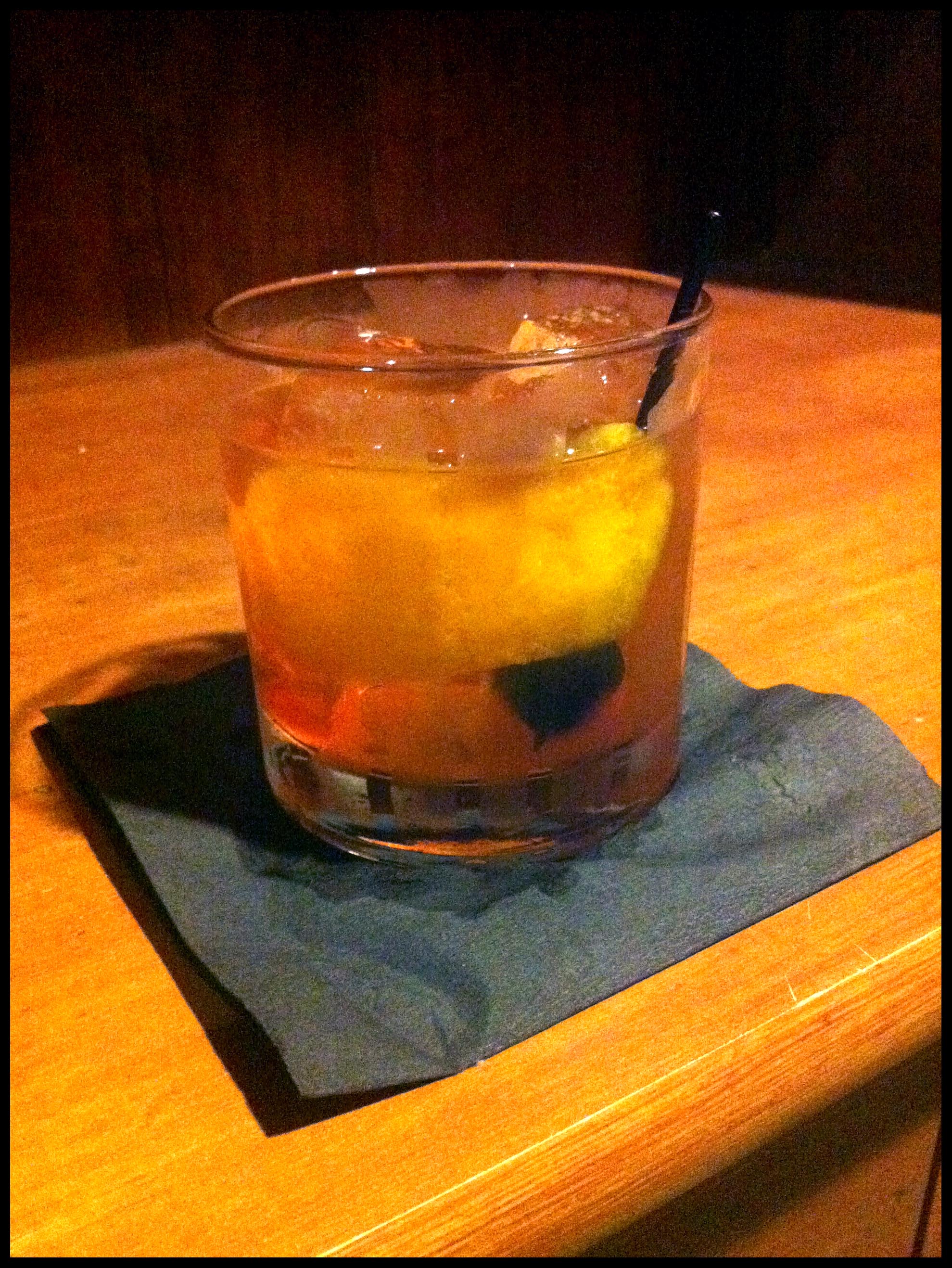
It should look like this: (and I’m sorry for the image quality of these pictures… I took them before this blog existed.)
*Nerd stuff: I have recently seen trustworthy evidence put forth by cocktail historian Jared Brown that “cock-tail” appears in print in 1798, a full eight years earlier than we originally thought. It is, alas, not defined, so the 1806 date remains, at least, not wrong.

OLD FASHIONED in SAN DIEGO (PART III)

There is literally nothing old fashioned about Southern California. In Los Angeles, they throw stones at anything older than 35, and San Diego roughly the same. Things don’t last here. Even Old Town feels new.

So it is with the Old Fashioned. With this drink, there are two rival camps, between whom there can be no peace. To garnish with the fruit, or to muddle it. One of them prefers the nuance and subtlety; orange oils accenting the whiskey, a little sweetness to wake it up, and a little bitterness to add spice and complexity, with minute variations in the choice or quantity of ingredients shifting the focus and balance for myriad incarnations. The other one prefers a swamp of pulpy fruit carcasses that add blunting sweetness, fibrous bits to get caught in your teeth, and a mess of trash in the glass. I won’t say which I am.

The good folks at Craft and Commerce know how to do it. Most of their bartenders, when asked for their favorite version, will use the drier, spicier, slightly more challenging rye whiskey, but the house Old Fashioned is with Bourbon. Buffalo Trace, a little bit of cane sugar syrup, angostaura bitters, stirred with both an orange and lemon peel.
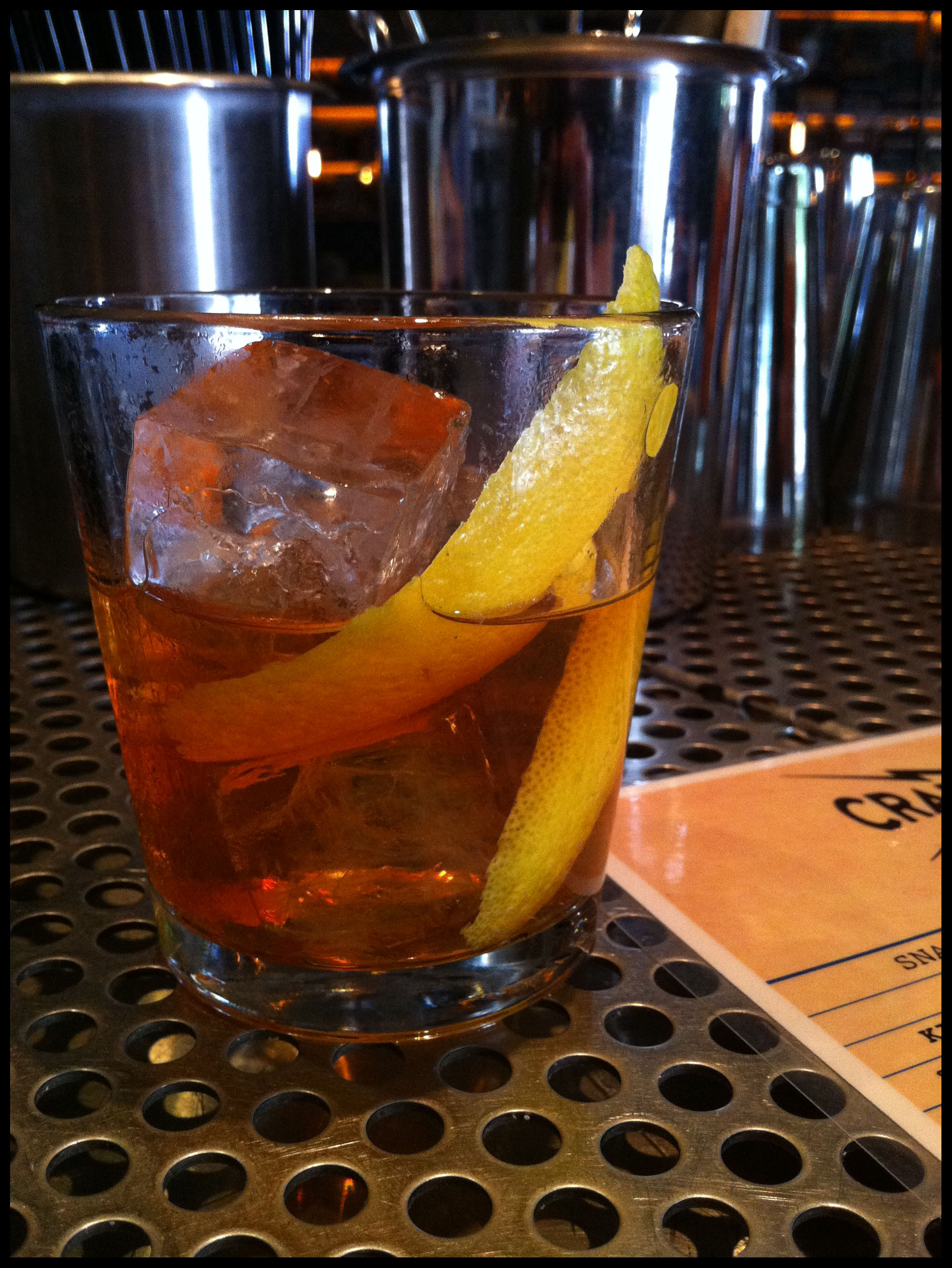
At URBN, where I work, we do the same… it was with a single barrel Elmer T. Lee, until we went through about 100 bottles of it and all but ran out. So we, too use Buffalo Trace. Even though we took it off the menu, we still sell dozens of these things a week, and to all kinds of people. It’s something that gives me faith.

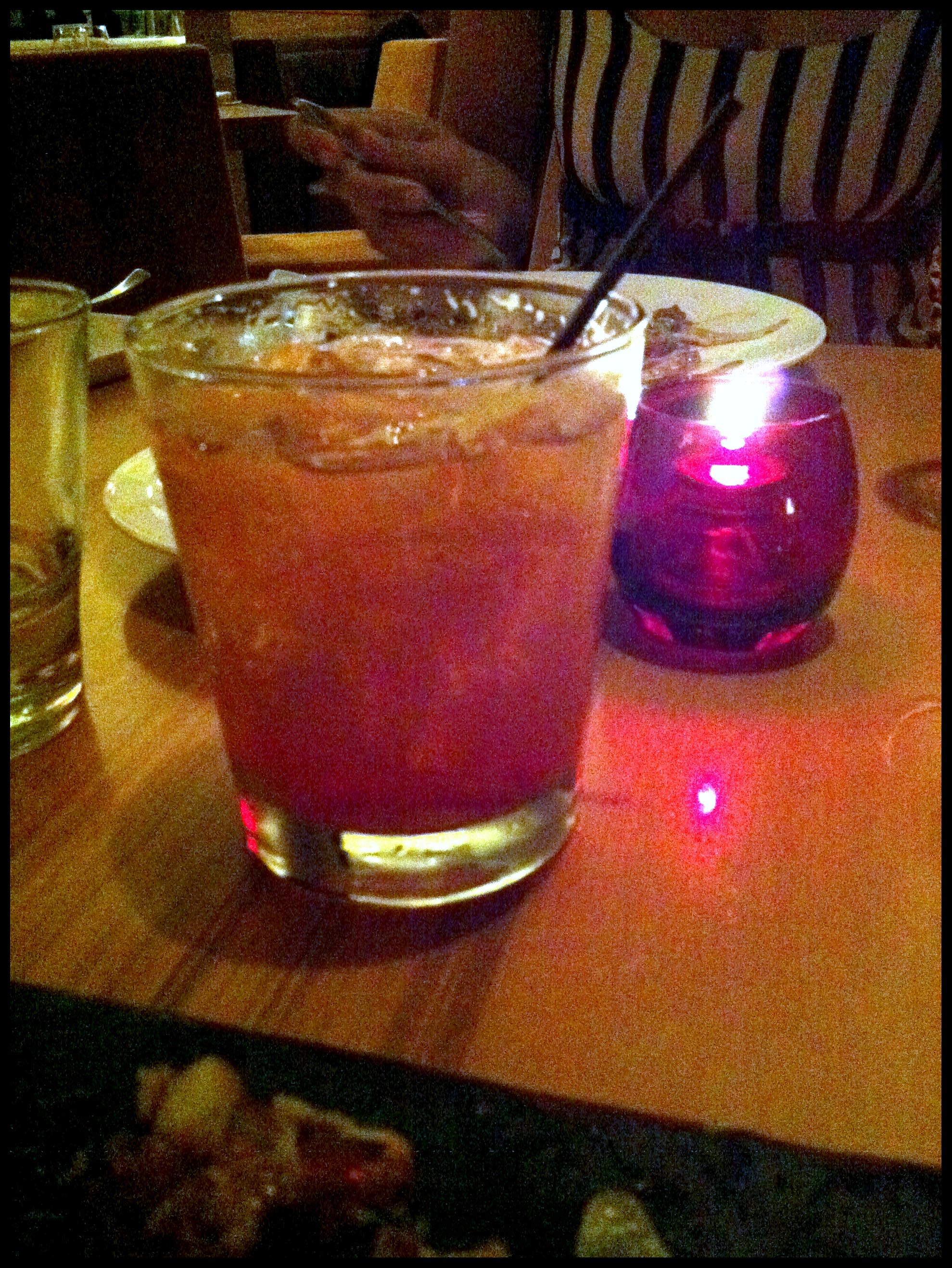
Sadly, some of the even very nice bars are muddling fruit. Kitchen 1540, in Del Mar, is one of the nicest restaurants in the area. They serve “craft cocktails” and yet an order for an Old Fashioned returns a very nice bourbon (he used the Van Winkle 12 year, definitely not their standard) and angostura orange bitters (not my taste, but a respectable choice), but sullied with a mashed cherry and dulled with a two-inch-tall hat of soda water.
And I don’t know where this morbid little voice came from, but drinking Haufbrau lager at the splendidly tacky Keiserhoff, in Ocean Beach, a place without computers where they make everyone dress like beer wenches from the German hinterland, something whispered to me that our 60 year old bartender, a consummate professional with more years of experience than I have years of life, that he might, just might, make a mean old fashioned.

I was wrong.

You have to go to a devoted craft cocktail bar to get it the right way. C’est la vie. Always a good excuse to go, I suppose.


Carpano Antica

The Facts:

Name: Carpano Antica Formula
Category: Vermouth — red (sweet); apertif
Proof: 33 (16.5% ABV)
Origin: Turin, Italy, since 1786
Nose: pungent sweetness; vanilla, caramel and citrus peel
Taste: vanilla, caramel, licorice, cinnamon, red fruit, figs, wood, orange peel, bitterness on the end, dry and lingering finish

Vermouth:

First, a quick word on vermouth: vermouth is not gross. If you think vermouth is gross, you don’t know what it tastes like, because it’s been shit on for so long by the extra dry vodka martini. The vodka martini is like that vindictive guy in The Last of the Mohicans, trying to not only kill vermouth, but make sure its seed dies with it.

This is because while vermouth is glorious in a gin martini, it does not belong anywhere near a vodka martini. Vodka needs a strong man on her arm or nothing at all, and vermouth is too weak, too delicate, and ends up making a vodka martini taste like overproof diluted vermouth. Which, even I will admit, is gross. So, people ordered less and less vermouth, making the open bottles sit behind the bar for longer and longer. And as it’s wine-based, it will go bad over time. So a self-perpetuating cycle began where the only vermouth anyone is exposed to is so old to be worthless, which makes people order it even less, and so on.

Vermouth is what happens when you add sugar, a little alcohol, and aromatic plants, spices, and herbs to wine. The latter’s called aromatizing and they’ve been doing it at least since ancient Greece. The word “vermouth” comes from the High German “wermut” meaning wormwood, one of the plants added to help fight intestinal parasites, and wormwood wine was popular in Germany and England as “vermouth” as early as the 1600s. But a modern drinker (such as myself) wouldn’t have recognized any of these.

The Story:

Vermouth in its current form joins us in 1786, when the experiments of a 22-year old liquor shop assistant named Antonio Benedetto Carpano culminated in what would become Carpano Antica, at once inventing the categories of both modern-day vermouth and the apertif. He infused a white wine base with “over 30” different herbs, roots and spices, livened it up with some sugar and (almost certainly) grappa, and as his cordial contained wormwood in a wine base, he, too, called it “vermouth.”

Carpano’s elixir was nothing dramatically new but for its quality, and that he had the good sense to send a sample to Victor Amadeus III, the ruler of that little corner of what would become Italy who reportedly found it exquisite and helped along its popularity. Not that the Carpano vermouth needed it — it was so good, and in such demand, the store reportedly had to stay open 24-hours a day(!)… which sounds to me like one of those bullshit liquor stories that everyone repeats because no one can say it isn’t so. Why the hell would people need to buy vermouth at 4am? Are we really to believe that they couldn’t service all their customers in the allotted nine hours a day, in a 250,000 person city-state in 18th-century proto-Italy? Far more likely is that production had to be extended late into the night, possibly even 24-hours a day.

It doesn’t matter. Either way, it was an unprecedented success and is now made and distributed worldwide by Fernet Branca, still according to the original recipe and even with the original label.

The Uses:

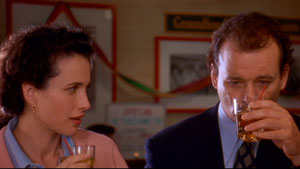
I used to think Carpano Antica was hands down the best commercially-produced sweet vermouth in the world. Most new cocktail bartenders do. As my familiarity with vermouth grew, I began to see it in a much broader context: it is powerful, it is vanilla forward, it is complex, and it is phenomenal. It’s great alone, it’s great on the rocks on a summer day. Of it’s contemporaries, it packs the most complexity and flavor, sweet without cloying, bitter without real challenge. Yes, sweet vermouth on the rocks with a twist can be completely delicious. Andie Macdowell had a little taste after all. Who knew?

But is it the indisputable best? No. There is no indisputable best. From each according to his ability, to each according to his need. So where does Carpano sit? It’s heavy, very vanilla forward, with broad shoulders and a ton of flavor. “Carpano is a linebacker and Cinzano is a soccer player,” says Jamie Boudreau, and he’s right. As I recently discovered in the Negroni trails, while I love Carpano Antica Negronis, while they’re many people’s favorite Negroni, they’re not my mine.

Personally,  I love Carpano in a Manhattan and Vieux Carre. It’s wonderful in the Don’t Give Up the Ship. And a Bitter Giuseppe and Growing Old and Dying Happy… etc. It’s never bad, just sometimes too much. Use it when you need a big vanilla flavor, to stand up to whiskey in particular.

See the full list of Carpano Antica cocktails here.


Autumn Negroni

When I was back in Chicago over Thanksgiving, Vikki, my sister Kelly and I took occasion to go to the Violet Hour — my favorite thus far of the Chicago cocktail bars, even if it is a faux-speakeasy. I’ve never really been into the whole  fake speakeasy idea, and am relieved that the trend seems to be dying. People sometimes forget that “pretense” is the root of “pretentious,” a fact I’m never more aware of as when I’m at a hidden, exclusive, “password-only” bar that I found by checking their address on yelp.

Regardless — once you find the stupid hidden door and wait at the stupid velvet curtain, actually being there is a very pleasant experience.

The standout drink I had there was called the Autumn Negroni, which on paper looked redundant. Five of the seven ingredients (71%) are bittering agents, and one could reasonably think that once you have Campari, Cynar, Fernet Branca, and Angostura Orange bitters, a dash of Peychaud’s seems like a waste of everyone’s time.

In practice, however, the bitters strip away individually and at different moments, yielding waves of flavors that make each each sip last like 10 seconds. Each ingredient picks up at the tails of the last one and carries the flavor for a while before handing off to another. It’s like a relay race, or cars of a train. This drink is so fucking good.

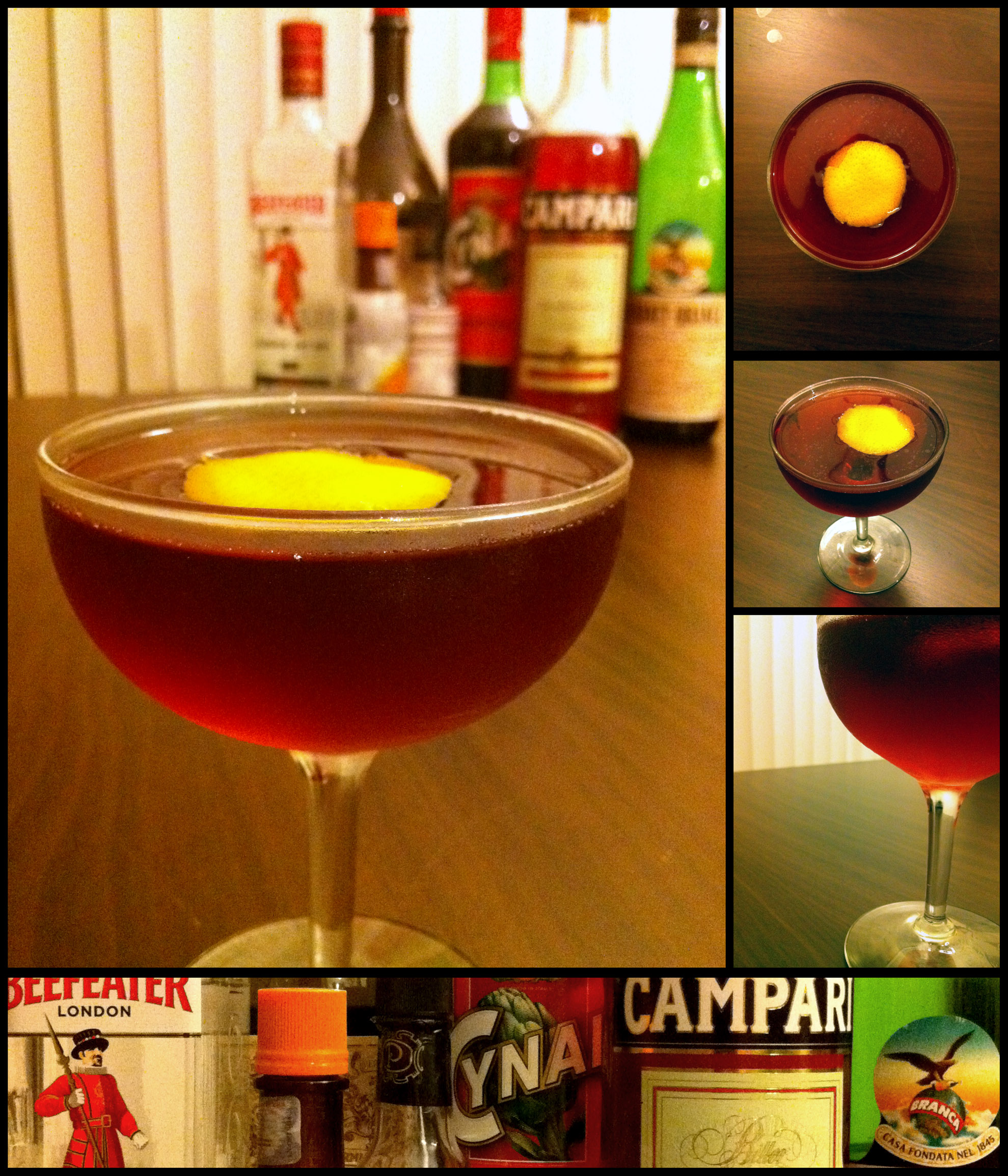
Autumn Negroni

2oz dry gin (Beefeater)
0.75oz Carpano Antica sweet vermouth
0.5oz Cynar
0.5oz Campari
0.25oz Fernet Branca
1 dash orange bitters (Angostura)
1 dash Peychaud’s bitters
Stir over ice and strain into coupe glass; garnish with orange peel.

I immediately asked them for the recipe, which they immediately gave me. Not to single out Saltbox, but I’ve made this drink for probably two dozen people, all of whom loved it, and all of whom now know where to get it if they ever find themselves in Chicago. I share recipes with anyone who asks. I firmly believe it makes all of us better.

Peychaud’s anise shows faintly on the nose alongside aromas of the sweet vermouth’s wine. But what’s so engaging about this drink is that you get to taste all the ingredients, more or less one after another. When taken, the sweetness of the amari mixes with the gin’s juniper, followed by the bittersweet Campari and the brightness of the orange bitters, but right when the Campari would turn rusty bitter that quarter ounce of Fernet Branca prickles up all peppermint and menthol, only to be batted back down by the long, earthy finish of the cynar.

Before this, I had no idea that bitters could layer in this way. I have since used this as the inspiration for the Mane of Needles, my favorite of the URBN cocktails and about which I’ll write soon.

This is the kind of drink that you keep going back to, keep taking small drinks because you identify something different in each sip, and when you feel like you’ve almost mapped all the flavors, you find there’s nothing left but sweetness on your lips and you have to do the whole thing all over again. Which is all I could ever ask from a cocktail. Four stars. A+.

Bénédictine

The Facts:

Name: Bénédictine
Category: Liqueur — Herbal
Proof: 80 (40% ABV)
Origin: France, at least since 1863, allegedly since 1510.
Nose: Honey and saffron; low spice notes of nutmeg & mace
Taste: Thick and sweet; cinnamon, honey and saffron instantly; vanilla on the midpalate with cardamom, with slight alcohol burn; faint cooking spices; long, lingering finish

The Story:

Here is what is indisputably true:

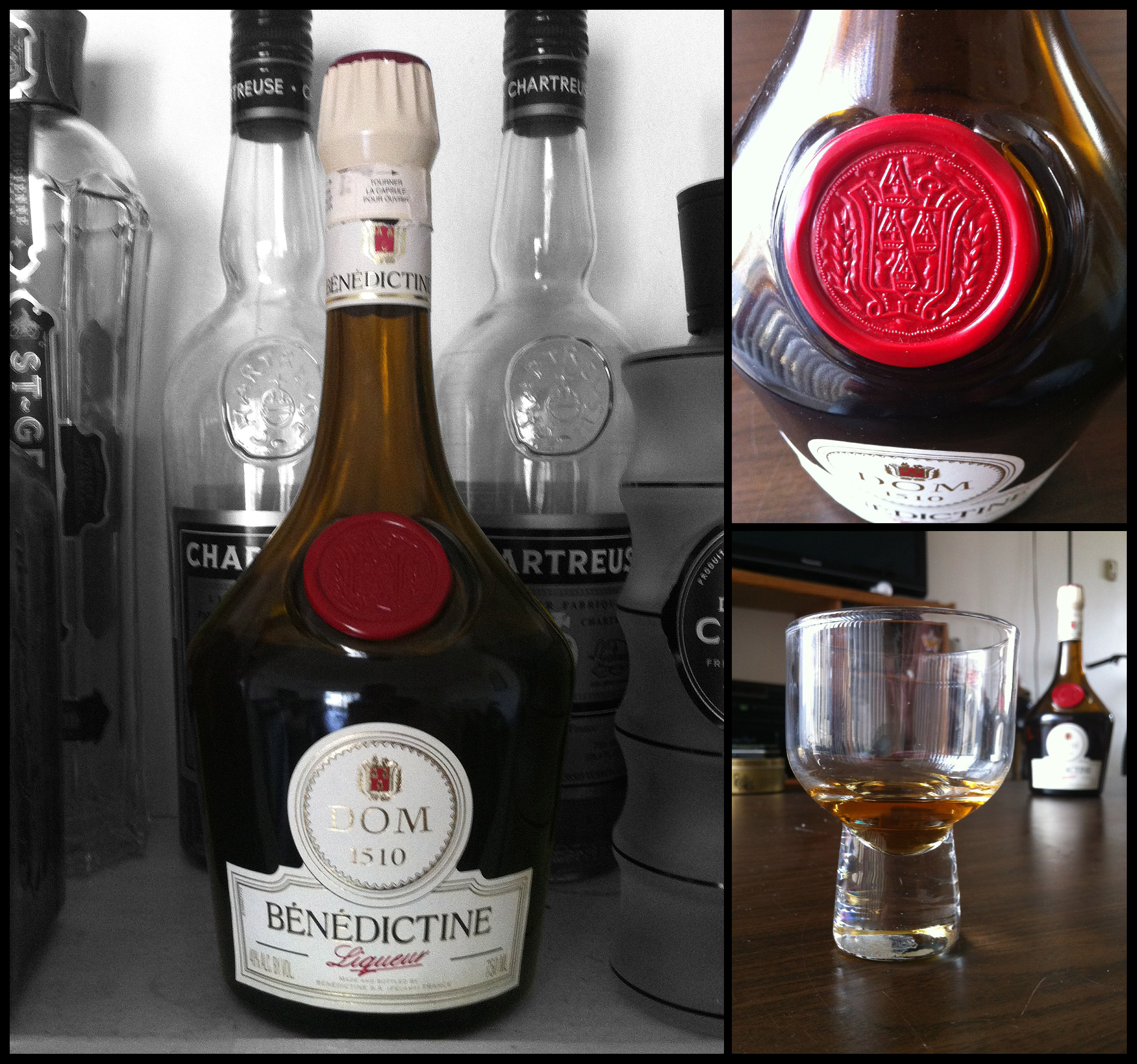
Bénédictine is a liqueur built on a neutral grain spirit base made from distilled beetroot (and not brandy or cognac, which is what practically everyone thinks). It is a combination of 27 different plants and spices, the exact composition of which is a fiercely guarded secret, but are known to include angelica, hyssop, aloe, arnica, vanilla, myrrh, nutmeg, mace, cloves, cinnamom, cardamom, citrus peel, saffron, and honey. The ingredients are divided in four different batches, or “esprits,” which are individually aged for 3 months, then combined with the saffron and honey and aged for 12 additional months. It is made at the baroque Le Palais Bénédictine, in Fécamp, Normandy, it is currently owned by Bacardi, and it is delicious.

Here is what we’re told is true:

At the dawning of the sixteenth century, a young Venetian monk of the Benedictine order named Dom Bernardo Vincelli was transferred from his comfortable lodgings in Monte Cassino to the abbey at Fécamp, Normandy. The erudite Italian was practiced in the alchemical arts and crafted several recipes, among them an initially medicinal “elixir” based on 27 plants and spices. The elixir of Friar Bernardo swiftly became a local favorite, impressing even King François I who, upon tasting the liquid during a visit to the region, exclaimed, “On my word as a gentleman! I have never tasted better!”*

Bolstered by a royal endorsement, the liqueur thrived on for almost three hundred years, until in 1792 the Abbey was partially destroyed during the tumult of the French revolution by whom the New York Times would later refer to as “the implacable republicans of Normandy.”

The recipe gone, the monks scattered, the abbey burned to the ground, the liqueur all spilled or drank by pyrophilic heathens, it seemed as if Friar Bernardo’s elixir was forever lost to time. Until about 70 years later, in 1863, a lucky wine merchant named Alexandre Le Grand discovered an ancient instructional manuscript at a relative’s house, and began making the liqueur, which he named after the monk who invented it. Being delicious, as it is, is rapidly propagated. He housed his distillery in Fécamp, as Vincelli had done, and began large scale production. The building again burned to the ground in 1893 and was rebuilt as something of a gothic castle in 1900, and Bénédictine has been produced there ever since.

Here is what is almost certainly false:

Pretty much everything you just read except for the last half-paragraph or so.

Wikipedia flat out says the story of the seredipideous manuscript is outright false, and common sense agrees. I don’t know why, but the world of liquor is uncommonly flush with these stories, of the toiling monks of the silent order who make the liqueur and only say one word a year, “…delicious,” and so on and so on. There was indeed a Benedictine abbey at Fécamp, and it was indeed partially destroyed, but there are no monks there anymore and haven’t been in centuries (note: Bénédictine never actually claims that monks currently make the liqueur), and no corroborating evidence I’ve been able to find for it. There is, in fact, no evidence of Dom Bernardo Vincelli’s existence at all.

Far more likely is that Alexandre Le Grand created a remarkably good liqueur, and created an ancient origin story based on the history of the city in which he was based. Bullshit though it likely is, it remains a charming story.

The Uses:

In play, it’s a tremendously versatile liqueur. It’s complex and delicious enough to drink straight after dinner, or mixed to great effect. Equal parts  it and cognac is a B&B (also pre-bottled by Bénédictine themselves, for the lazy) and it pairs tremendously with whiskey for drinks like the Fort Point or Bobby Burns and just a little bit of it shines like a diamond out of the Vieux Carré.

See the complete list of Bénédictine cocktails here.

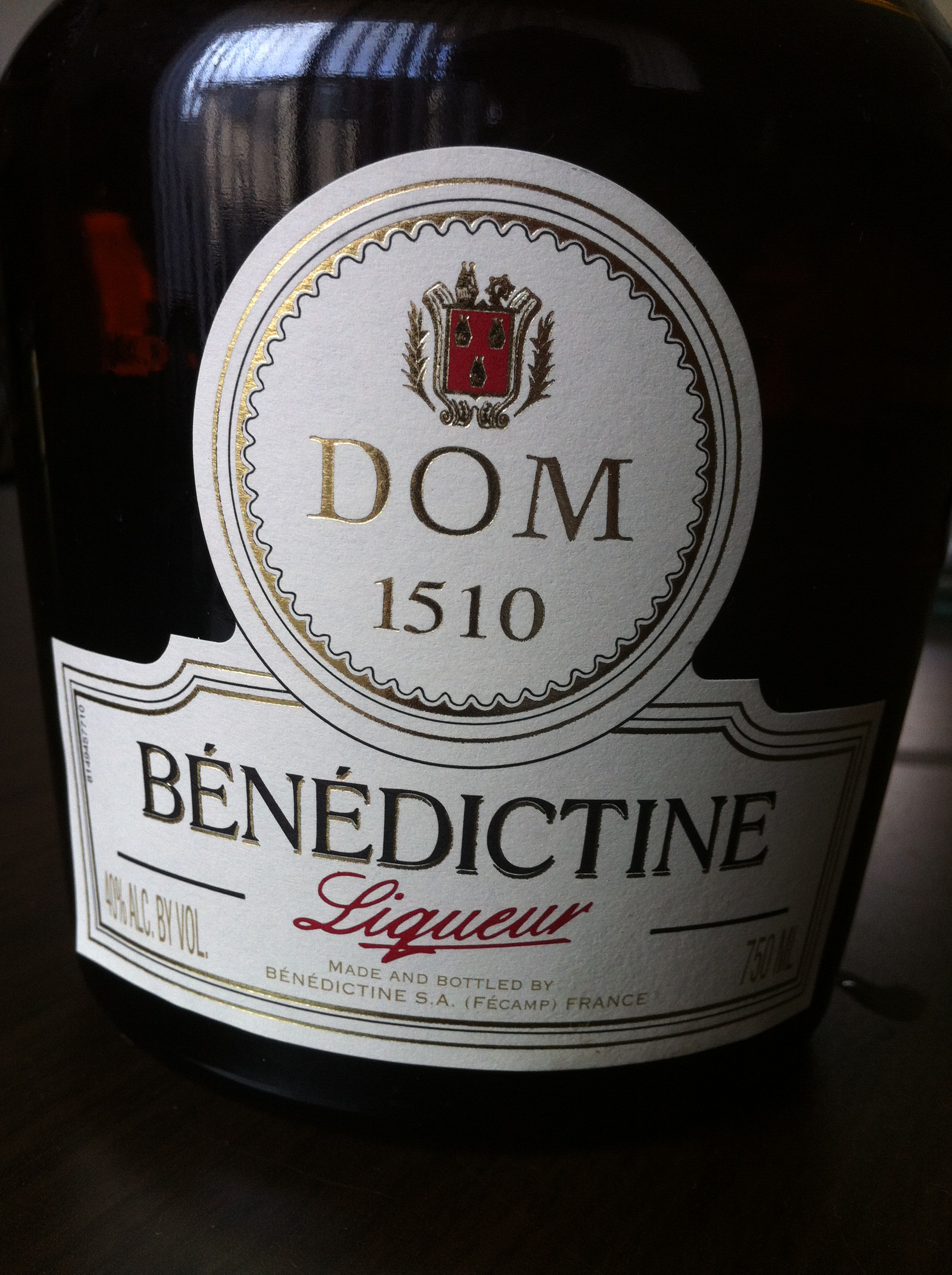
Trivia!: The promonint “DOM” does not refer to the “Dominican Order of Monks,” a wholly imagined backronym. It is “Deo Optimo Maximo,” the latin motto of the Benedictine order, which they translate to “to God, most good, most great.”

(Trivia about the above trivia!: “Deo Optimo Maximo” was a Latin phrase from way back. All the way back to when the Romans were polytheists, actually, as it directly translates to “to the greatest and best God,” referring to Jupiter. When the Roman empire became Christian, they cleverly took advantage of the arbitrary nature of latin phrasing, so “to the greatest and best God [of all the rest]” became “to God, greatest, best.” Which doesn’t have a thing to do with drinks or drinking, but is interesting nonetheless.)

*He would’ve said this in French.

Copper Monkey

The magnificently named Copper Monkey is a creation of Bek Allen, in-house bartender at Saltbox and the other half of Erin Williams’ Hush Cocktails. On paper, it looks like it has the potential to be the most offensive drink ever made. It features not one but three distinct ingredients that are found revolting by a significant cross-section of Americans. The Bols Genever with its malt & agricole funkiness, the briny smoke of Islay scotch, and of course the Vida mezcal, with all its lovely notes of smoked gasoline.

I’m crazy about scotch and mezcal and I tolerate genever, but even I wouldn’t imagine they would taste very good together. And I was, of course, wrong.

Copper Monkey

Bols Genever
Del Maguey Vida mezcal
Highland Park scotch
Bénédictine
“Ginger” (Canton ginger liqueur)
Highland bitters
Orange bitters

I asked for the proportions, and was rebuffed. Rebuffed! Apparently they don’t do that, which is kind of lame. It’s against my professional philosophy to keep recipes secret, but I do more or less understand. Also, Bek herself wasn’t there, so perhaps I can grab it from her personally next time I see her, seeing as she invented it and all.

For all of its bizarre and intimidating ingredients, the cocktail was surprisingly approachable. Faint genever and Bénédictine on the nose, and the first impression is strangely one of sweetness. It’s not a trivial amount of Bénédictine – probably 0.75 to 1oz – and the sweetness serves to make it complex instead of abrasive with a sweet, long finish.

The scotch shows up on the finish, along with a hint of the mezcal. Honestly I expected to taste the mezcal a lot more, making me wonder if it’s just a rinse. The agricole from the Bols Genever forms the backbone of the drink, with some fresh orange notes from the bitters along with a whisper of cinnamon here and there (I assume from the “highland bitters,” which are new to me). The only sensation that really steps out from the crowd of ingredients is one of sweetness. Aside from that, it’s a terrifically balanced and inventive cocktail.

Heering Flip

There are, believe me, no shortage of cocktail recipe books. And even someone with no experience with a single one of them could likely guess that most of them are complete garbage.

There are two easy ways to tell. The first is the easiest: generally speaking, the more recipes a book has, the worse those recipes will be. If the cover boasts more than, say, 750 of them, it’s probably an admittedly enormous collection of completely terrible drinks.  The second is almost as easy: flip to the recipe for a Margarita. If it calls for sweet and sour there (or really anywhere in the book), throw it away because it is worthless.

What we have left are the histories, the celebrated single-bar books, and the books with no recipe for a margarita (which is a promising sign). Beta Cocktails (formerly Rogue Cocktails) is an example of the latter. Written by Kirk Estopinal and Maksym Pazuniak, Beta Cocktails is a thin little number with about 40 recipes that range from imaginative to bizarre. It’s a fantastic and innovative mini-collection, great to jog the imagination, or just to try something totally new on a Sunday night.

Heering Flip

2oz Cherry Heering
0.5oz Bittermans Xocolatl Mole bitters
1 whole egg
1 pinch salt
Add all ingredients, shake with no ice to emulsify, add ice and shake the jesus out of it. Strain over fresh ice. Garnish the egg-foam head with three drops Mole bitters.

Yes, two ounces of Cherry Heering. Yes, a half ounce of bitters. See? Bizarre.

This isn’t so much a dessert drink as it is a dessert course. The nose was a predictable cherry and chocolate, but the first sip evoked chocolate milk and, strangely enough, pie. The egg serves to thicken the already very thick Heering base, and the salt only makes it more savory while offering a bit of sourness on the back end.

The overal impression was that the drink is cooler than it is delicious, but still very drinkable. And strangely balanced – while definitely a sweet drink, it’s not too sweet as the ingredients might suggest. It is, however, exceptionally thick and rich. This is for someone who’s done with their food but still hungry. I will definitely make this again.

Barrel-Aged Vieux Carré (a.k.a. Ancien Carré)

Barrel-aging entire batches of cocktails is a relatively recent phenomenon. The idea, they say, is that the cocktail softens and sweetens in the used whiskey-barrel, picking up picking up flavors and tannins and adding a really cool complexity. The New York Times Magazine did a nice little piece on it about 18 months ago, and has since been written about extensively, including by Jeffrey Morganthaler, who more or less invented the process.

To cities a little more serious about cocktails – Portland, Seattle, New York, etc. – Barrel Aging has come, peaked, and all but left. In the rest of the country, as will happen with trends, barrel   aging   is   fucking  everywhere. But apparently, everywhere still doesn’t include San Diego, so here we are. There’s a bit at Small Bar in North Park and a bit at Vin de Syrah and The US Grant Hotel Downtown, but for the most part the trend has avoided our fair city.

This is problematic for those of us who want to put them in our mouths. So we have to do it ourselves. Enter barrel:

I’ve wanted to try to barrel age cocktails ever since I heard about it. I started the hobo way, with oak chips I picked up from the local homebrew store and a bottle of Buffalo Trace White Dog, and it went…. okay.

You’re supposed to use about 2oz of oak chips per 5 gallons of liquid. I used 0.75 oz for about 12 oz of liquid, exceeding the recommended dose by about 2000%. “I’ll super-age it,” I thought, because I’m an idiot. It tasted like a puréed oak tree. I am not a patient man.

I had fully intended to try again, but my friends Dan and Sam bought me a 3L barrel from these wonderful people for my birthday. The first thing I could think of was a Vieux Carré. It’s one of my favorite cocktails, with a delicacy and sweetness that evokes barrel aging anyway, and I’m terribly curious to see what happens to it.

The only (possible) problem is that barrel aging yields the most dramatic changes to things that haven’t already been barrel aged. So gin over whiskey, white rum over aged rum, etc. But Jeffrey Morganthaler’s first experiment was with Manhattans which he says changed considerably over two months, so fuck it. I’m having daydreams about selling this for $15 each at the bar and making my money back, but odds are good that this will be just for my friends and I.

Ancien Carré
25oz Hine V.S.O.P cognac
25oz Rittenhouse 100 rye
25oz Carpano Antica sweet vermouth
6oz Bénédictine
25 dashes angostaura bitters
25 dashes Peychauds bitters

First, prep the barrel with water and let sit. Casks are made without glue, so we need the oak to soak up the water and swell, sealing the barrel. The water will leak out at first, so we do it in the sink.

Empty water. Then, we mix all the ingredients together. Then pour. Carefully.

Then, demonstrate monkish patience and try not to see the little guy poking out at you from the bottom of your barware shelves.

It went into the barrel Tuesday, February 7th. I anticipate about two months, but will start tasting it in a week or so to see how its coming along. I’ll keep you posted.

Cynar

The Facts:

Name: Cynar (Chuh-nar)
Catagory: Potable bitters – the “amari” (plural) or “amaro” (singular) in Italian
Proof: 37 (16.5% ABV)
Origin: Italy, made since 1952.
Nose: Molasses; orange sweetness
Taste: sweet front palate; warm earth and orange; vegetal flavors; firm, robust bitter finish

The Story:

I had Cynar for the first time in 2008 at a place called La Groceria, an Italian restaurant in Cambridge, Massachusetts that had been around for 37 years. The restaurant was closing down and we were taking stock, and from the depths of the lowest shelf was pulled an fading bottle of Cynar, encased in so much dust we could barely tell there was liquid left in it. No one could remember where it came from. Charlie, the owner, swore it had been there since the late 80s. Of course, the inevitable — “What does it taste like?” his son Matt asked — and we were soon betting each other to try.

At 16.5% alcohol it wasn’t immune to the ravaging of time, and the decades had left it with the viscosity and color of used motor oil. I knew nothing whatsoever about it, just that the label featured an artichoke busting into the foreground like a cartoon superhero, and everyone seemed to agree that a small sip would be worth five dollars.

It was then, and remains now, the worst thing I’ve ever had.

Fortunately, bottles that haven’t long ago given way to decay are significantly more palatable. Which is not to say that it is not challenging. Those with no exposure to potable bitters will dislike it the first time they have it, and look at you with a face of wounded betrayal, like a dog when you take it to the vet. A face that says, “I thought we were friends… why are you doing this to me?” While it comes sweet at first, the finish is a distinct and robust bitter mixture of earth and copper, like a mouthful of pennies mixed with topsoil. But in a good way.

Cynar is one of the crucibles of the craft cocktail world, one of those things that cocktail people use to tell other cocktail people because of the inherent hurdles involved with (1) finding a bottle behind a bar, (2) finding a bartender who has the slightest inclination to use it, and (3) overcoming the obvious mental difficulties in purposefully ordering a cocktail featuring an artichoke.

But like most all the Amari, once embraced it can be a delightful liqueur, and one that can give incomparable depth of flavor to cocktails. Its bitterness isn’t quite as sharp as Campari’s but is much fuller and rounder and more reminiscent of earth than Campari’s rust. It also features a nice sweetness that leads the palate to the pronounced bitter finish. Like Campari and Aperol, it’s artificially but appropriately colored, with dark orange hues in dark brown base that give a hint of what’s to come.

The Uses:

In my experience, it is most successfully mixed with gin as a base, or with some of its Italian brothers. Its role in cocktails is definitely to deepen or enrich. Things that are too sweet or light could do with a small dose of Cynar, or really anything that wants some robust earthy fullness. Sweet vermouth and Cynar (with a pinch of salt) makes a Bitter Giuseppe, and it can be layered with about 5 other bitters to make an Autumn Negroni.

View the full list of cocktails here.

Trivia!: Unlike what I’ve heard at least one uninformed douche tell someone, “artichoke” in Italian is not Cynar but “carciofo.” The name Cynar comes from the Latin genus of the artichoke, Cynara cardunculus.

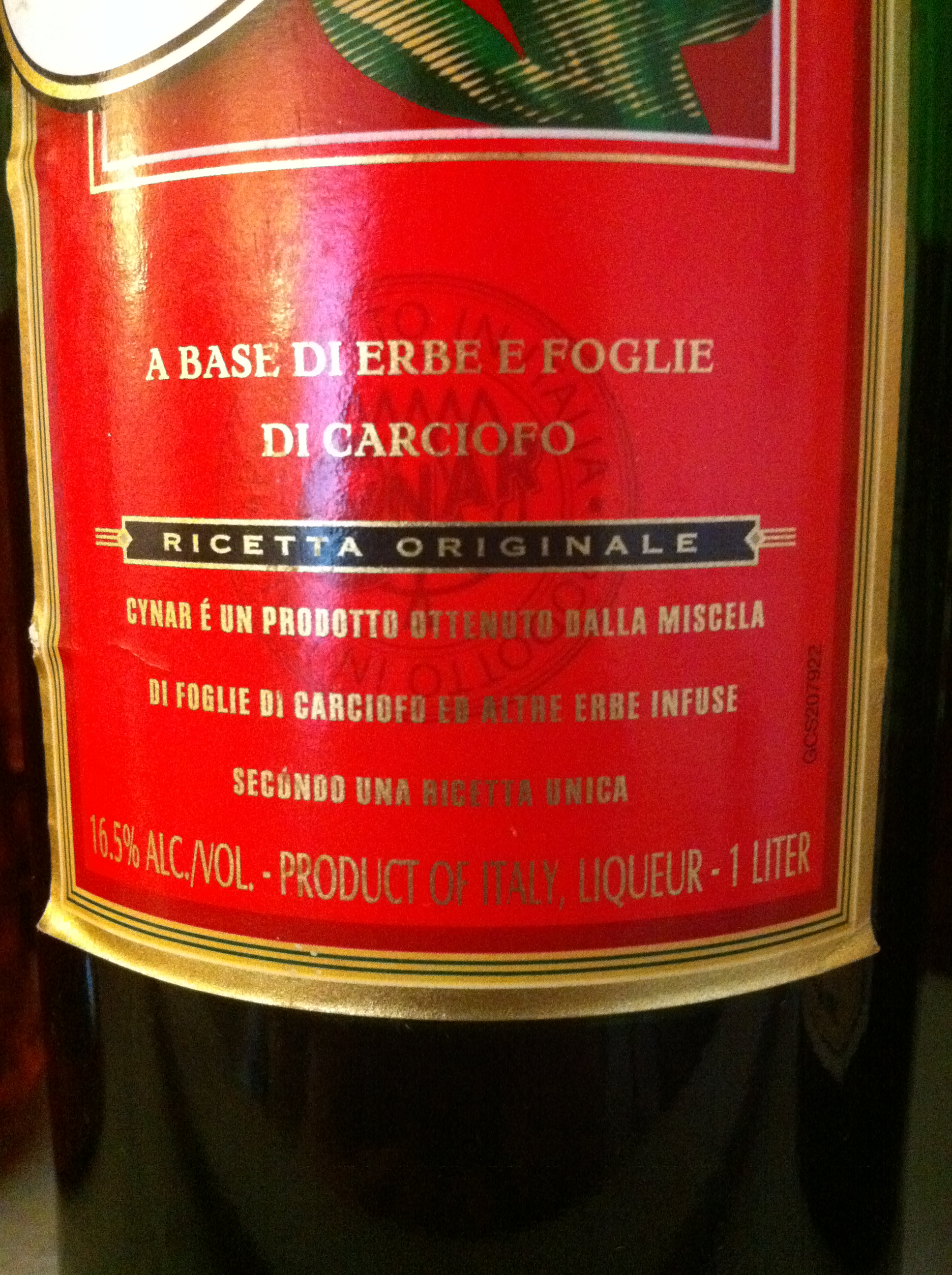
The label on the left translates to, “Herbal and artichoke leaves – The Original Recipe – Cynar is a product obtained from the mixture of artichoke leaves and other herbs infused according to a unique recipe.”

Bitter Giuseppe

After the Milano Swizzle, I wanted more salt in cocktails, and thought back to a drink my friend Addison had made me some six months ago, the Bitter Giuseppe.

There are a few different versions of this drink floating around. According to this blog, the drink was created by Stephen Cole of Chicago’s wonderful The Violet Hour, and then made salty by Kirk Estopinal of Cure in New Orleans. Estopinal’s recipe calls for Punt e Mes with salt, Cole’s original with Carpano Antica without, but both share Cynar’s artichoke heart. At Craft and Commerce, they (predictably) do it their own way.

Bitter Giuseppe
2oz Cynar
1oz Carpano Antica sweet vermouth
2 small dashes of salt
Combine ingredients in Old Fashioned Glass over ice.
Cut a lemon peel with enough meat to extract about 10-15 drops of juice
Squeeze juice into the drink, express peel oils on top, stir, and serve.

As detailed in a marvelous post on beta cocktails, the extra salt reins in the Cynar — this cocktail has twice the Cynar but only half the bitterness of the Milano Swizzle. Apparently while reading French scientist Hervé This’s dense & detailed volume, Molecular Gastronomy, Estopinal found that salt curiously tempers bitterness in liquids even more than sugar.

In this case, the salt blunted the bitter effect, allowing the liqueur’s component ingredients to showcase their otherwise overpowered flavors. The nose is a bit unengaging, but the taste offers a complex and pleasing barrage of herbal notes (orange and artichoke, to name two of several) and deep salted umami that fades into soft and lingering bitterness at the finish.

Milano Swizzle

Every great once in a while, a happy accident aligns our schedules and all my best friends have the same afternoon off. Tuesday was such an afternoon, and never one to beat a dead gift horse, we all immediately descended upon Craft and Commerce for some sunshine cocktails.

It was gorgeous outside – we’ve had more summer this winter than we had all of last summer – so I plucked the Milano Swizzle off the menu for something bitter and refreshing before my embarrassingly bourgeois meal of bacon-wrapped corn dogs.

Milano Swizzle
0.25oz lemon juice
1oz Cynar
1oz Beefeater London Dry Gin
1oz Carpano Antica
pinch of cracked salt
Fill with crushed ice, swizzle or stir until glass frosts;
garnish with lemon peel.

I’m fairly confident that this is unrelated to Tony Abou Ganim’s Milano, and shares the Italian city only as a source for the lovely potable bitters – in this case, the earth and artichoke of the Cynar. This is essentially a Negroni with a different bitter and a bit of lemon juice. What really excited me about this drink was the salt, still a stone relatively unturned in my cocktail experience and used deliciously here.

The drink started tart and led to a complex orange and earth herbaceous that the salt made almost savory, with the alchemy of the ingredients intensifying the Cynar for a sharply bitter finish. The salt was mostly undetectable but for the savory effect, and definitely makes me want to play with it more.

Our bartender Ryan commented that salt and Cynar enjoy each other’s company. Drinking it, you can clearly see how it can be taken too far, but you can also get a glimpse of its potential.