Fernet Branca

The Prelude:

Devil Fernet. My old friend.

My first taste of Fernet Branca was forced upon me at Green Street Grille in Boston. I think the bartender’s name was Andy, but we called him Copatude, in honor of ‘tudes he would so invariably cop. He mentioned Fernet, and then incredulous of our vacant expressions, asked (with raging ‘tude), “how have you never had Fernet?!,” and poured us some. I smelled it, and looked up at him to see if this was some kind of prank. “Dude,” he said, “trust me. This is the business.”

It tasted like boiled woodchips. It tasted like some hideous pre-Hippocratic Chinese remedy, or maybe the kind of after-dinner mint they’d offer in hell. It tasted not so much bad as unlikable, and I nope’d my way through every subsequent Fernet offering for at least a year. After a while, curious that so many people around me claimed to like it, I tried it again, and was surprised to find it tolerable. Six months later, I had it and I actually liked it. Then, the cravings began, the inexplicable desire for that sharp bitter complexity, a need for which nothing else would do. It was all I wanted to drink. “Mysteriously satisfying,” they say, one of the only lines in alcohol marketing that I completely affirm. That was probably three or four years ago, and it hasn’t stopped since.

This is how it goes for everyone, and Fernet Branca is, thus, the shibboleth of the cocktail world: when someone asks for a shot of Fernet, I usually ask them where they work. It is the bartender’s handshake, a way to recognize each other, as acquired a taste as you’ll ever find behind the bar. In fact, it’s so vile to the uninitiated that it works — more than any bar tool or tattoo or mustache — to distinguish between cocktail people and non-cocktail people. The perennial us and them.

This may all sound insufferably pretentious to you, and I’m not here to say you’re wrong. All I will say in our defense is that it’s not an affectation: we really, sincerely do love it.

[fernet] antique

The Facts:

Name: Fernet Branca (Fur-net, not Fair-nay)
Category: Potable bitters — the “amari” (plural) or “amaro” (singular) in Italian.
Subcategory: A digestive, and the first and most popular of the subcategory of Fernet
Proof: 78° (39% ABV)
Origin: Milan, Italy, since 1845.
Nose: pine; menthol; sharply herbal
Taste: layered throughout with peppermint oil, menthol, resiny pine, aloe, saffron, a little coffee, cooling mint, deep mid-palate bitterness, and a lingering, peppery minty finish that reminds me of the spots you blink out of the darkness after a firework show.

The Story:

Italians, as a people, are somewhat preoccupied with digestion. As such, they view eating and drinking as two arms of one culinary experience, meant to be enjoyed concurrently: before a meal, an apertivo/apertif has bitter herbs to stimulate the appetite; wine comes during the meal to compliment the food; and after, the bitter herbs in a digestivo/digestif allegedly (see Trivia, at bottom) hasten digestion and stimulate enzyme production while the carminative herbs relieve some of the gaseous effects of overeating. It’s not that they drink any less than we do. They just have a more convincing pretense.

So what is Fernet Branca? It is a digestive made by the Branca company, and the first and most popular of the subclass of amari (bitter liqueurs) called Fernet. So even though everyone always calls it “Fernet,” there are in fact many different Fernets — Branca has just managed to become synonymous with the category. So much so, in fact, that even bartenders are frequently surprised to hear that other Fernets exist. At the Branca distillery, they have an enormous case of these imitators (below), in a kind of “isn’t that cute” magnanimity.

[fernet] imitators

Fernet Branca was marketed initially as a home remedy. In 1845, Bernardino Branca (or his herbalist daughter-in-law Maria Scala) created the elixir in Milan and named it after Doctor Fernet, a Swedish centenarian who, they claimed, attested to the liquor’s health benefits and who, we know now, never actually existed. Despite his rather glaring ontological disadvantage, the imaginary Swede was very convincing, and together with Scala’s no-less-dubious claim that it relieves menstrual cramps, the brand took off.

One funny thing about Branca is that they’re unusually proud of their advertising prowess, a subject most brands allergically avoid. Most liquor companies don’t want their populace-manipulation tools to be scrutinized, but Branca has a whole section on their website about it, and a solid hour of their distillery tour is literally just showing you advertisements from the last 165 years. Funny or not, they were early to the idea that alcohol is a field especially susceptible to marketing, and this knowledge continues to serve them well.

[fernet] advertisements

Italians have it after dinner, or sometimes as a hangover cure, spiked in a bit of espresso. Fernet and coke is the national drink of Argentina, Fernet with a ginger back is the civic drink of San Francisco, and as I said, Fernet shots are the unofficial liquid mascot of the craft cocktail world.

The Product:

[fernet] flavor wheel

They tell people it’s made from 27 herbs, some of which are secret. The real number is closer to 40, seeing as there is actually an enormous flavor wheel at the Branca distillery that shows you 29 raw ingredients. It may be 27 herbs and 14 roots, or whatever, but the point is that there’s a lot. Here’s what they’ll tell you is in it:

Orris, colombo root, coffee, laurel leaf, myrrh, cardamom, aloe, small centaury, mace, bitter orange, juniper, zedoary, chamomile, tea, anise, cocoa, musk yarrow, linden, peppermint, marjoram, white agaric, Chinese rhubarb, bitter orange ring, gentian, cinnamon, chinchona bark, galanga, saffron, and what my notes seem to say is “Green Perding,” which is not a real thing but I embarrassingly can’t read my own handwriting.

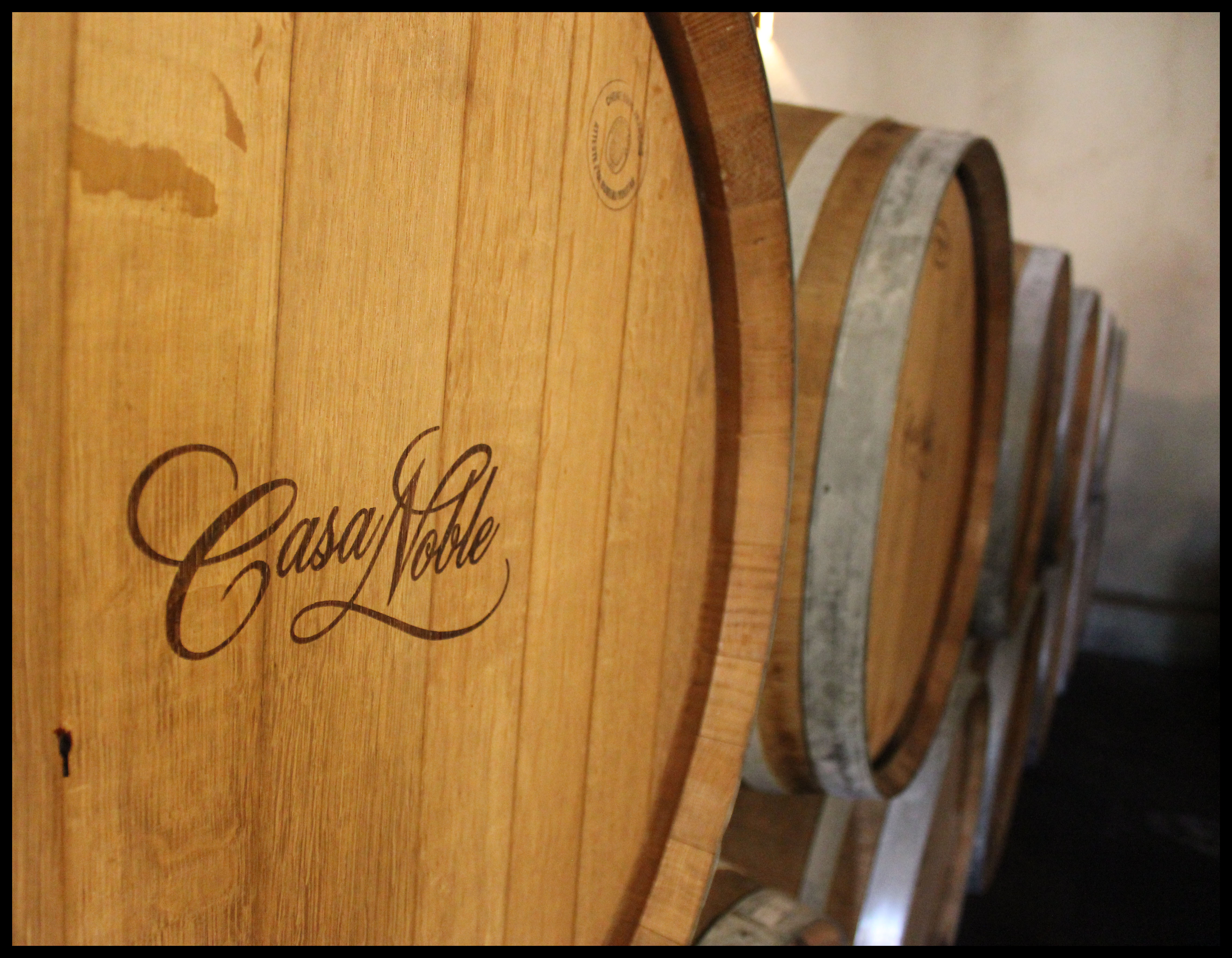
They infuse these in (secret) batches according to their (secret) recipe on a backbone of overproof neutral spirit they buy by the railroad car. It’s aged in their cavernous cellar in 10ft tall, 20,000-30,000 liter Slovenian oak barrels for a year before bottling.

[fernet] caves

One of the things that marks Fernet Branca is that it’s exceptionally dry — there is very little, if any, sugar added, and is therefore not a liqueur, by definition or otherwise: liqueurs are sweet and soft and simple, meant to facilitate introductions between spirit and drinker, like Fredo Corleone sent to Vegas to meet Moe Green and establish the family. Fernet is more like Sonny, who can barely spend 10 full minutes in a room before either (1) fucking someone or (2) beating the shit out of them.

The Uses:

I’m of the opinion that alcohol is never healthy — there are smart people who swear by that digestivo business, but I personally have never experienced it. I will say that a shot of Fernet is the greatest short-term hangover cure ever created (long term being, of course, cheeseburgers and action movies). It’s great to shoot and nice to sip, once you’ve acclimated. It goes well with ginger ale or ginger beer, and the South Americans will insist on pouring coca-cola into it, and… you know… fine.

In cocktails, you rarely see it more than a half-ounce at a time. It’s an uphill battle getting it to play nice with other ingredients, and the best Fernet cocktails I’ve had use between 0.25oz and 0.5oz for a lingering peppermint finish. Online searches will give you the Toronto and the Hanky Panky, but the best Fernet cocktail I’ve had is either the Autumn Negroni or the Don’t Give Up The Ship.

Full list of Fernet Branca cocktails here.

TRIVIA #1: Allegedly. Digestivos allegedly aid digestion. This article is written taking this claim at face value, but I’ll save you the Google work and tell you there is no reputable scientific evidence for these claims, or at least none that I could find. In fact, every single time the emotionless light of science has been shined on this particular issue, it finds the opposite: alcohol hinders digestion considerably more than any herbs in the alcohol would help it. As a mild anaestetic and vasodialator, alcohol may relieve some of the experience of overeating, but hasten digestion it don’t.

TRIVIA #2: The inclination to pronounce it “fair-nay” is understandable, as it actually is a French word. It’s a surname originating (as best as I can tell) around Burgundy. The Brancas probably chose it for their fictional 100 year old Swede because it was exotic. Nonetheless, as Fernet Branca is an Italian product, we pronounce it the Italian way, and Italians — like almost every other language using the classical Latin alphabet — think a silent T is fucking stupid.

Chrysanthemum Cocktail

“Numerous early-20th century cocktails, none more pleasant to sip than this drink, were named after flowers.”

— Jim Meehan, PDT Cocktail Book

There are more complex cocktails than the Chrysanthemum, there are more inventive drinks and more refreshing drinks, but I can’t think of anything more unrelentingly pleasant than this bizarre little sipping cocktail from 1916.

History:

In bars, the Chrysanthemum is semi-known: ask for one, and you’ll see your bartender try to summon it from a dim echo of memory. Even if he or she knew the recipe at one point, they’re rarely made and never ordered. On the internet, however, seemingly every cocktail blog that has ever existed in the world has written about it in one way or another.

[c] google screenshot

Usually when I see this kind of wall-to-wall, Kardashian-grade coverage of a topic, I just move on. But here’s the thing: I can’t stop telling people about this drink. It’s that fucking good.

It’s sometimes erroneously credited to Harry Craddock’s 1930 Savoy Cocktail Book. Craddock’s book does include the recipe, but he adapted it from Hugo Ensslin’s Recipes for Mixed Drinks, published some 14 years earlier in New York City. Ensslin, a German immigrant, was head bartender at the Wallick Hotel at the southwest corner of Broadway and 43rd St (an intersection now more or less engulfed by the neon madness of Times Square), and he self-published his cocktail book and sold copies out of his modest home, in what is now Harlem. He wasn’t the celebrity Craddock was, but his talent, told through his drinks, was monumental.

The Chrysanthemum is unusual in that it doesn’t contain any traditional liquor base at all. It’s chiefly dry vermouth, spiced and warmed with the 80 proof liqueur Bénédictine, and spiked with a dash of absinthe. 

Chrysanthemum Cocktail

2oz dry vermouth
1oz Bénédictine
2 or 3 dashes (<0.2oz, about 1tsp) of absinthe
Stir over ice for some 20-30 seconds. Serve up, garnished with an orange peel.

[c] glamour shot

The vermouth is a very light spiced wine, whose botanicals stretch and showcase and diffuse the much more pungent Bénédictine very well. We get all of Bénédictine’s warm spice, the cinnamon, saffron, honey and nutmeg, combining with the vermouth to give a curious and alluring bready note. The absinthe spikes up and adds complexity, culminating in a delicate, elegant, beautiful drink.

[c] bottles

Variations:

The only problem with this drink is that it’s a little bit sweet, on par, as Erik at Savoy Stomp points out, with a glass of apple juice. With the sweetness and the absinthe, I’ve had more than one person compare it favorably to a Good & Plenty. It’s not so sweet to be a problem for everyone, but it’s a valid critique. And that’s already toned down: in Ensslin’s 1916 original, it was equal parts (!) Bénédictine and dry vermouth. Craddock improved it in 1930 by making it 2:1, but he still says to shake it, which absolutely no one should ever do. Nonetheless, his 2:1 with a few heavy dashes (~1/8th oz) of absinthe is most-quoted recipe.

If the sweetness is an issue, it might seem obvious to reduce the amount of Bénédictine, but this is a mistake. Bénédictine is the backbone of this drink, and bringing it down to even 0.75oz gives you a watery, effete cocktail. In Meehan’s PDT Cocktail Book, he lists it as 2oz dry vermouth and 0.75oz Bénédictine, but he comes with a full 0.25oz absinthe. This does succeed in bringing down the sweetness while keeping the overall force of the drink, but for me, the absinthe chases away much of the delicacy.

[c] from the topIf sweetness is a problem for you, my favorite mitigation is to tune up the vermouth a little. My submission:

Chrysanthemum Cocktail (Dry)
2.5oz dry vermouth
1oz Bénédictine
2 or 3 dashes (<0.2oz, about 1tsp) of absinthe
Stir. Up. Orange peel.

It’s worth your time, any way you take it. Cheers.

Tax Stamp Bourbon Tasting

** Disclaimer: more whiskey nerd stuff.**

If you’re like me, you sometimes find yourself in the whiskey aisle gazing somewhat disdainfully down at the bottom shelf. They’re all labels you’ve seen before – dirt cheap with comically dated graphics, all their names “Old This” or “Ancient That” or “Ye Olde Grandpap’s Straight Old Fashioned Style Very-Old Bourbon.” And if you, like me, wonder why these fiery dinosaurs continue to exist… well, turns out, some of them used to be pretty fucking good.

Southern California Whiskey Club:

Last week, Chris Uhde of the excellent Southern California Whiskey Club made stop down in San Diego to offer us a slice of whiskey fanaticism. Chris is a 7th degree black belt in Liquor Store Archaeology  and makes a hobby of unearthing forgotten, dusty bottles hidden behind armies of Hiram Walker sugar-syrup on crusty aluminum shelves. His ability to host tastings like this one stems exclusively from this ability – he finds them, buys them, and then shares them with us.

Tax Stamps were proof of taxes paid, a thin whitish strip over the cap of bourbon (doubling as a tamper-proof seal), and were federally mandated until 1985. So generally speaking, “Tax Stamp bourbons” are bourbons bottled at least 27 years ago. Whiskey isn’t like wine – it doesn’t change once it’s in the bottle. So these tastings are both rare and valuable, because these bottles are essentially time capsules. How does our bourbon today compare to what they were drinking 30 or 40 years ago?

The Tasting:

I’ll present them as we had them, in pairs of two. The reason for this is because I believe it’s extremely difficult, maybe even impossible, to taste things out of context. What something has next to it will greatly inform how that thing tastes, and while one should continue to aspire to objective tasting, I’m not sure it’s possible.

This is also why I’ll occasionally use terms like “tastes like ass.” I find them descriptive.

First Round: Antique (1970s) vs. Yellowstone (1976)

Antique came from the Athertonville distillery, closed in 1980, and seems to have been a pretty good product. Yellowstone was a fantastically popular bourbon in the 60s and 70s, from the Glenmore distillery, which closed in 1991. They continue to produce it at Heaven Hill, but no one cares.

1. Antique 6-year – 80 proof – from 1970s

Nose is heavy caramel and molasses, indicative of a corn-heavy mashbill. Palate confirms: there’s a graininess, a kind of hay-ish grain, and a strong note of maple. Add a few drops of water and the graininess more or less goes away, replaced with a harder maple note, which now evokes French toast and butterscotch.

This is surprisingly good. I like the heavy hitting sweet notes. Long maple finishes are pleasant.

2. Yellowstone 4 year – 86 proof – from 1976

Softer than the Antique, despite higher proof and younger age. A bit fruity with sweet spice. More maple notes, but again, softer. Delicate for such a young product.

Interesting. I can see why this was Kentucky’s best selling bourbon in the 1960s. It’s not terribly mature or complex, but it is hazardously drinkable.

Second Round: Old Crow (1976-1978) vs. Old Crow (2013)

The Old Crow is an interesting story: Old Crow was, at one time, the best selling bourbon in the United States. Something happened in the 60s to alter the recipe – no one really talks about it, but the rumors point to a production mistake that money-hungry owners never cared to fix – and the brand, while still a competitor to Jim Beam, never recovered. So when National Brands unloaded Old Crow in 1987, Jim Beam bought it, and set about to more or less ruin it so Beam would look better by comparison. It is now their bottom shelf, essentially a 3-year old Jim Beam.

3. Old Crow – 80 proof – from 1976-1978

There’s a hot corn punch to the nose, whose volume is turned a little down to on the palate, but not that much. Thick mouthfeel, gives a corn blast on the palate. Like a less-good Buffalo Trace. A few drops of water lead to harder caramel notes but it’s still very dry. Textured and bitter.

This is no prize or anything, but it’s way better than the shit they’re bottling now.

4. Old Crow 3 year – 80 proof – from 2013

Big ugly rye graininess. “A slice of ass,” our table mate posited. A little fruity, a little minty. Raw oak. Young. Hot. This tastes like what it is: a bourbon not good enough to call itself “Jim Beam.”

I’m pretty sure I’ve worse had bourbon than this, but it’s hard to remember when.

Third Round: Old Taylor (1982-1984) vs. Old Taylor (1977)

Old Taylor was sold in 1972 to Jim Beam, who didn’t exactly shit on it the way they did Old Crow, but who turned it into a Beam product. But, it was then, as now, a six-year old bourbon, so bottled in 1977, it would’ve still been Old Taylor distillery juice.

*** EDIT – 5/7/16: Some very informed stranger corrected me in the comments: Old Taylor was distilled at the National Distiller’s Castle Distillery until 1972, at which point the distillery was shuttered (too much fine bourbon, not enough people drinking it. Imagine that.) From here, people disagree: Two people are saying Beam bought Castle Distillery in 1972 and shuttered it (but continued to use warehouse space), while Chuck Cowdry says ND closed it themselves, and didn’t sell it to Beam until 1987. In all such matters it’s best to believe Chuck Cowdry.

So, it appears that National Distillers didn’t sell the brand to Beam until 1987. So while the two Old Taylor’s were different proofs and from different distilleries, they were both National Distillers products I guess. Thanks informed stranger! ***

5. Old Taylor 6-year – 86 proof – from 1982-1984

Rye nose. Smells like a Beam product. On the palate, it’s a little hot, not only with alcohol but with cinnamon as well – hot like Red-Hots. A tangled midpalate and a curious note of raspberries leads to long, maple-sugar finish. With a bit of water, the heat changes, becomes expressiveness.

With a spot of water, this is actually pretty good.

6. Old Taylor 6-year – 80 proof – from 1977.

Similar, but with the volume turned down. The rye is expressive, but the flavors don’t pop – it stops short of the heights. Less amplitude. Caramel spice. Rye. Straight-forward.

A totally acceptable, if a bit uninteresting, bourbon. It clocks in a couple degrees lower than the other Taylor, and it tastes like it could benefit from a bit more heat. I actually prefer the Beam product later product. Imagine my surprise.

Fourth Round: Old Grandad (2013) vs. Old Grandad (1977)

When the Old Grandad distillery closed and the brand was sold to hungry-hungry brand hippo Jim Beam, Beam tried their best to keep everything the same. Same mashbill, same distilling numbers, same entry proof, etc… basically, the exact opposite of what they did to Old Crow. Tasting it, it’s clear they were not successful.

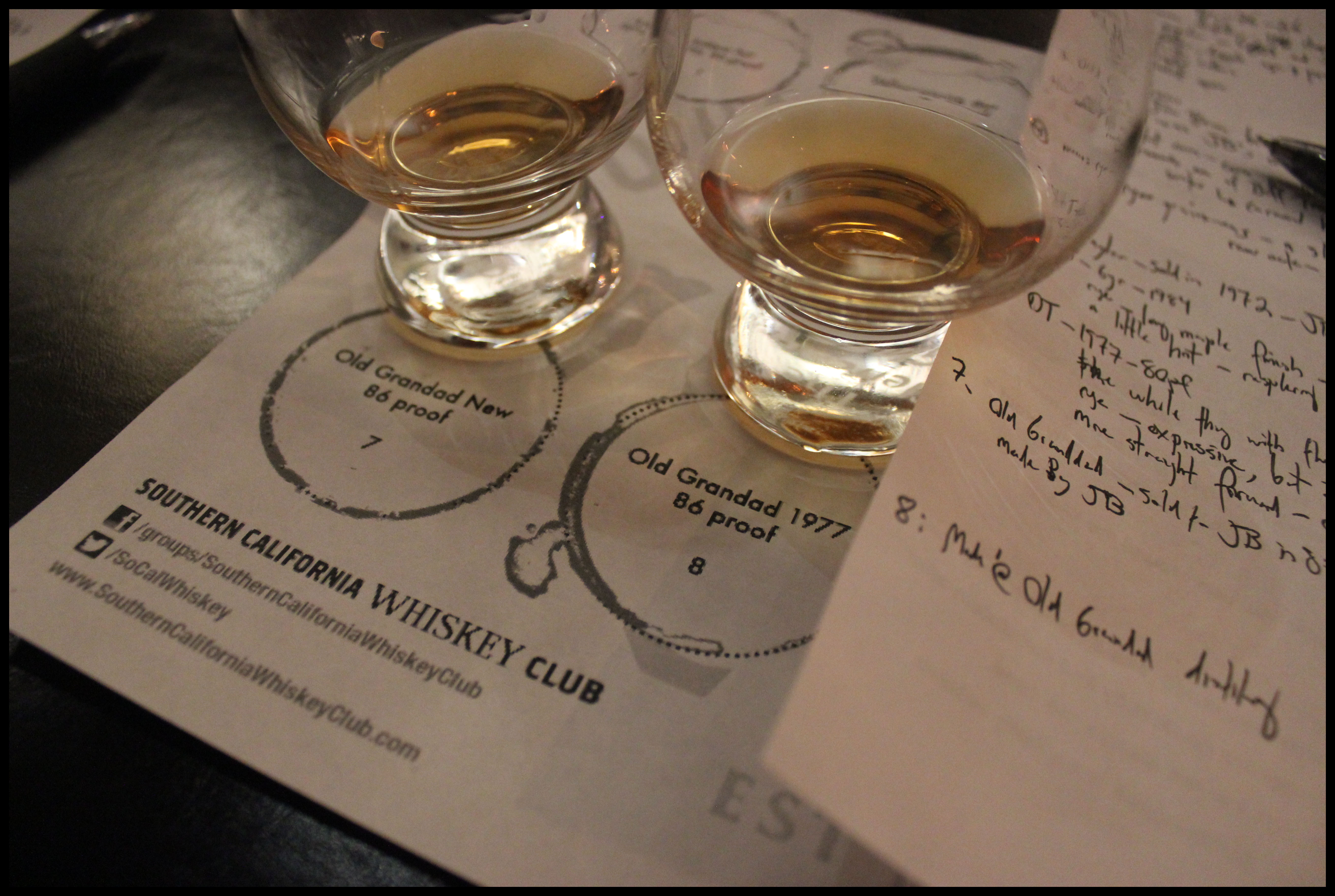
7. Old Grandad – 86 proof – from 2013

On the nose: big rye punch. Rye graininess and almost fruity flavors. This is more or less confirmed on the palate, at least in the front palate: it comes first rye-forward, and then a powerful caramel note I didn’t see coming on the nose takes it all the way home.

Not a bad product, and a good value for the not-very-much money it costs, but I’m still not buying a bottle.

8. Old Grandad – 86 proof – from 1977

Nose: complex. Corn and rye both. Caramel spice, and a strange and alluring note of dried fruit (raisins). Once sipped, the dried fruit becomes more apparent – this tastes a little like rum, or some wonderful mixture of rum and whiskey. The mysterious Rumisky. Vanilla adds to dried fruit. Cognac notes. Tastes like it was rum cask finished.

Wow. Clear winner of the night. I want to drink this all the time.

Fifth Round: Early Times (2013) vs. Early Times (1982)

Early Times uses both new and used barrels, and as such legally prohibited from calling itself a bourbon (bourbon must be only new barrels). It was a bourbon in the 80s though, and so a direct comparison is mildly unfair, but it’s fun to see what it was.

 9. Early Times – 80 proof – from 2013

This smells rubbery, inorganic. Not much else – used barrels give less flavor, and this is evident in the lightness of the final product. Very mild. A little like Seagrams 7 or something, but a little hot. Evokes wet paper.

My thoughts best expressed as a quote from our host, when someone remarked to him that this tastes like hot, dirty water: “What is this — $7.99 a bottle? They’re not selling this to bourbon drinkers. They’re selling this to alcoholics.”

10. Early Times – 80 proof – from 1982

This is a bourbon – it smells rich (especially comparatively so) with corn sweetness. This continues on the palate and is added to by the type of lighter, ethereal flavors a lower proof encourages: coconut; marshmallows; toast.

Comparatively this is the cat’s fucking meow, but I’m not ready to call it great. It’s a solid, entry level bourbon, and more than anything (just like all of these, really), it’s a fun look at the genealogy of the brand.

Lillet

The Facts:

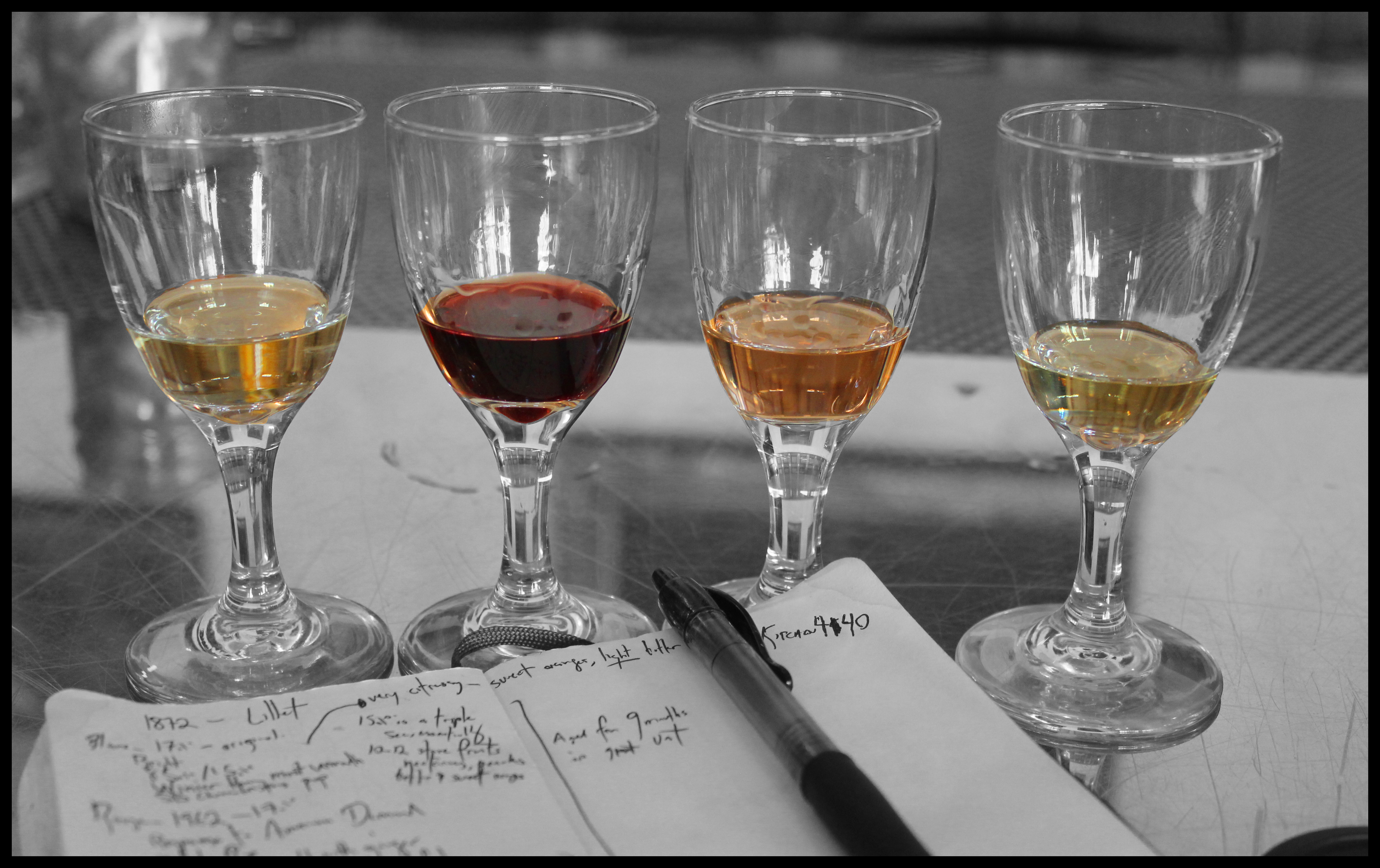
Name: Lillet
Category: Aromatized wine — “tonic wine,” or quinquina
Proof: 34 (17% ABV)
Origin: Bordeaux, France — since 1887.
Composition: 85% wine; 15% fruit liqueur
Styles: Lillet Blanc, Lillet Rouge, Lillet Rose

lillet welcome shot

The Story:

In 1872, the brothers Lillet (Paul and Raymond) began distilling and dealing in wine in the town of Pondensac, just south of Bordeaux, France. Bordeaux then, as now, was big business; beyond its formidable wine reputation, the city sits on the Gironde river just in from the Atlantic coast and was a major trading port, so local residents enjoyed access to the kinds of fruits, herbs, and spices they wouldn’t ordinarily see.

The Lillet brothers began making eaux de vie and liqueurs from some of these exotic fruits (sweet oranges from Valencia, green oranges from Morocco/Tunesia, bitter oranges from Haiti), and before long come up with a recipe for an apertif based on the excellent local wine, bucked up with some liqueur and spiked with the antimalarial tonic quinine, from Peruvian cinchona bark.

The product was explosively popular. They called it Kina Lillet — the “Kina” a reference to  quinquina, the French collective term for apertifs infused with quinine — and by the turn of the century they ceased production on all other liquor and began making Kina Lillet exclusively.  Prohibition in America was obviously a hurdle, but it got a couple nods from soon-to-be-classic cocktail along the way — the Corpse Reviver #2 in 1930 was probably the best of these, but the 20th Century (1937) and Casino Royale’s Vesper (1953) helped it along.

Lillet tried to expand the line in 1962 with Lillet Rouge, made from red wine, specifically for American palates. That Lillet Rouge is phenomenally tasty must’ve been kept some kind of secret, because no one bought it. Tastes drifted away from apertifs and sales continued to sag, and in 1985 the brand was sold to Bruno Borie (of the Grand Cru classified Chateau Ducru-Beaucaillou) and given a face-lift in 1986 — they dropped the “Kina” from the name and just called it Lillet Blanc. Whether or not they changed the recipe (to make it less bitter) remains an area of some (still quite bitter) dispute. More on this below.

Rounding out the line is the Lillet Rose, a delicate,  mostly-blanc mixture of the two products that hit shelves a couple years ago. And they continue to produce a kind of reserve, Jean de Lillet Blanc, which I’d never even heard of before the tasting the other day.

The Dispute:

Lillet now has competition. The cocktail resurgence has been wonderful for it — sales jumped 20% after Daniel Craig ordered the Vesper cocktail in Casino Royale, and with the resurrection of the Corpse Reviver #2 in particular, every well stocked bar now keeps a bottle of Lillet Blanc. However: the competing and the long awaited Cocchi Americano is now available on American shores. Cocchi is less wine forward, both sweeter and more bitter, and general wisdom says that it’s the closest thing to what Kina Lillet used to taste like, before they changed the recipe. Therefore, this wisdom says, if you’ve got the Cocchi, use it in the aforementioned cocktails.

The company line at Lillet has now become we have never changed the recipe shut up you all are lying shut up. This is a difficult position to take in the face of several competing claims: there is a particularly damning book of Lillet history that leads up until the rebranding, as well as a 3rd-party Bordeaux information site that seems both complete and well informed. From these, we know that the production was modernized in 1986, and that it was rebranded as “fruitier, lighter, and less bitter.” So at first glance, it would seem that Lillet is simply lying, as they have every financial reason to do so.

But as it turns out, it’s not as easy as all that: apparently, there were at one point two different recipes, a “dry export” version and an “extra dry,” in addition to some confusion with a vermouth called Lillet, and blah blah blah. Erik over at Savoy Stomp has made a project of this somewhat tepid controversy, and he explains it in better detail than I ever could or would, if you’re interested, here.

What I know is how it tastes, which is pretty damn good. I don’t really care if they changed it or not.

What we have is two similar but different products, which is not like uncharted territory or anything. Make the drink with both. Whichever one you like better? That’s the one to use.

The Styles & Tastes:

They treat their bottles pretty much the same down the line. Each is 85:15 wine: liqueur, each oak aged for 9 months.

Lillet Blanc
85% white Bordeaux wine (80% Semillon, 15% Sauvignon Blanc, 5% Muscadel)
15% fruit liqueur (85% orange liqueur, 15% stone fruit liqueurs)

Very bright, very citrus-forward. The orange combines wonderfully with the white wine, giving sweet orange and a light bitter balance. This is considerably lighter than Cocchi Americano, and distinctly evokes wine (sometimes the wine flavors are infused right out). The brand ambassador suggested we take it on ice with a lemon or orange peel, which sounds like an excellent idea to me.

Lillet Rouge
85% red Bordeaux wine (80% Merlot, 15% Cabernet Sauvignon, 5% Cabernet Franc)
15% fruit liqueur (85% orange liqueur, 15% stone fruit liqueurs)

The rouge was the big shock to me, and my clear favorite of the day (Amanda commented that this is frequently the men’s favorite). The rouge is different from the other two, and should be treated as such: I’d serve it chilled but keep it away from ice. It’s powerful with big red-wine fruit and tannins, which is only intensified by the sweetness. Pungent, powerful, beautiful apertif. I bought a bottle and Vikki and I killed it in like 3 days.  Like the others, it is extremely wine-y, and as such is somewhat difficult to mix — I haven’t yet made something I like better than just sipping it on its own — but taken neat, chilled, with lemon peel or without one, it’s wonderful.

Lillet Rose
85% wine (mixture of all the grapes, but mostly white)
15% fruit liqueur (85% orange liqueur, 15% stone fruit liqueurs)

The youngest child, and the favorite of most people at the tasting. Firm, bright, and textured, the Rose has flavors all its own — strawberries, stone fruit, grapefruit — while remaining not too sweet to be refreshing. Take it as you would the Blanc — on ice, kept light, maybe with bubbles. It’s marvelous on crushed ice. For some reason I want to mix it with watermelon, which sounds mildly redundant but almost inescapably delicious.

Reserve Jean de Lillet (vintage)
Same genealogy to the Blanc

This one is aged in French Oak for 12-16 months compared to 9 for the others. I’ve literally never seen it in the wild (they only make like 1000 bottles or something) but grab one if you see it: it’s oakier, richer, and sweeter. A little oxidized. Tastes like a Sauternes. Delicious.

BONUS TASTING:

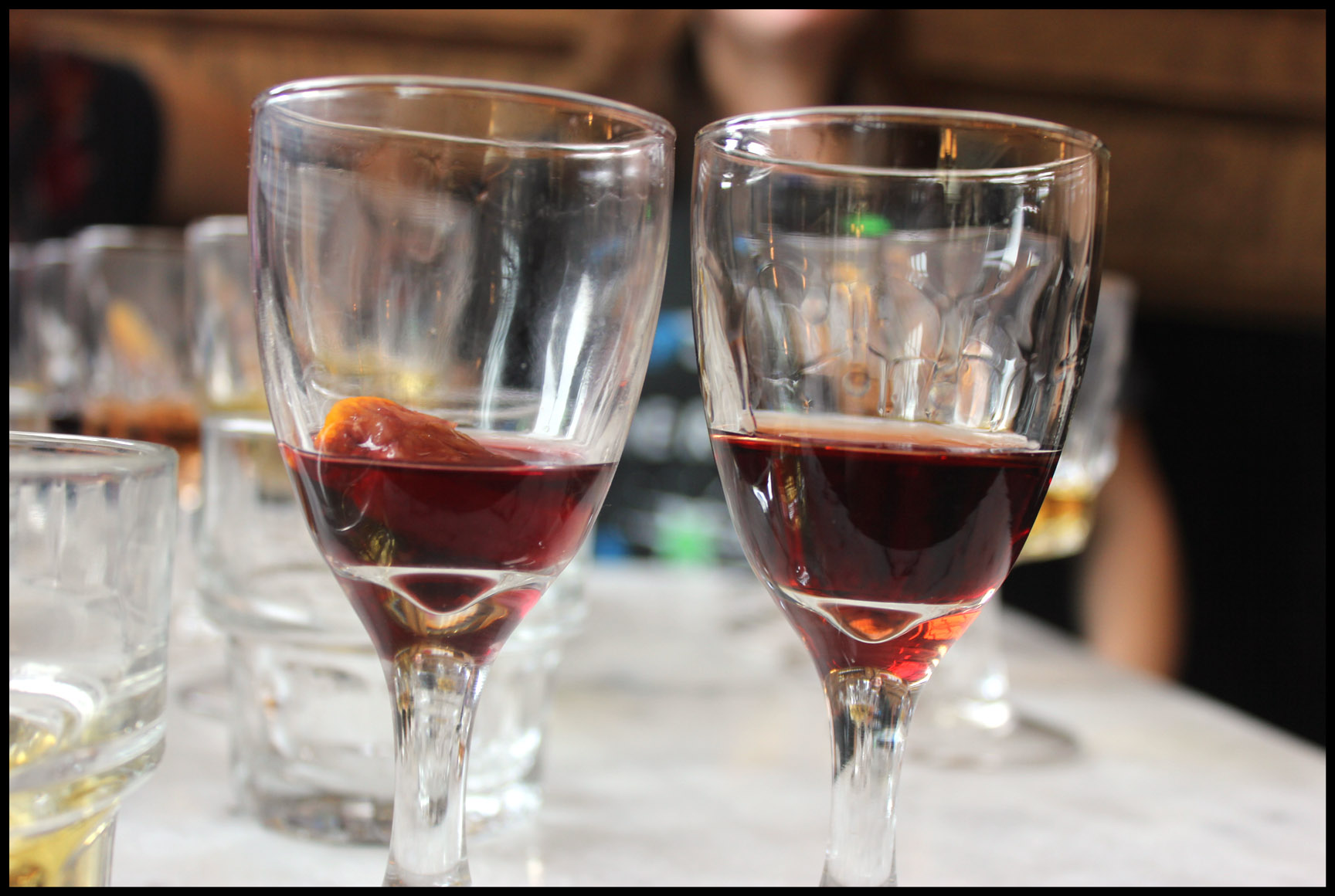
Someone at our table asked, “What’s the difference between Dubonnet (another French, red-wine based, quinine-containing apertif) and Lillet Rouge?”

Dubonnet is sweeter and way more oxidized. The Lillet is powerful with tannins and fresh grapes, while Dubonnet evokes port, all dried fruit, figs and raisins, and is textured, a bit more bitter with quinine. And now you know that.

Casa Noble

The Facts:

Distillery: Cofradía
NOM: 1137
Origin: Tequila, Jalisco, Mexico, since 1996
ABV: 40% for their standard offerings, some cask-strength (51%+) special releases
Distinguishing characteristics: dusty/sweet chocolate; vanilla; cinnamon; pepper; baked agave

The Preamble:

There are too many tequila brands in this world.

While it’s certainly not unprecedented for a single distillery to put out more than one brand, no one’s run away with it quite like they have in Mexico. There are roughly 140 active distilleries in Mexico putting out, as of March 19th, 1633 different brands, most of which come in a set of blanco, reposado, and añejo, and a weighty proportion of which are bad. There’s an embarrassing amount of celebrity brands, there are the slickly marketed giants and the bottom scraping mixtos and a bewildering array of products that come in oversized glass firearms… so the question, “what makes this bottle special?,” for tequila, can be a particularly difficult one.

I say that to say this: one of the nice things about Casa Noble, out of the Cofradía distillery just outside the town of Tequila, is that they make that question extremely easy to answer.

The Story:

Casa Noble has history stretching back to the 1770s, but has existed in its current form since 1996. Jose “Pepe” Hermosillo’s family has been in the tequila business for seven generations and affiliated with Cofradía for 70 years — it’s all a bit vague as to exactly what and who and how — but what’s important is that almost 20 years ago he co-founded Casa Noble as we know it today.

Whether in response to the colorful homogeneity of the tequila aisle or in anticipation of it, Casa Noble takes great care to set themselves apart, claiming not one but five unusual or unique distinctions:  it is a (1) triple distilled, (2) kosher (3) organic tequila that’s been (4) certified Green by the Mexican government, and (5) aged in new French oak.

Points #1, #3, and #5 have significant flavor ramifications, #4 is just cool, and #2 doesn’t matter at all. But let’s unpack it:

(1) triple distillation:

Most tequila is only double distilled, which is, for the most part, a good thing. Very generally speaking, the more distillations, the higher alcohol proof, and the more flavor is stripped out of the product. So the designation of triple distillation is a strange one because it is simultaneously attracts novices and repels aficionados.  However. The speed and quality of the distillations is exponentially more important than their number, and Casa Noble’s three passes take the spirit only up to 57% or so, which is industry standard. They take three runs to get to where most people get in two.

(2) kosher:

The kosher rules for spirits are predictably silly but don’t dictate any big change in their methodology. I think they have something to do with the lunar cycle, but the “this is stupid” voice in my head actually drowned out Dave’s explanation, and I lost the salient details. What it really means is that production in the entire Cofradía distillery has to shut down and wait for rabbis to come poke around and give it their OK.

(3) organic:

Casa Noble began pursuing an organic certification about 10 years ago, and finally got it in 2009. They are one of only a few organic tequilas, and this is more significant than it may at first seem. They court USDA certification through the stringent California Certified Organic Farmers (CCOF) organization, which includes all the normal rules in addition to a tedious litany of their own (your fields must be >1km away from major highways, lest an errant inorganic seed fly off a truck and plant itself in your land, etc.). Why does this matter? Because of the care they are forced to take with their fields. When you can’t apply the hammer of modern biochemical science, you really need to look after your plants. The agaves are stressed and the yield is smaller, but Casa Noble believes this makes a more complex, dynamic spirit.

(4) certified green by the Mexican government

This doesn’t mean so much for flavor, but it gives an indication of where their priorities are: they have a modern water treatment plant on the grounds, so all the waste water from distillation, all the otherwise toxic fusel alcohols, and all the compost agave fibers get treated and returned safe to the land. Which is… you know… nice.

(5) aged in new French oak

Almost all tequila, when aged, is aged in used bourbon barrels, because the bourbon industry gluts the market. Bourbon, by law, must be aged in a brand new white oak barrel each and every time, which is wasteful on a uniquely American scale, but has a fringe benefit in that tequila, scotch, rum, and everyone else gets once-used barrels at absurdly low prices (think somewhere around $50, compared to somewhere around $1000 for new French oak). French “Limosin” oak is toasted instead of charred and has a tighter wood grain, and after time, this expresses itself through the tequila with flavors of bitter chocolate, cinnamon, and vanilla. While I generally prefer the reposado of most brands, Casa Noble is one of the few tequilas I think, for the most part, gets better as it gets older.

The Process:

Agaves:

Casa Noble is all estate grown, from some 6500 acres hosting about a million plants. Their land is in Uzeta reigon of Nayarit, right on the border of Jalisco, and agaves are harvested between 10 and 14 years for peak ripeness, on the long side of standard (though possibly because of that no-chemical approach).

Baking & Crushing:

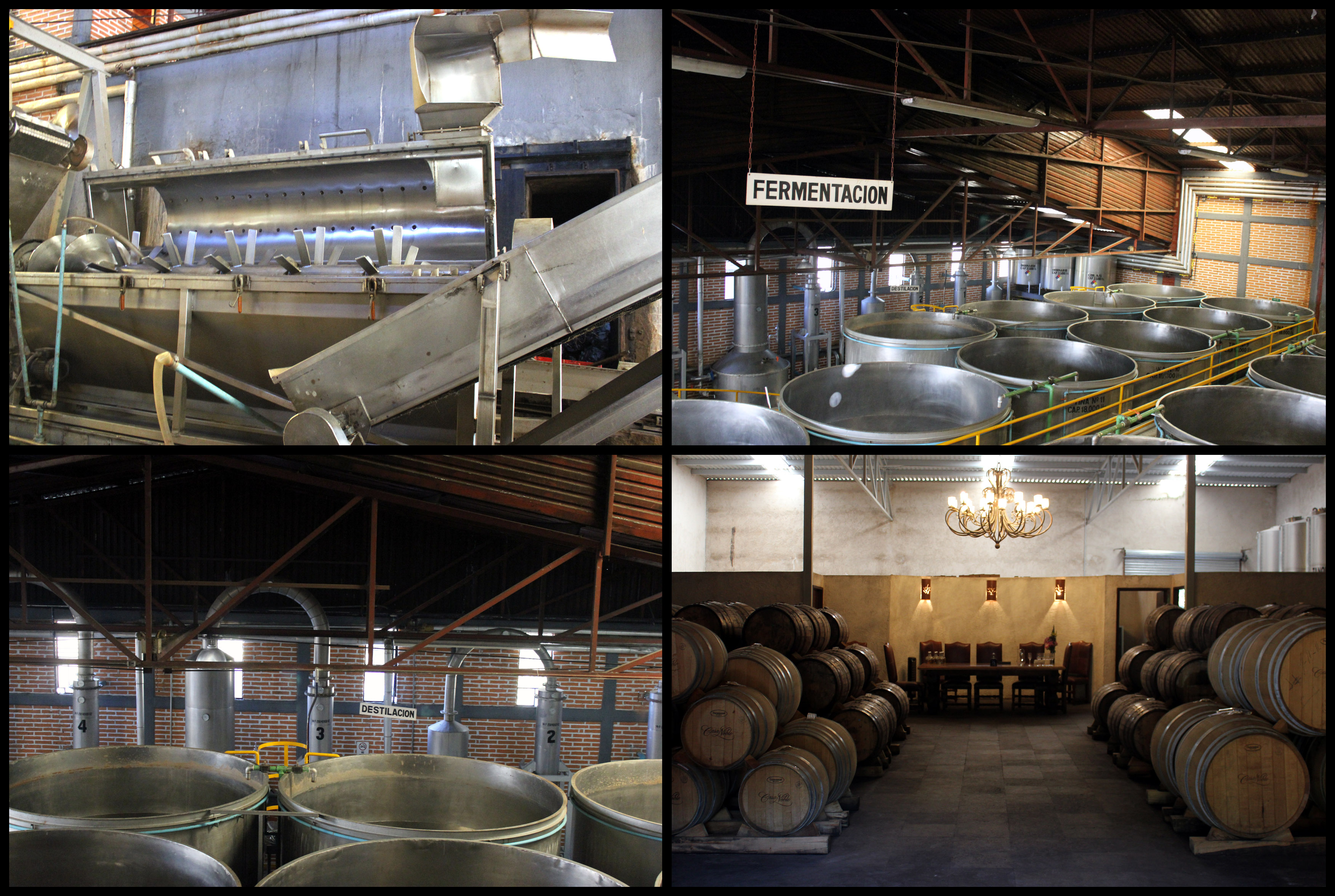
Cofradía keeps 5 brick ovens, where they steam-cook the agaves for about 36 hours to release all the juices. There’s a drain in the oven as well, so to not lose any of the precious “oven-honey” that sags out of the hearts when they’re cooked.

Piñas may keep the precious sugary nectar but they are still essentially wood, so they need to be crushed. Casa Noble has an unusual crusher, a long narrow 800rpm combination screw/spike – the agaves are broken apart with the screw, then fibers separated by the small narrow fan-like blades, which was designed to extract the juice without pulverizing the wood grains. Less overall violence means less methanol, which means less blindness.

Left to right, top to bottom: (1) the agave crusher, (2) fermentation tanks, (3) stills, (4) their combination barrel room/tequila church.

Fermentation & Distillation:

They keep eighteen 18,000L fermentation tanks, and like almost everyone else, they ferment using a proprietary yeast. It takes some five days before the low-alcohol agave brew shipped to the stills.

Cofradía has five total stills but only Casa Noble is only distilled in three passes – the first run through what they charmingly refer to as “the destroyers” gets the spirit up to somewhere around 25%, then the second pass and third pass on smaller stills, ultimately capping out around 57% ABV. Again, not only is it unusual for a tequila to be distilled three times, it’s unusual for a triple distilled product to only be distilled to 56% — usually people distill higher than that, as the whole idea is to further purify (read: remove flavor from) the spirit.

I’d be intensely interested to taste a twice-distilled Casa Noble, but we don’t get everything we want.

Aging & Tasting:

The blanco – they call it “Crystal,” because they know how to market as well as anyone – is unaged. There’s some vanilla, but most sweetness is distinctly baked agave sweetness. Mint and herbs (thyme?) and a stronger note of black pepper. It’s not very showy and my least favorite of the lot — a great (if expensive) mixing tequila, it’s certainly not bad, but I get the sense that it was built to be aged.

The reposado is aged 364 days, exactly one day short of it being a technical añejo, in some of their used barrels. The French oak influence sets itself apart here – you get bitter chocolate, baking cinnamon and faint vanilla notes to compliment the sweet baked agave flavor. The reposado is phenomenal.

The añejo sleeps two years in brand new French oak barrels, and is both sweeter and darker/richer than the reposado. Here, it’s bittersweet chocolate that shifts beneath firm oak presence. The wood mutes it a bit, turns the volume down: it coaxes more vegetal notes out of the agave. Bitter cinnamon. Not much left of the vanilla, but it’s there. Long chocolate finish.

The five-year añejo is a single barrel, extra aged gem. Mine was the barrel selected by Hi-Time liquors in Costa Mesa, and it’s utterly decadent. The bitter chocolate turns sweet, along with rich, buttery oak and vanilla flavors weaving in and out. Rich rich rich, like buttery 80 proof agave chocolate. Remarkable.

And bonus: Casa Noble Joven, *EDIT*: a blanco aged for a scant 8 weeks in French oak (thanks, Dave, for correcting me on this point): 51% ABV. The heat helps the overall intensity of flavor. Chocolate and earth. Grassy spice, mace and maybe nutmeg. Sensation is a very dry, herbal chocolate.

This was my second time visiting Casa Noble, and the hospitality they showed us I can only describe as legendary. Thank God they make such a good product. It would be very difficult to be unkind to them.

[cn] hospitality

Thanks again.

The 24 Whiskeys of Christmas

*** Fair warning: this is going to almost aggressively boring to those of you who aren’t into whiskey. And I mean, seriously into whiskey. ***

In the middle of December, the angelic Daniel Wootton sent a friend and me an advent calendar. One that was a bit more geared toward our particular interests.

[24] advent calendar

It was a gift to both of us, so my friend and I had to drink them together. The problem is that I don’t see him everyday… so instead of a half-ounce each of whiskey for 24 days, we did something like 4 ounces of whiskey in three successive rounds. Once we started approaching palate exhaustion — once the tasting notes became laborious and the camera started filling up with cute pictures of his dog Zygo (which happened all three times) — we’d retire and go again later.

Why share this? Why not? I mean, all these pictures and all these notes, n’ here somebody here gon’ post?

ROUND 1

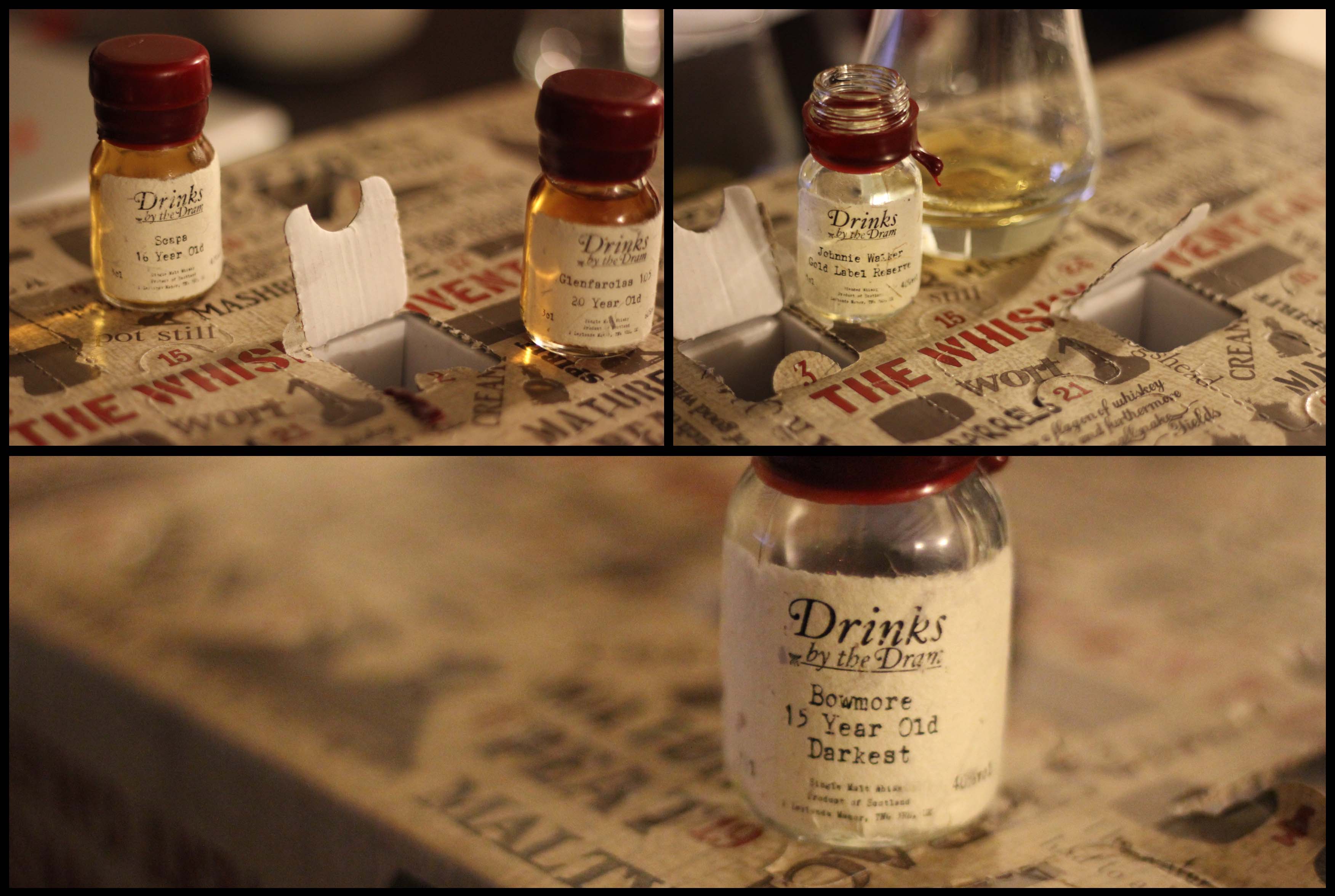
1. Scapa 16yr old — 40%

Color of light gold. Smells sweet and a little fruity. Like fruitcake. Color doesn’t suggest Sherry but flavor might. No smoke or peat. Honey a little. Tastes big and heavy. Sweet entry, full bodied. Candied fruit. Raisins. Rich and complex for an unpeated whiskey.

Wondering how I’d never heard of this. It’s delicious.

2. Glenfarclas 20 year — 60%

Quite a bit more earthy. Sherry entry. Dried fruit. Burnt gold color. Drier than the Scapa. Smells like dry hay. Water makes the flavors cascade, but it’s still a bit sharp on the finish. Tiny hint of peat.  

I expected to like this a lot more. Glenfarclas usually does such good work. Oh well.

3. Johnny Walker Gold — 40%

Color is… well… gold. Maybe they don’t caramel color this one. Nose has a hint of peat, but not much. Tastes of brown sugar. Caramel. Some peat. Flat at the end. 

Blended scotch is for peasants. Yes, I’m a snob.

4. Bowmore 15 year “Darkest” — 40%

BBQ smoky nose. A pulse of peat smoke. Tastes way smokier than it smells. Sam calls out a Mesquite BBQ taste, which is right on. Big beautiful sweet smoke. Chewy smoke. Caramel.

“Darkest” is a silly name for whiskey. Regardless, this is unexpectedly wonderful. I want a bottle.

1-4: The Dawning

5. Yamazaki 12 — 43%

Malty graininess. Hint of smoke and honey.Medium bodied, well balanced with a nice faint current of smoke throughout.

Fantastic, but I already knew that. Like all high quality Japanese flavors, delicate and complex. An old favorite.

6. Talisker 2000 Amoroso Finish Distiller’s Edition — 43%

Sea saltiness. Brinyness. Peat and smoke. Take all the normal Talisker loveliness and add a sherry cask finish. Candied fruit and caramel. Peppery finish.

Not necessarily better than the standard Talisker 10, but still good. Quite sweet, but with a lot of personality. Not unlike myself.

7. Tobermory 15 year — 46.3%

Bready nose. Grainy. Smells thin & peaty. Heat initially. Numbing prickliness.  Big empty peatiness leads into a honey sweet finish. Unbalanced.

Feels like it was sloppily distilled, but maybe I’ve been drinking. Then, maybe not. I hesitate to call it bad, but let’s say it’s unburdened by greatness. I won’t be back.

8. Four roses Single Barrel 2012 — 54.7%

Big caramel richness. Tropical fruits. Banana. It’s weird to spike all this malt with bourbon’s corn muscularity. Like bringing a linebacker onto a soccer field. All the same, long sweet finish. Woody spice. Intense grainy heat. Lingering woodiness. Creme Brûlée. Charcoal. Faint banana finish.

Four Roses makes damn good whiskey.

5-8: Even Whiskeyer

ROUND 2

9. Glenlivet Nadurra 16 – 0512T — 53%

Color is light straw. Like well-hydrated urine. On the nose, bruised yellow apples. Otherwise, I don’t smell a fucking thing. Sam blew past the nose and just started drinking. Taste is more present: yellow apples. Caramel. Peat finish. Lemon zest. Long finish. Full bodied. Bittersweet – oak dryness mixed with sweet finish.

Better than I expect from Glenlivet. Maybe because of the high proof. Cool.

10. Wasmund’s Single Malt — 48%

Gold. Shimmery. This one is from Copper Fox distillery in Virginia. Googling tells me it may have been aged for as long as 42 months. The notes for this one are best presented as quoted:

Nose:

Vikki: A garden.
Sam: A newly painted and remodeled kitchen.
Jason: Topsoil.
Vikki: Disturbingly chemical.

Taste:

Sam: I just licked the floor of that kitchen.
Vikki: It tastes like I just ate a flower.
Jason: Mulch. Heavy mulch. Kava.
Vikki: Moss. Peaches.

11. Caol Ila 12 — 43%

Very light in color. Equal parts sweet and salty and oily and peaty. Long finish. Medium bodied. Touch of sweetness. Perfectly balanced.

“Cool Eye-la.” As delicious as it is fun to say. One of my longtime favorites.

The Triumphant Return

12. Aultmore 5 year single cask — 66.8%

Smells funky. Like armagnac. Young and green. Still smells like it came from a carbon-based life form. Youth + proof = hot hot heat.  Watering down leads to some softer notes, but it’s still green.

Definitely needs more age. Doesn’t yet have its shit together.

13. Glendronach 15 revival — 46%

Now that’s age. Smells like old whiskey is supposed to smell. Taste is rich and dark. A little sherry influence? A little malt bitterness. Brief finish. What age does to scotch.

Slightly incomplex, though the sherry helps. All the same, this is a pretty good whiskey.

14. Hibiki 17 — 43%

Smells of brown sugar and plums. Hibiki is partially aged in old plum wine casks, more evident here than in the 12 year, which is a kind of obvious thing to say. Taste: restrained. How Japanese. Light with grain whiskey (it’s a blend i.e. not all malt). Glint of peat. Caramel brown sugar front palate.

Sam: “its a great dessert whiskey.” Agreed. I wouldn’t pay $100 for it, but I’d gladly accept if offered.

15. Jameson — 40%

Oh, for fuck’s sake.

16. Edradour 10 year — 40%

Solid. Sweet all the way though. Barley sweet, grainy, molasses like. Faint echo of peat – or is that heather? A plains flower.

This tastes like a plains flower, growing wild on the grassy, wind-swept Scottish plains. Probably trampled by sheep. Maybe we should stop for the night.

#12-#16: Things start to get a bit loopy

ROUND 3

17. Auchentoshan three wood — 43%

Very woody and surprisingly grainy. Grain overwhelms nose. Sip, and grain continues. You could sell me on this being a rye. Nice sweetness from barley develops at the end. A bit woody and very grain forward. I’m supposed to be getting sherry, but I’m not. Strange.

This one makes me wonder if a mistake could be made in filling these little 3cl bottles.

18. Lagavulin 16 — 43%

Full bodied. Oily even. Peat bomb. Smells like dried craft paint. To quote Brian Cox: “works like a depth charge.”

An epic whiskey. Not for the faint of heart. One of my favorites.

19. Compass Box Hedonism — 43%

Very pale. Watery yellowish. To me, it smells like nothing. Then faint bacon(?). But mostly nothing. Tastes extremely light. Unrelenting sweetness that endures front to back. I don’t know if it’s blended, but it tastes like it is. Lightly peaty. Kinda gross.

The connection between this whiskey and the concept of hedonism remains utterly opaque.

20. Aberlour 12 double cask — 43%

Unpeated. Light fruit. Honey sweetness. Tastes light and sweet. Same as the nose, lightly fruity and a bit of heather. Licorice notes. Light sherry leads to sweetness.

It’s certainly not bad, just not terribly interesting. Reminds me of the Balvenie Doublewood, except less engaging.

17-20: Baroque decadence, and the beginning of the end.

21. Dalwhinnie 15 — 43%

Nose is rich honey, spiked with faint agricultural graininess. Every once in a while, whiskey reminds you that it’s essentially an agricultural product. Very faint here, but still cool. That note vanishes for me in the actual palate… very light entry, then builds in flavor and heat to a full, honeyed, slightly hot mid palate explosion.

Like a sneeze, only better. I forgot about this one. I like this one.

22. Wild Turkey Rye — 50.5%

Sam: “now that’s rye.” Oh yes. Taste is big, kicking sweetness. Rye grain. Muscular. Peppery. After the last three honey sweet malts, this is a jolt.

Higher proof and bigger balls than anything we’ve had. USA! USA!

23. Glenfarclas 30 — 43%

Nose is subtle but expressive. Raisins. A bit of fruitiness. Definitely sherried. This is already better than that Glenfarclas 20 year back in #2. Taste: up front, peat and sherry and honey malt all at once. Then the flavors extend out, dropping off individually to highlight the others. Almost unbelievably long finish.

This is what you’d hope a 30 year old whiskey would be. The best one we’ve tried yet. Amazing.

24. Master of Malt 50 year old Speyside 3rd Edition —43%

50 fucking years? Wow. Color is light gold with curious tints of green. Smells of apples, raisins, and cinnamon spice. Basically, like a snack. These are mostly confirmed on the taste: raisins and spice and cinnamon, in that order. Super long finish as well.  Oak dryness to finish, despite the light color. Dried fruit. Honey. A little blunting on the finish, actually. I feel like you taste some tails in there.

I actually prefer #23, but still… phenomenal.

21-24: My only friend, the end.

What an incredible gift. This was a lot of fun.

We're gonna need a montage.

Thanks, Dan. You’re the best.

Seriously.

Cheers.

Bottle Conditioned Cocktails: La Grenade

I find carbonated drinks to be mysteriously satisfying.

I know I’m not alone on this. It’s just a tingly feeling, a strange pleasure completely isolated from the thinking part of the brain, and yet so many of us find it so pleasant. It’s the kind of dumb sensory stuff that makes me feel like a gorilla, but regardless: there’s nothing quite like it.

One of the better trends in the craft cocktail world over the last couple years has been applying that sensation to our drinks. Not just adding soda water or sparkling wine to cocktails (as we have been since forever) but actually carbonating the cocktails themselves. The basic idea is instead of relying on a splash of carbonated liquid for your bubbles, use flat liquid and then carbonate the whole thing in whatever way you can. It works particularly well with cocktails that are designed for carbonation. So while a carbonated Negroni (Campari, Sweet Vermouth, and Gin) is weird and semi-unpleasant, a carbonated Americano (Campari, Sweet Vermouth, and Soda Water) is glorious.

There are two ways to carbonate. We’ll call them the easy way and the hard way.

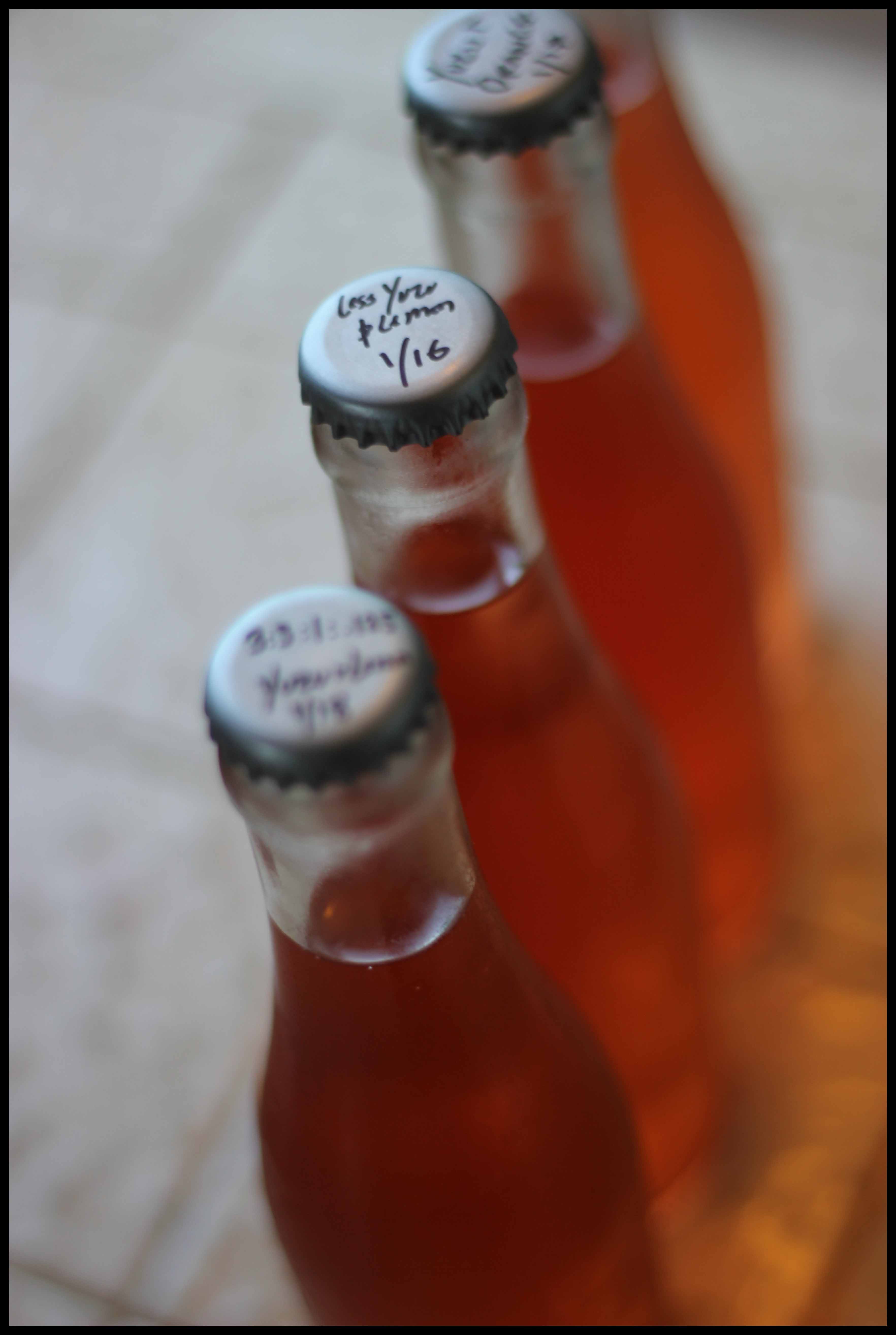
A work in progress...The Easy Way: As far as I know, this is a technique yet again pioneered (or, at least popularized) by Jeffrey Morganthaler, and is referred to in the home-brew business as “force carbonation.” You make your batch of cocktail, get it as cold as possible, somehow get your hands on CO2 (either a large tank or single-use cartridge), and hit the liquid with the gas in a pressurized environment. This is SodaStream, Soda Siphons, anything by iSi, and pretty much all DIY carbonation methods. It’s clean and simple, and produces larger-type bubbles. From there, either serve it, or bottle it for later (picture, right).

The Hard Way: Fermentation. Yeast + sugar = alcohol, heat, and CO2. When you’re done fermenting (in other words, when the yeast has eaten all the sugar it can), you’re left with low-alcohol mixture (beer, wine, etc), which, if you did it under pressure, is also carbonated. If not, the bubbles escaped to air, so you can add a small amount of what’s called “priming sugar” before bottling, and the yeast will finish off this sugar in the bottle, creating the carbonation you experience when you open it. This is called “bottle-conditioning” or “secondary fermentation.” The best beers and all Champagne producers do this, giving them their very small, delicate bubbles. (Aside: the most knowledgeable and passionate Bubble Connoisseur I know, Ms. Victoria Young, insists on such small bubbles.)

Now: me, you, or anyone with a soda siphon can do technique #1. I did a couple for the cocktail menu at Gang Kitchen. Don’t get me wrong: it’s hard to come up with a good carbonated cocktail recipe, as CO2 turns into carbonic acid (C2HO3) when induced into a solution, which fucks up the balance of whatever you’re trying to do. But as a technique, force carbonation is fairly easy.

As for technique #2, Champagne and beer are tricky enough, but it must be mind-bendingly difficult to bottle ferment a cocktail and do it in a way that’s not gross. Fermentation is primal. It muddies the waters, very unlike the clean measurements and individual ingredients we cocktail people are used to. Yeast affects flavor and final character dramatically, and a little carbonic acid is the least of your concerns. If you use the wrong kind of yeast, it’ll be disgusting. If you add your spirit at the wrong time, nothing will happen at all. If you miscalculate the sugar levels even a little, your bottles will literally explode.

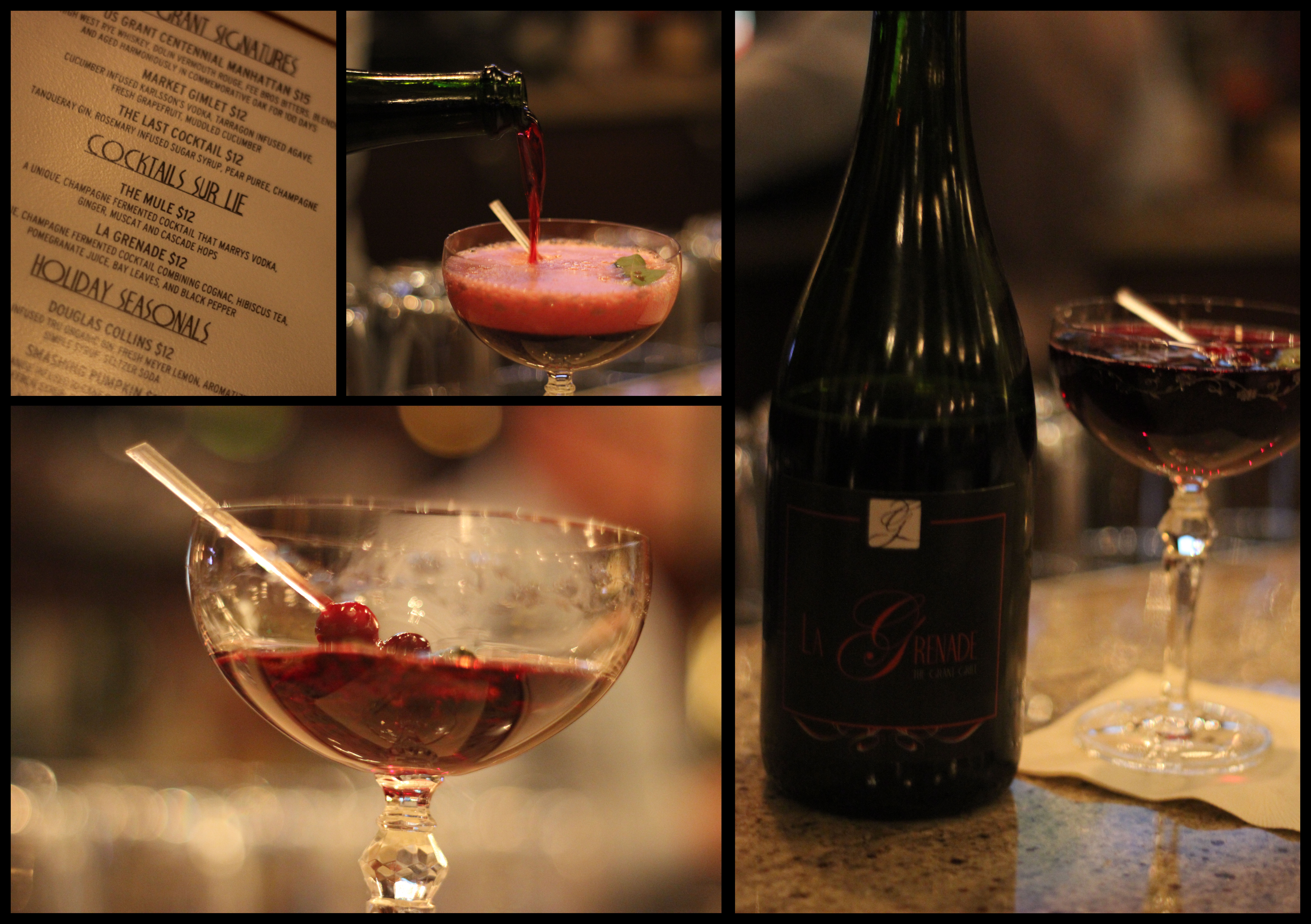
It’s hard. And Jeff Josenhans, at the Grant Grill, has managed to do it.

How cool.

La Grenade
Cognac
Hibiscus Tea
Pomegranite Juice
Black pepper
Bay leaf

Sadly I don’t have a recipe for you. I imagine, as a technical innovation, that’s under lock and key.

The cocktail is called “La Grenade,” which I wish was a reference to that exploding bottle business but is actually the French word for “pomegranate” (the same root as the pomegranate syrup Grenadine, if you were ever wondering). Initially the first impression is one of wine. The delicate carbonation combined with the floral element from the hibiscus and the tart juiciness of the pomegranate evoke a Lambrusco. The cognac is barely detectable, coming though as a kind of stickiness on the finish. The pepper adds a bit of spice, and the bay leaf just kind of hangs out.

If I’ve got my critical pants on, I’ll say I can’t help but feel like it might want for a little acid to help with that slightly thick finish. I notice that neither this nor the Mule (his other Cocktail Sur Lie, as he calls them, French for “on the lees” a.k.a. resting on yeast) use any citrus. I wonder if they mess with the fermentation process.

That said, this is delicious, something I would absolutely order again. As with anything cocktail-related I can’t do, I want to learn how to do this. Thus far, I’ve only learned enough to know how impressive it is that he actually pulled it off. This is a proper achievement. Check it out some time.

Fort Point (Smoked)

I used to work for a newspaper in Boston. Every couple of months we had a seasonal insert — “Summer Fun” or “Ski and Snowboard” or whatever — that were all themed articles, pretty much just filler to sell extra advertising space. So when I pitched them Christmas cocktails for the Holiday insert, I got an enthusiastic “why the hell not?!”

What are some nice holiday drinks? I spend an hour or so googling candy-cane martinis before I realized I could use this opportunity to literally subsidize my drinking, and decided to recruit my friend Nick for some boozy reconnaissance. We went to go to five different bars, and ask each bartender for two drinks that evoke Christmas for him or her in any way.

Two nice things came out of that night. The article was published (here), and I was given what is probably the best drink I know how to make.

It happens all the time at the bar: “I don’t know what I want. What’s your favorite drink?” I used to try to explain to them that my favorite is irrelevant, that I love bitter whiskey things but that’s a taste I’ve acquired over several years, that like a favorite movie or book or meal, one’s favorite drink can be tasty but not for everyone………… but I don’t do that anymore. When someone asks me for my favorite drink, I just say ok and make them this:

Fort Point (Smoked)
2oz Rittenhouse Rye
0.5oz Punt e Mes
0.25oz Bénédictine
Rinse of smoky scotch (Lagavulin works wonderfully, but really any smoky/peaty scotch will do).
Stir over ice; strain into cocktail glass rinsed with smoky scotch. Garnish with flamed orange peel.

Aside from the flamed orange peel, this is a creation of Misty Kalkofan and a subtle variation of the Fort Point, the house cocktail of Drink in Boston. The Fort Point is the same without the smoky rinse or the orange peel, so this isn’t different enough to earn its own name (nor should I name it, as I’m not its father), but this version is definitely my favorite.

Punt e Mes is a sweet vermouth made by same people as Carpano Antica, a little sweeter with brighter fruit flavors and a lot more bitter on the back end, making aromatic bitters unnecessary. With a backbone of rye and just a hint of that warm herbal sweetness from the Bénédictine, this is a phenomenal drink. It’s at once simple and grandly complex, each sip offering a different accent as it warms.

But the scotch. The scotch is what makes it both transcendent and niche. Without, it’s excellent for pretty much everyone who likes whiskey. With, it’s perfect for me. Though just a rinse it’s a definite presence, picking up where the others drop off and taking you blissfully into the finish. There are some flavors, some floral or smoky or herbal ones, which seem somewhat undimmed by mixing as if they exist on a different plane.

Remembering that, if you don’t like that medicinal peaty flavor of scotch, skip the rinse. But if you do, don’t. It’s divine.

BONUS! How to rinse a glass:

1. Pour a very small (<0.25oz) amount of rinsing liquid in the glass.

2. Tilt the glass over a container so the liquid approaches the rim, then slowly twist the glass while steadily dripping the liquid out, thereby coating the inside of the glass with the flavor without leaving too much volume behind.

3. Drink the liquid out of the container.

I really do love rinsing with scotch.

Widow’s Kiss

*** Note: a version of this article appears at RobbReport.com ***

“As the scene opens, you are up in your grandmother’s attic opening the dusty steamer trunk she brought from Europe in 1914. You reverently turn back layer upon layer of old lace and brocade … unveiling a packet of old love letters tied in silk ribbon. Ancient dried rose petals flutter down from between the envelopes.

This is what the Widow’s Kiss is like. Sweet, complex and darkly golden, thought-provoking and introspective. It is a cocktail of fall turning toward winter, and it wins [my] award as the most evocative drink ever. Have one by the fire.”

— Ted Haigh, Vintage Spirits and Forgotten Cocktails

There’s something about the Widow’s Kiss that compels people write about it romantically. It’s not just that it’s delicious, though it is. And it certainly has one of the best cocktail names in history. But there’s something else… as with the lovely Colleen Bawn, this drink uses Yellow Chartreuse and Bénédictine, both pungent herbal liqueurs, which lock into each other like a vacuum seal. They work wonderfully together, full and rich and infinitely complex. Add the apple brandy at their base and some Angostura bitters to spice the apples, and the result synergizes into wistfulness like a half-forgotten memory, and seems to force people to write about it like this:

On a chilly November evening, post-Dallas, post-Watergate, post-Florida, post-9/11, and not-yet-post-Iraq, there’s no small amount of satisfaction to be found in a drink that calls up a honeyed past, and provides a moment’s distraction from the bitter present.

— Paul Clarke @ The Cocktail Chronicles

Or consider The New York Herald, in the 1890s, writing an article about the drink’s creator George J. Kappeler and his bar the Holland House, declaring:

[The Widow’s Kiss is] the most passionate poem which the liquor laureates of the Holland house hand out.

Facile alliteration aside, I think you catch my point. People just can’t seem to help themselves.

Not that I blame them. The Widow’s Kiss is a wonderful drink, in any of its forms. Everyone agrees on the principal ingredients: Apple brandy (either the clean American kind or the earthier French Calvados), Yellow Chartreuse, Bénédictine, and Angostura bitters. Most agree on the proportions, preparation, and technique, as well, though there is some reasonable dissent. Here’s the thing: it’s really goddamn sweet. Tastes have grown drier in the 117 years since this drink’s invention. So there are three things that people do:

  1. Reduce the proportion of the liqueurs. It’s traditionally 2:1:1, and some very reputable people, like Jim Meehan in the PDT Cocktail Book, go instead 8:1:1. This or something like it is similarly recommended by Savoy Stomp, Eric Felten at the Wall Street Journal, and others.
  2. Do your best to water it down. Some, like David Wondrich in Imbibe, stick with with Kappeler’s original instructions to shake this drink instead stirring it. Shaking is considerably more effective to dilute and chill than stirring (100 seconds of stirring ≈ 12 seconds of shaking), and it also aerates, making the drink thinner. Others, as with the Stinger (another all-booze drink that’s too sweet), advise crushed ice to deliver the extra water.
  3. Deal with it. Accept the drink as it is and only serve it after dinner, at the end of the night, or any other time a sweet drink is called for.

After an exhaustive and grisly round of experiments, I am firmly in camp #3. My favorite recipe:

Widow’s Kiss
1.5oz Calvados [French apple brandy]
0.75oz Yellow Chartreuse
0.75oz Bénédictine
2 dashes Angostura bitters
Stir over ice, strain into cocktail glass; garnish with nostalgia.

Notes on execution:

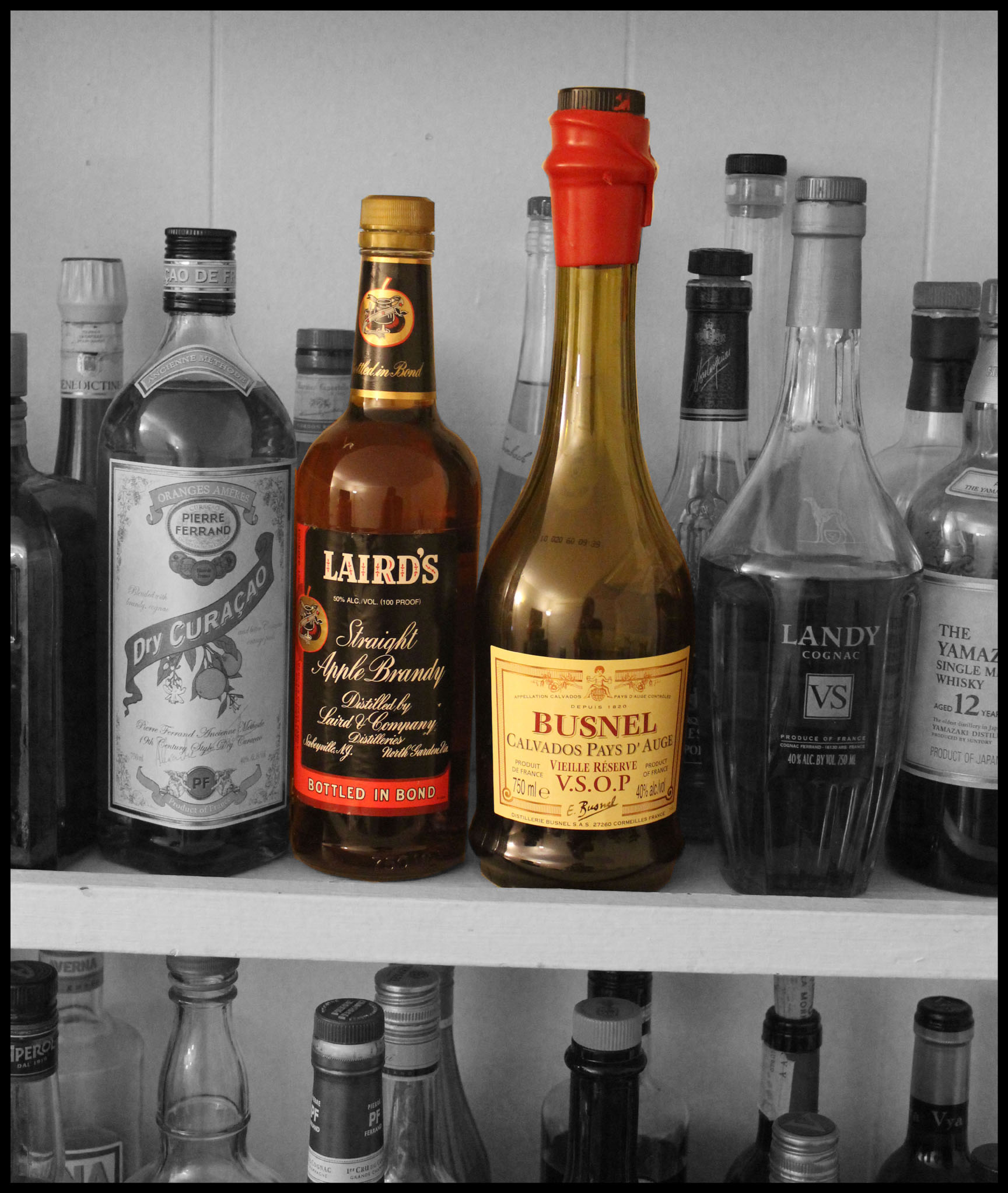
Insofar as calvados vs. apple brandy is concerned, go with calvados if you’ve got it. It’s a heavier spirit, more rustic and agricultural than American apple brandy, and it seamlessly fills the gaps left by the liqueurs and bitters. With calvados, use either no garnish or a neutral aesthetic garnish, like a cherry. If all you have is Laird’s Apple Brandy, or even worse, Applejack, feel free to make the drink but garnish with a lemon peel: the lemon oils offer a rather pleasant misdirection to compensate for the brandy’s lack of weight.

Whether to shake or stir (a.k.a. why above point #2 doesn’t really work): this kind of sweetness is only acceptable to the palate if it’s enrobed in velvet texture. Shaking makes it thinner, losing the silkiness and shoving the drink into diaspora: too sweet for a thin drink, too thin for a sweet drink. What I found curious about this experiment was that even though more dilution means less overall sugar/ounce, the shaken drink had an increased perception of sweetness. It needs the texture. That’s all there is to it. Stirring, for the win.

As for reducing the ratios of the liqueurs (a.k.a. How I Learned To Stop Worrying and Love the Sweetness): maybe you shouldn’t try to mitigate the sweetness. Maybe you should just accept that this is a sweet drink. My feeling is that the Widow’s Kiss is a perfect after-dinner-on-a-brisk-winter-night drink. Apple, honey, cinnamon spice… what could be better than that? It’s strong and warming, with no ingredients under 80 proof. It’s pungent and herbal, with complexity that unfolds over time. The sweetness helps neutralize the strength, the thickness helps justify the sweetness, and the flavors help recommend it all. They lean on each other like a tripod, and changing one brings the whole thing down.

That’s the problem with the PDT recipe. It’s fine, but it adapts the recipe to be an average anytime drink, as opposed to an exceptional after dinner drink. It loses the magic, the fifth essence, that ineffable harmony that makes Wondrich write things like “we don’t know if Kappeler had any particular widow in mind. If he did, she must have been something.”

Colleen Bawn

As I’ve already said, I think maybe more than once, it was in Boston that I learned how to drink. The bar that was singularly instrumental in teaching me was Green Street Grill in Cambridge.

It was the kind of bar people go out of their way for. Fortunately for me, I lived about 35 seconds from it, and it was there I had my first Old Fashioned, first taste of Fernet Branca, first flip, fizz, Collins, sour, etc., etc., etc. And it was there I had my first Colleen Bawn, then a fixture on their extended cocktail menu.

We ordered so many of them that winter that the bartenders used to groan when they saw Vikki’s bright red coat walk in the front door, because they knew they would be forced to make at least one egg drink. Eggs, you see, are a giant pain in the ass. You have to shake them once without ice and then once with, and with the ice you have to shake them forever, and you usually have to garnish ornately, artful dashes of bitters or hand-grated nutmeg or other such annoying flourishes that take up valuable doing-other-things time.

It’s worth noting, however, that we didn’t care about their groaning then, and I have even less sympathy for it now that I work with eggs myself. Never let a bartender make you feel bad about ordering a drink. If like Amaretto Sours, order an Amaretto Sour. I don’t care if you like Splenda Mojitos in January: you want what you want, and our job is to make it for you. Unless, of course, you order Ramos Gin Fizzes on a busy weekend night, in which case you can go fuck yourself.

Anyway.

The Colleen Bawn (meaning “fair girl,” from the Irish cailín bán) is the name of a play from 1860 by Dion Boucicault. It dramatizes the true story of Ellen Hainley, murdered at 15 by her wealthy husband and his servant. The murder of a beautiful young commoner and indictment among the aristocracy caused something of a stir, as you might imagine, and the story became about justice overcoming social class. Both men were hanged, and Hanley was interred under the inscription:

“Here lies the Colleen Bawn
Murdered on the Shannon
July 14th, 1819”

Once again, the connection between this cocktail and its name eludes me — my best guess is that it’s named after a “fair girl” because it’s so lovely, but who the hell knows? What we do know is that  it shows up in 1904 in Edward Spencer’s The Flowing Bowl, and it’s as good today as it was then:

Colleen Bawn
1oz Rittenhouse Rye
1oz Yellow Chartreuse
1oz Bénédictine
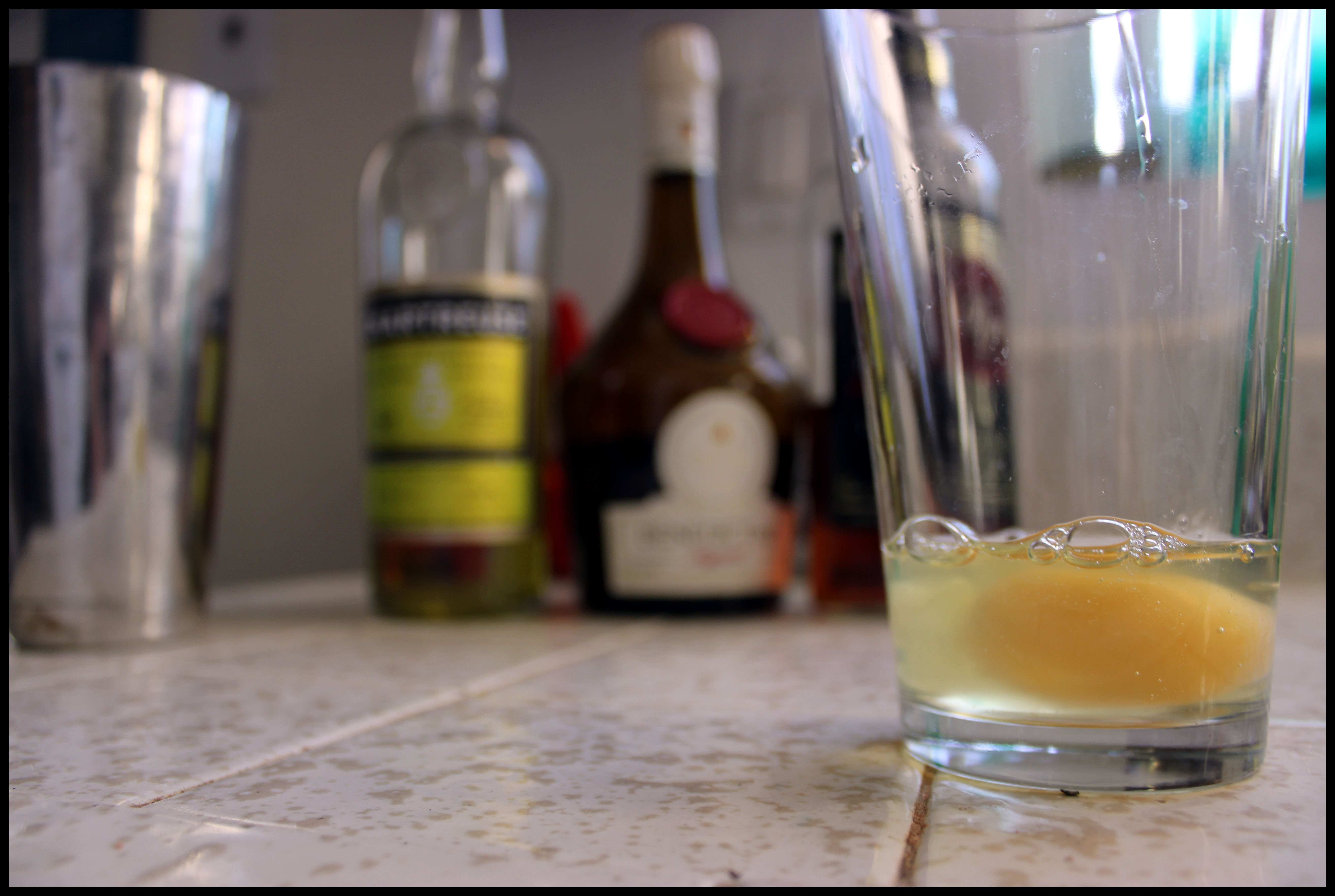
1 full egg
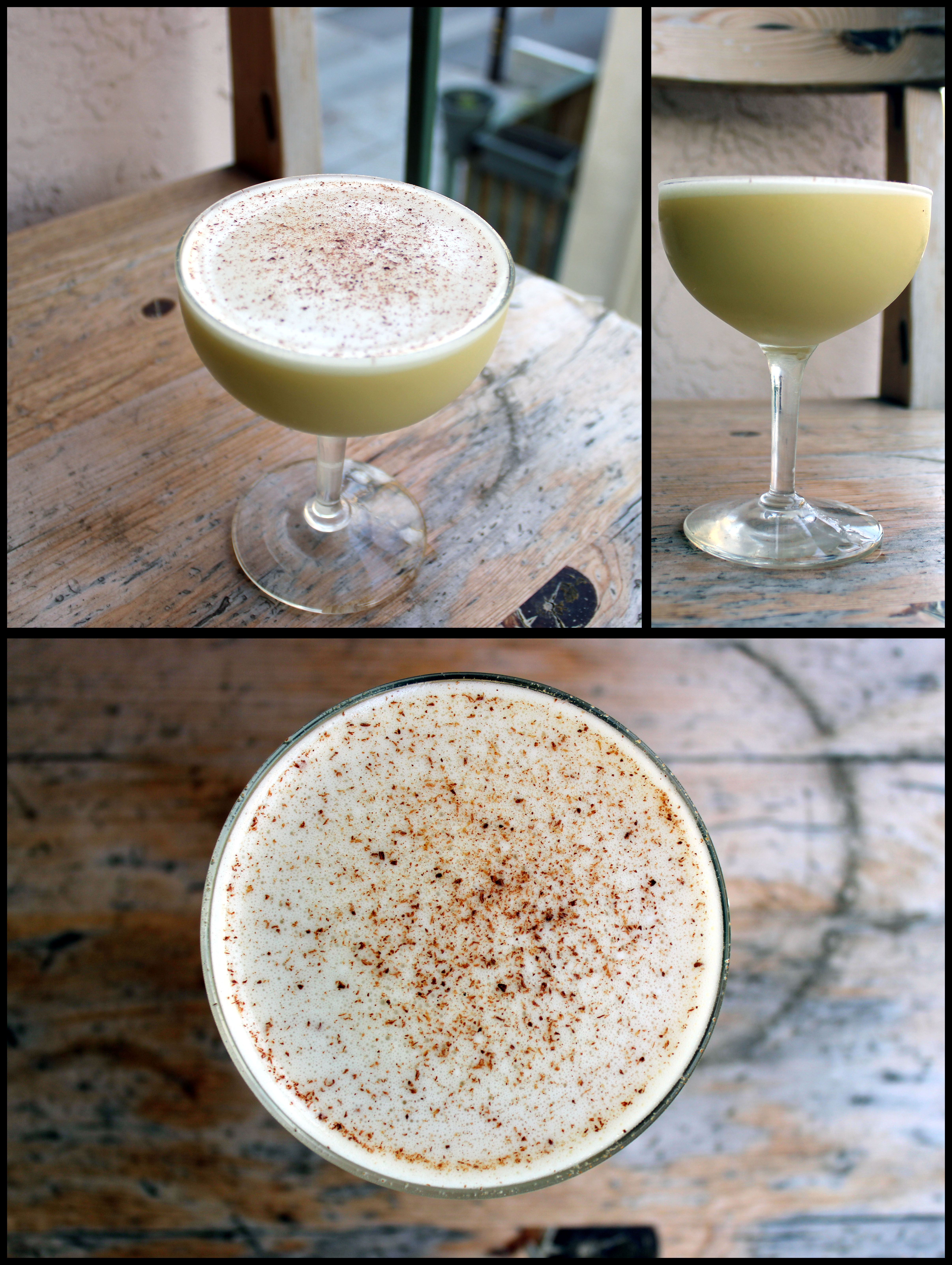
Shake without ice to whip the egg; add ice and shake with hearty vigor; strain into cocktail glass; garnish with grated nutmeg and/or cinnamon

Yes, I realize I’m advertising a cold weather drink with pictures of sunshine. I live in San Diego. Deal with it.

The egg combined with the saffron in the Chartreuse gives the drink the color of custard, which texture-wise is not so far off. It is creamy with egg, smooth and a little thick. The rye, big as it is, is more for infrastructure than flavor; the liqueurs, as with the wonderful Widow’s Kiss, mix perfectly together. Individually, Yellow Chartreuse and Bénédictine are both full, pungent, herbal French liqueurs, and it seems kind of silly to put them together save for the fact that it works.

This is a drink of strange opposites: it’s highly complex but not difficult, it’s a little sweet but also a bit bracing. While it’s good any time, the thickness of the egg and the sweetness of the liqueurs (also that one cocktail is the equivalent of 3.2oz of 80 proof liquor) make the Colleen Bawn perfect as the last drink on a cold night.